 (Editor’s note: This is the final piece of our 4-part series on economic injustice. You can find Part 1 here, Part 2 here, and Part 3 here. In this final piece, Dr. Terence Lester shows how compassion can grow into systemic change.)
Over the years, after working within many denominational spaces—from UMC to Baptist, Lutheran to Presbyterian, Anglican and beyond—I’ve come to love what ecumenism has done to expand my theology and faith. Serving alongside churches with diverse expressions of worship, racial identity, and cultural understandings of the gospel has changed me.
I am better for having been proximate to others who follow Jesus and express that journey differently from myself. I have also witnessed the power of God in communities that dare to step beyond lines, connect, and become both symbols and agents of repair.
In fact, I’ve come to see a common thread. What truly makes a difference is not the type of church building or the denominational label—it’s the people. It’s the community embodying a reparative, justice-centered witness within and beyond the church walls. These communities understand that repair can happen wherever people show up.
They see the church not as a building but as the people who gather—the biblical vision of community.
Reparative communities live out a faith that doesn’t stop on Sunday. It moves into the rhythms of daily life, showing up in overlooked neighborhoods, among excluded people, and in places crying out for the shalom of God.
Reparative churches break down barriers, speak truth to power, and stand for justice even when it’s unpopular. They make room for everyone, because they believe everyone belongs. They take John 3:16 seriously—that God’s love is wide enough for whosoever will come—and they refuse to draw lines where God has not.
These communities also hold a deep, integrated theology—personal and public, head and heart—that equips them to offer the care the world desperately needs.
When churches embrace this reparative vision, it becomes clear that those truly living out a public witness are the ones who refuse to gate-keep belonging. They create spaces of truth-telling, justice, and bridge-building that uphold the dignity of all. As divisions widen through voter suppression, housing crises, and political polarization, the church cannot retreat into silence or comfort.
Reparative communities must step into this moment—showing that the Good News is still good, still for everyone, and still powerful enough to bring healing and repair. This piece might read more like an epistle than an article—and that’s intentional. The urgency of this moment demands it. The church must embrace the slow, patient work of healing fractures caused by harm, injustice, policy, racism, violence, and all the -isms that have pushed people away from trusting the Body of Christ.
This is not quick work. It is the sacred calling of the church—to stand in solidarity, name what is broken, lament with those who suffer, and stay until wholeness begins to overshadow brokenness.
Reparative communities live in the tension of the “already and not yet,” the holy work God calls us to in Isaiah 58:12: “You shall be called the repairer of the breach, the restorer of streets to live in.”
Isaiah reminds us that repair is both spiritual and social. It means rebuilding the ruins left by systems that exploit the poor, marginalize the unhoused, and neglect the vulnerable. It calls the church to a faith that is public, visible, and engaged where people are hurting.
As we look ahead, reparative communities and churches will need:
Eyes that see dignity: Every person bears the image of God (Gen. 1:27). No qualifiers. Reparative communities don’t see unhoused neighbors, poor families, underserved students, or marginalized people as projects but as beloved image-bearers deserving of equity and love. Where the world sees lack, God calls us to see dignity.
Hands that repair: Jesus modeled repair when he washed his disciples’ feet (John 13:14–15). Repair doesn’t come through power or control, but through compassionate action—rebuilding trust, restoring belonging, and standing where systems fail. These hands repair through food, housing, education, and health care—tangible expressions of love.
Voices that speak up: Proverbs 31:8–9 calls us to “Speak out for those who cannot speak.” Reparative communities do not stay quiet when injustice is loud. Silence protects the status quo. Truth-telling, even when uncomfortable, is an act of repair. It challenges harmful policies and names injustice when dignity is on the line.
Hearts that persevere: This work requires endurance. Systems of injustice do not crumble overnight. Galatians 6:9 reminds us, “Let us not grow weary in doing what is right.” Reparative communities stay faithful even when progress feels slow, showing up again and again because love that lasts is the love that repairs.
Together, these practices help faith communities resist performative charity and move toward the deeper, harder work of justice. Becoming reparative is not just about meeting immediate needs—it’s about dismantling the structures that create those needs in the first place.
This is the invitation: to embody the gospel in ways that affirm dignity, pursue justice, and make belonging real.
I leave you with this liturgy of repair.
Liturgy of Repair
God of repair,
you see what is broken.
you care for the wounded.
you are the source of repair.
But you call us to stand in the gap.
Make us people who repair.
People who embody Your witness.
Where there is division, let us sow peace.
Where there is injustice, let us seek your justice.
Where there is despair, let us embody hope.
Form us into a community that does not turn away,
but stays, present, proximate, and faithful, until your kingdom comes on earth as it is in heaven.
Amen.
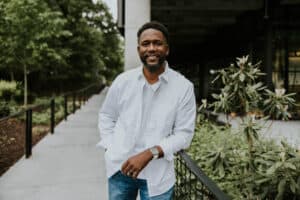 Dr. Terence Lester is a storyteller, public scholar, community activist, and author. He founded Love Beyond Walls, a nonprofit committed to raising awareness about poverty and homelessness, and teaches public policy and social change at Simmons College of Kentucky. His latest book, From Dropout to Doctorate: Breaking the Chains of Educational Injustice (IVP, 2025), traces his journey from high school dropout to PhD and issues a bold call for equity. Through his life and writing, he uses narrative, policy insight, and faith to challenge systems that leave people invisible and to inspire practical change.