
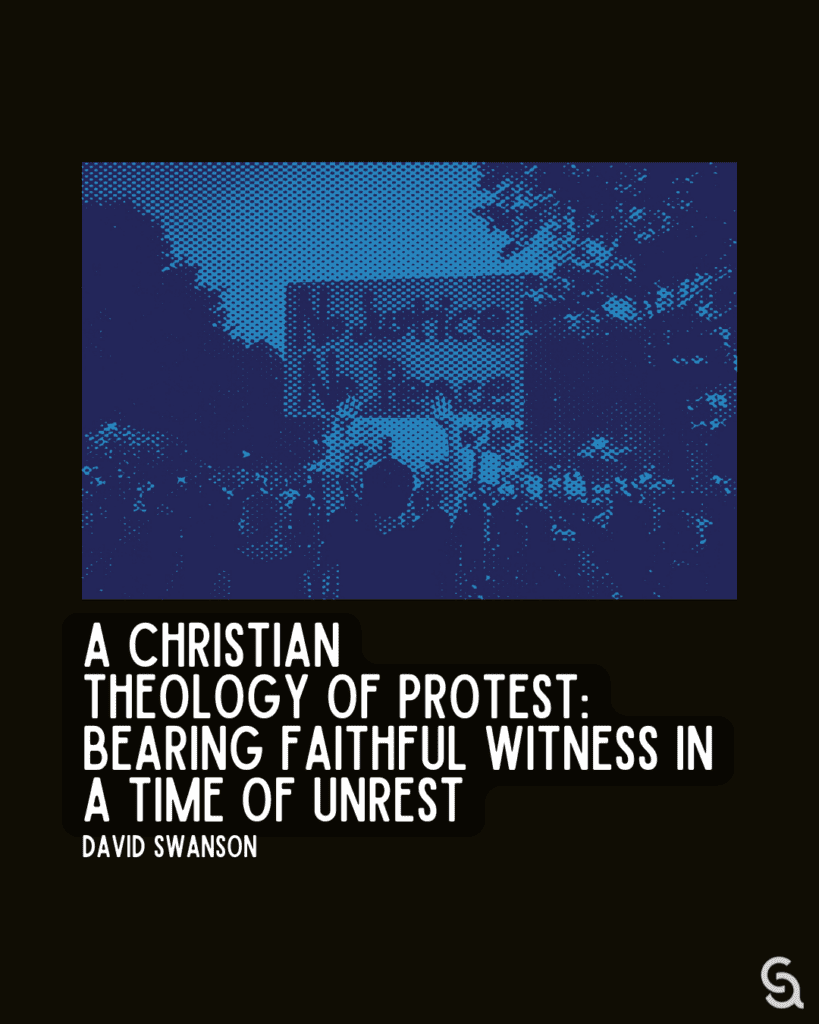
 (Editor’s Note: January 21, 2026 | This essay was written prior to the most recent events unfolding in Minneapolis and other cities and is not intended as commentary on any single protest, incident, or tactic. We share it now as a theological reflection for a moment marked by heightened civic unrest and moral urgency. Recent data shows that protest activity in the United States has increased significantly over the past year, reflecting widespread concern across communities, issues, and regions. In such moments, Christians often ask not only whether to protest, but how faith shapes our identity, discernment, and methods of dissent. Our hope is that this reflection by CSA Pundit David Swanson helps readers think carefully and prayerfully about what it means to bear faithful witness in times of upheaval — rooted in Scripture, attentive to context, and guided by love of neighbor.
Introduction
In response to the presidential administration’s authoritarian-like rhetoric and policies, 2025 was a year of protest around the U.S.
Here in Chicago, in addition to the national protests like 50501, Hands Off, and No Kings, our city has regularly taken to the streets in support of those neighbors targeted by the administration’s mass deportation campaign.
As these events have grown in number and size, some of my fellow Christians have wondered whether to join their fellow protestors. More than once, I’ve overheard influential leaders who, despite their sympathies with the protesters, suggest that there are more effective ways that concerned Christians should direct their time and energy. Others have jumped in with both feet, drawn by compassion or outrage but, from my vantage point, not especially reflective about how our faith shapes whether or how we protest.
I’ve helped organize a few protests and participated in many others. Over the years our aims have included reducing gun violence, demanding police accountability, and defending our immigrant and refugee neighbors. These on-the-street experiences have led me to reflect on three protest themes informed by our Christian faith: our identity, our context, and our methods.
(1) Our Identity
If protest is a public act of dissent or disapproval, then fundamental to Christian identity is our instinct to raise our voices and situate our bodies in protest. Importantly, Christian protest begins in prayer. In fact, Scripture portrays God’s people protesting God more than any specific person, government, or social system.
In response to God’s declaration that he will send his people away, Moses protests,
“If your presence will not go, do not bring us up from here.” (Exod. 33:15)
Jeremiah puts his protest in the form of questions,
“Why does the way of the guilty prosper? Why do all who are treacherous thrive?” (Jer. 12:1)
“Awake, Lord!” protests the psalmist. “Why do you sleep? Rouse yourself! Do not reject us forever. Why do you hide your face and forget our misery and oppression?” (Ps. 44:23–24)
Jesus himself, in the language of Psalm 22, protests the excruciating abandonment and betrayal of the cross,
“My God, my God, why have you forsaken me?”
None of these examples are only protest, of course; there is also grief, lament, and complaint. But isn’t that the nature of protest? Our dissent is not emotionless. Our disapproval is shaped by heartbreak, loss, and profound disagreement.
While Christian protest begins in prayer, it doesn’t end there. Esther, Daniel, Shadrach, Meshach, and Abednego each, in their own ways, used their voices and bodies to protest the empire’s abuse and coercion. Peter and the apostles, when commanded by the religious authorities to stop preaching in the name of Jesus, made their disapproval plain,
“We must obey God rather than any human authority.” (Acts 5:29)
The seven churches in Revelation are variously praised and warned based largely on how faithfully they dissented from the empire’s demand of worshipful allegiance.
Protest is an essential part of Christian identity that shapes our posture toward God and the world. It is always important to discern what, how, and when we protest, but not if we protest. We are a protesting people.
That this moment requires public dissent from U.S. Christians seems obvious to me.
The government’s mistreatment of vulnerable people and the way it cloaks its cruelty in the language of Scripture and the symbols of Christianity require our visible and audible dissent. Thankfully, our very identity prepares us for a moment like this.
(2) Our Context
Sometimes, after pointing fellow-Christians to examples in our Scriptures which motivate our decision to protest injustice, I’ve been told that our context in a modern Western democracy is too different from the social locations of those we read about in the Bible.
Their point is that easy equivalents between wildly different times and places cannot so easily be made. It’s an important observation and, in order to discern the shape and scope of our protest in this political moment, there are two contextual differences we should reckon with.
First, many of the instances of protest in both the Old and New Testaments take place within the context of empire. In Reading Revelation Responsibly, Michael Gorman defines empire as an
“entity that has come to widespread (global or nearly global) dominance through deliberate expansion by means of the extreme exercise of some form(s) of power–economic, political, military, and/or religious–resulting in the creation of colony-like clients of the entity and of enemies who perceive the entity as oppressive.”
Sometimes, God’s people in Scripture were besieged, captured, and exiled by an empire; other times they were living as subjects scattered throughout the empire. Many of the examples of protest we find in the Bible take place in response to the injustices of empire. Leaving aside the many similarities shared between the U.S. and Gorman’s definition of empire, our political context is very different than those endured by God’s people in Scripture.
That most Americans can vote for our representatives and senators is but one obvious difference. Unlike our Jewish and Christian fore-bearers, our political context is one of representative government, however imperfectly implemented.
Another important contextual difference is the role of Christianity throughout our country’s history. With threads reaching beyond the nation’s founding, Christianity has long provided language, assumptions, and symbols for the country and those who govern it. Things couldn’t have been more different for the first Christians.
Their doctrine and ethics, liturgy and hymnody were utterly foreign to imperial culture. Just imagine the dissonance should one of those early Christians be transported to an American truck stop in 2025 and find racks of “Jesus Is My Savior, Trump Is My President” merchandise!
While the best those beleaguered and occasionally persecuted Christians could expect was for the empire to ignore them, American Christians, especially white Christians, have often pulled the levers of government to advance their aims and protect their values.
Recognizing just how different U.S. politics are from the imperial, pagan culture the Christians of Scripture faced leads some to believe that the protest we find in the Bible has no place in a representative democracy shaped by Christianity. The contextual differences, they claim, are simply too great.
One of our greatest American protestors, a Christian and a pastor, would disagree. Responding to those who appealed to the nature of U.S. government as a reason not to protest, Rev. Dr. Martin Luther King Jr. turned their argument on its head. From the Lincoln Memorial in August,1963, King explained,
When the architects of our republic wrote the magnificent words of the Constitution and the Declaration of Independence, they were signing a promissory note to which every American was to fall heir…
And from a Birmingham jail cell, he added:
Was not Jesus an extremist for love… Was not Amos an extremist for justice… Was not Paul an extremist for the Christian gospel…
King, and many other U.S. Christians, typically outside of the power centers of American Christianity, make plain that acknowledging the particularities of our context doesn’t diminish our protesting identity. While our circumstances will shape the tenor and content of our dissent, they don’t have the power to shut our protest down.
(3) Our Methods
Acknowledging that our Christian identity includes a posture of protest and that our contemporary context requires our protest still leaves questions about how Christians protest. Throughout this past year and now into this new year, as the presidential administration has mobilized against its more vulnerable citizens and residents, Christians have found a variety of ways to make our dissent known.
Some have protested with our wallets, participating, for example, in the boycott of Target, Home Depot, and Amazon. Others have joined nationwide anti-authoritarianism demonstrations or local rallies in support of immigrants and refugees. Still others have taken the risk of direct, non-violent action, placing their bodies in harm’s way.
Behind these different tactics is a shared commitment which activates how we protest: bearing witness.
Christianity is fundamentally a faith built on testimony; we share with others what Jesus has done in the world and in our lives.
We are all the Samaritan woman who, having encountered Jesus at her village well, returned to her community with an invitation:
“Come and see.” (John 4:29)
But what does it mean that bearing witness is the commitment which animates different expressions of Christian protest?
First, followers of Jesus bear witness to him as the world’s only true Lord and Savior. While this world’s rulers make petty claims like, “I alone can fix it,” Christians are witnesses to the “First and the Last and the Living One” (Rev. 1:17–18). So when we observe political powers speaking beyond their identities and acting beyond their authorities, followers of “the Alpha and the Omega, who is and who was and who is to come, the Almighty” (1:8) will publicly speak truth to those deceptions.
Second, bearing witness to the presence of Jesus means seeing our Lord in our harassed, exploited, and abused neighbors — not simply among them, but as them.
“Truly I tell you,” said Jesus, “just as you did it to one of the least of these brothers and sisters of mine, you did it to me.” (Matt. 25:40)
When Christians protest the government’s cruel deportation campaign, whether by gathering for a prayer vigil or wading through tear gas–choked streets, we are looking for Jesus. It is our assumption that the older woman gasping from the chemical gases released by masked government men, the child whose parents are too afraid to allow her to leave the apartment for school, and the neighbors awoken by the sound of military helicopters descending onto their building in the dead of night — it is our assumption that Jesus has so identified himself with each of these neighbors that we cannot help but associate ourselves with them, too. This also is what it means to bear witness to Jesus.
Not long ago, I met Audrey and Ben Luhmann. Ben is a professor at a Christian college, and the two of them have been active in responding to the ICE raids that have terrorized their suburban town. But, as a recent article points out, the real activists in the family are the couple’s teenage sons, Ben and Sam, who spend hours each day patrolling their community, alerting neighbors when immigration agents are sighted, and filming those agents when they attempt to detain their neighbors.
“They’ve documented immigration enforcement from Carpentersville to Little Village. They’ve gone toe-to-toe with federal agents, asking officers questions and checking to make sure they’re abiding by court orders. And they’ve started to compile a list of plates on federal vehicles that appeared altered.”
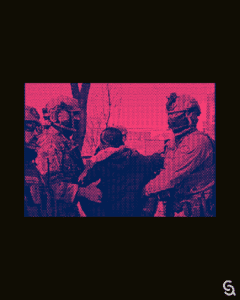
Their advocacy has been costly, keeping them on the road and away from family as they stay up with schoolwork and college applications. In one memorable instance, while following a federal vehicle, the young men were pulled over. Pounding on their windows, the agents demanded the brothers get out of their car.
“Sam had been recording the confrontation, but when he opened his window, an agent took his phone and then pushed him against the car with his arms behind his back,” he said. The agents threatened to arrest them for obstructing their investigations and endangering other drivers on the road.
In Ben and Sam’s courageous actions, we see how bearing witness is the foundation of our protest. Standing up to armed and intimidating agents, their actions reveal that the state’s violent and dominating power is not ultimate. And by rearranging their lives around the vulnerabilities of their neighbors, they point to where Christ is abiding among us today.
Your protesting methods will likely be different from what these teenagers are doing in Chicago’s suburbs. But followers of Jesus will find that the call to bear witness to our Lord opens countless creative opportunities to join our dissenting voice with theirs.
 David Swanson is an author and the Founding Pastor of New Community Covenant Church who lives with his family on the South Side of Chicago. He is the Founder of New Community Outreach, a non-profit organization dedicated to healing community trauma through restorative practices.
David is the author of Rediscipling the White Church: From Cheap Diversity to True Solidarity and Plundered: The Tangled Roots of Racial and Environmental Injustice. He is a board member of A Rocha USA, a coach for the Wheaton College Preaching Institute, and a former Director of Church Planting for the Evangelical Covenant Church. David is a CSA Pundit.

5 Responses
i feel as a Christian we need to stand up against, the immoral leftist agenda happening in the streets of America, I live in Oklahoma, no way to travel to places these protest are happening.
We need to unit, stand up for Christianity, get in their faces, show them we are not week, its time, they will run over us if we let, its happening know!!
A nation wide unity, to bring us together and counter protest this evil agenda happening
I really appreciate this article. This is so applicable for right now. I am thankful that you emphasize the need for peaceful protest but also to be bold. I think this intersection of being peacemakers but also being courageous is so valued right now. Thank you for your work.
William, I would recommend you spend some time getting to know Jesus instead. As I listen to your words, “stand up for Christianity”, “get in their faces”, and “show them we’re not weak”, it’s clear to me that you have never met Him. Please read Jesus’s sermon on the mount (Matthew 5-7). I pray that He will draw you near to Him and soften your heart and you’ll experience the beauty of our one true Savior.
Huh. Also this Jesus: Matthew 21:12-13
12 Jesus entered the temple courts and drove out all who were buying and selling there. He overturned the tables of the money changers and the benches of those selling doves. 13 “It is written,” he said to them, “‘My house will be called a house of prayer,’[a] but you are making it ‘a den of robbers.’[b]”
excellent article..the Bible passages remind us..that early Christians Gentiles, Jews, immigrants long agao were were persecuted…
we must stand strong in our faith..& help our fellow man..as Jesus stated!