 On a sweltering Alabama summer night in July 1993, a man named Gregory “New York” Huguley was forced into a car, driven to an abandoned Little League field, tied to a bench, doused in gasoline, and set on fire. His screams echoed across the diamond until they were silenced in death.
The four men allegedly responsible for this heinous act were Quintay Cox, Moneek Marcel Ackles, Shawn Ingram, and Anthony Boyd. Trial court records state that Cox provided a gun used in the abduction, Ackles and Boyd duct-taped Huguley to a park bench, and it was Ingram who doused Huguley with gasoline and set him on fire. The record states “The defendant [Boyd] and the other participants watched ‘New York’ burn for 10 to 15 minutes until the flame went out.”
Each of the four men allegedly responsible was arrested shortly thereafter and tried separately for their roles in the murder. Cox testified for the State and received a plea deal for life in prison. He was released on parole in 2009. Ackles received life in prison without the possibility of parole. Shawn Ingram was sentenced to execution and remains on Alabama death row as of the end of 2025. Anthony Boyd was also sentenced to execution and, after a long series of appeals, was executed by the State of Alabama on October 23, 2025.
Throughout his 30 years on death row, Anthony Boyd maintained his innocence.
He had no significant prior criminal history. Alibi testimony that would have corroborated his innocence was overlooked. A signed recantation of a key witness was suppressed. Constitutional protections such as due process, confrontation rights, and effective assistance of counsel were undermined. The only thing tying Anthony Boyd to Gregory Huguley’s murder was the incentivized testimony of Quintay Cox.
The jury was not unanimous in Boyd’s sentencing, voting 10-2 in favor of execution.
In most states, this would have prevented the death penalty from being applied. But Boyd wasn’t from most states. He was from Alabama, one of two states that allow non-unanimous juries to impose a death sentence. More than that, he was tried in Talladega County — America’s “death penalty capital” during the 1980s and 90s — a small county of 74,000 responsible for 10% of Alabama’s death row population.
In the words of Dr. Jeff Hood, Boyd’s spiritual advisor,
“There is no possible justification for the execution of Anthony Boyd to proceed.”
Yet, after two decades of appeals, Anthony Boyd’s execution did indeed proceed.
Boyd’s case is tragically familiar.
Meant to apply only to the worst of offenders with the strongest of evidence, the death penalty is often levied against defendants who are Black and poor — and against whom the evidence is shaky. There is no good guarantee that those the State condemns to death are actually guilty of the crime for which they’ve been declared guilty.
Since 1973, 1,647 people have been executed in the United States. In that same time frame, 201 death row inmates have been exonerated and released.
For every eight people executed, one person on death row has been exonerated.
These shocking statistics should cause anyone to pause to ask if the death penalty is the best and most appropriate way of ensuring justice.
For 30 years, Anthony Boyd placed his fate in the hands of the American people and its judicial system. In 1995, he refused a plea deal which would have required him to testify to a murder he said he wasn’t involved in, believing that a jury would exonerate him due to a lack of evidence. By his death in 2025, after 30 years of appeals, his plea had evolved from an appeal for his life to simply that he be allowed a dignified death.
Methods of Killing
In 2018, the Alabama legislature introduced a new method of killing its death row inmates — nitrogen hypoxia. SB272 passed 29-0 in the Alabama Senate, followed by 75-23 in the House before being sent to Gov. Kay Ivey to be passed into law.
Proponents of the bill advocated for it given the difficulty of obtaining lethal injection drugs, calling it a simpler and more humane method of execution. Republican Trip Pittman, who sponsored the legislation, claimed that inhaling nitrogen gas would be like dying on an airplane that depressurizes in flight — quick and painless. Based on this information, 51 of Alabama’s 180 death row inmates signed statements declaring their intent to face the gas over lethal injection or the electric chair.
Anthony Boyd was one of those inmates.
Then, in 2024, Alabama executed the first person by nitrogen hypoxia. Kenneth Eugene Smith had been scheduled to die in November 2022, but the execution was stayed after the execution team was unable to connect his IV lines before the expiration of his death warrant. With Smith traumatized by the botched execution, his lawyers argued that a second attempt by the same means would constitute cruel and unusual punishment — a violation of the Eighth Amendment. As a workaround, Alabama chose nitrogen hypoxia.
In the lead-up to the execution, United Nations experts expressed alarm over the decision, noting that it “may subject [the inmate] to cruel, inhuman or degrading treatment or even torture.” Nonetheless, on January 25, 2024, Kenneth Eugene Smith was executed by the state of Alabama. Journalist Marty Roney, a witness to the execution, reported that Smith:
“appeared to convulse and shake vigorously for about four minutes” once the gas began to flow. It took a few more minutes before Smith lost consciousness “all while gasping for air to the extent that the gurney shook several times.”
The State would insist Smith’s convulsions were “nothing out of the ordinary” and “was expected.”
Experts disagreed.
Dr. Thomas Andrew, former chief medical examiner of New Hampshire, told The Associated Press that:
“You certainly will have a sense of the absence of oxygen, air hunger, and all of the panic and discomfort that is part and parcel of that way of dying.”
Smith’s horrific death ended the myth of a painless execution. Inmates who had elected this means of execution based on false promises were now desperate to undo that decision. Alan Eugene Miller, next in line for execution, sued the state of Alabama to challenge the method of execution.
Miller eventually agreed to settle with the State, allowing his execution by hypoxia to proceed. His execution was similarly horrific. Lauren Gill, a witness to his death, wrote, “we watched from the witness room as Miller thrashed and jerked on the gurney, shaking and pulling at his restraints.” John Muench, a physician and Miller’s spiritual advisor, said:
“His face was twisted and he looked like he was suffering.”
Despite the mounting evidence, three more individuals were executed by nitrogen hypoxia: Carey Dale Grayson, Demetrius Terrence Frazier, and Jessie Hoffman Jr.
During this time, Anthony Boyd had been in prison attempting to block his execution on the grounds that death by nitrogen hypoxia was cruel and unusual. Boyd begged the Supreme Court to step in — not to stop the execution, but to change its method. He requested an execution by firing squad. In a 6-3 decision, without any written reasoning or rationale, the Court declined the stay.
On October 23, 2025, Anthony Boyd was killed by the state of Alabama. It took him at least 15 minutes to die. The Rev. Jeff Hood, who has witnessed multiple nitrogen hypoxia executions, called it “the worst one yet.” Thirty years after Gregory Huguley died in flames that stole the oxygen from his lungs, his alleged murderer died in a similar if sanitized fashion: strapped to a bench, body tied down, his breath stolen from him.
Not “An Eye for an Eye”
In the theology of too many white American Evangelicals — 75% of whom support the death penalty — this isn’t an ironic symmetry, but a fitting end. The State is seen as those who “bear the sword” as God’s “agents of wrath” (Rom. 13:4). They invoke the concept of “an eye for an eye” and say that the Bible requires the death penalty for murderers “because humans are created in God’s image.”
That Anthony Boyd died as he did is seen as a hallmark of justice. But this is not justice.
In the Sermon on the Mount, Jesus challenged the eye-for-an-eye concept. N.T. Wright translates it this way:
“You heard that it was said, ‘An eye for an eye, and a tooth for a tooth.’ But I say to you: don’t use violence to resist evil!” (Matt. 5:38-39a, NTFE)
We can look at Anthony Boyd’s case and see how it is riddled with holes, but even if he were factually guilty, he did not deserve to die at the hands of the State.
Dissenting to the Court’s denial, Supreme Court Justice Sonia Sotomayor wrote:
“Boyd asks for the barest form of mercy: to die by firing squad, which would kill him in seconds, rather than by a torturous suffocation lasting up to four minutes. The Constitution would grant him that grace.”
In the Sermon on the Mount — the constitution of God’s kin-dom community — Jesus goes even one step further, calling us not to perfect the machinery of death with a more efficient, less painful, and quicker alternative but instead to dismantle the destructive forces of violence altogether. In the Kingdom Jesus proclaimed, justice does not end with death — it begins with grace.
Anthony Boyd’s last words were this:
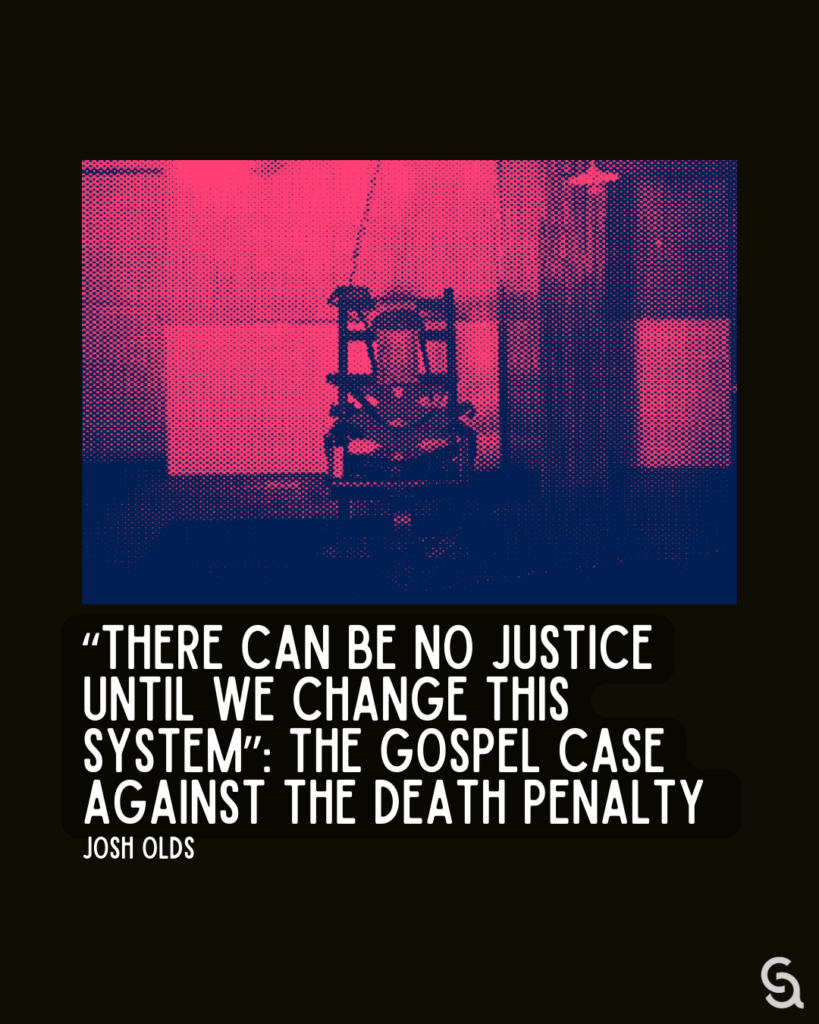
“There can be no justice until we change this system.”
No reforms to protocols, procedures, chemicals, or gas masks can redeem a punishment rooted in fear, racial disparity, and the illusion of a deserved death.
Embodying a Mercy that Disarms Death
If we follow the crucified Christ — the One who absorbed state violence rather than inflict it — then we cannot remain content with systems that disguise vengeance and the wielding of power over life and death as “justice.” The gospel calls us to something more courageous — to imagine beyond what the State calls justice and to embody a mercy that disarms death itself.
If anything is to change, it will be because the church refuses to surrender its moral imagination to the sword and instead proclaims that justice cannot be found in perfecting the means of killing, but in cultivating a world where violence no longer has the final word.
We must educate those around us theologically and push back against the narrative that Scripture demands death — even for those who are guilty. Those who support the death penalty because “the Bible says so” must be taught to read the Scriptures contextually and confronted with the reality that faithful, high-view-of-Scripture Christians reject state killing as incompatible with the gospel.
We must educate those around us judicially, challenging the myth that those sentenced to death are “the worst of the worst” or convicted with certainty.
Many who support the death penalty do so because the crimes are heinous and the desire for justice is strong — but they must be confronted with the truth that capital punishment is often a political performance of being “tough on crime,” not a pursuit of justice.
We must educate those around us medically to understand that there is no humane method of execution. Many Christians support the death penalty passively, or through silence, believing it does not touch their daily lives. But that silence shapes our collective conscience and weakens our evangelical witness. In a world that watches how Christians speak about life and dignity, refusing to speak is itself a form of complicity.
As followers of the crucified and risen Christ, we cannot normalize — and must not sanctify — a system that takes life.
The death penalty persists in the American judicial system because of the support or silence of American Christians. We cannot be silent.
We must educate. We must organize. We must pray.
And we must speak for those who are having their breath taken from them — for there can be no justice until we change this system.
 Josh Olds (D.Min.) is a public theologian and pastor for those disillusioned with institutional church. He is the creator of the forthcoming small-group video series “Year on the Mountaintop” covering the Sermon on the Mount and a featured contributor to Fostering Hope: A Prayerbook for Fostering and Adoptive Parents. Follow his work on Facebook or at JoshOlds.com.