 (Editor’s Note: As Christians for Social Action, we are committed to making space for voices from within the global church, especially those whose experiences are shaped by conflict, constraint, and deep faith. This reflection comes from within the Greek Orthodox tradition and is shared during Holy Week, as these communities in the Holy Land move through this sacred time. We offer it as an invitation to listen, to pray, and to consider how the life, death, and resurrection of Jesus speak into places marked by suffering and uncertainty.)
“The war will end. The leaders will shake hands. The old woman will keep waiting for her martyred son. That girl will wait for her beloved husband. And those children will wait for their heroic father. I don’t know who sold our homeland. But I saw who paid the price.” – Mahmoud Darwish, Palestinian poet
Beloved reader, let us begin with the words of this Palestinian poet — in silence, in truth, and in sorrow. Let us dwell on these words and allow them to settle in our hearts. Let them become a prayer.
When the Greek Orthodox faithful of the occupied Palestinian territories (oPt) begin their journey into Holy Easter this week, the experience is a school of repentance and liberation. This is not merely a season, but an invitation into a sacred time. In 2026, this holy and sacrificial observance is unfolding in a land where there is also deep and ongoing suffering for Christian communities.
On February 28, 2026, the United States and Israel launched military action against Iran, an escalation that many international observers and legal scholars have raised serious concerns about under the Hague and Geneva Conventions. These developments have contributed to growing instability in the region and have raised broader questions about the state of international law and global security.
The conflict has already engulfed multiple countries.
As the regional war intensifies across the Middle East, the Christian faithful of the Holy Land are living in this Lenten season amid fear, uncertainty, and possible displacement. Let us hold them in our prayers.
In 2026, the Greek Orthodox faithful of Palestine began their Lenten fasting period on February 16, continuing until April 11. The Greek Orthodox Church in Palestine is a Christian community that traces its heritage back to the earliest centuries of Christianity, with communities deeply rooted across historic Palestine. It is the largest Christian denomination in the region. The faithful are ethnically Palestinian Arab; the term “Greek” refers to their liturgical tradition (Greek Byzantine) and the administration of the Orthodox Patriarchate of Jerusalem.
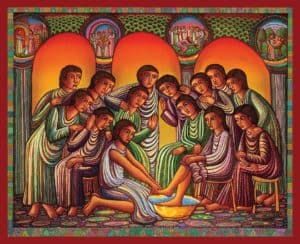
The Greek Orthodox fasting period calls the faithful to abstain from meat, dairy, fish, eggs, wine, and olive oil. In addition to fasting from food, these communities are also called to fast from sin. As Saint John Chrysostom has written:
“For what does it profit if we abstain from birds and fishes, and yet bite and devour our brethren?”
This fasting period is a preparation for the Feast of Feasts, Holy Pascha, the traditional Christian name for Easter. The Greek word Pascha means “Passover.” Fasting from food is only the beginning, since true fasting must transform the heart. As Christians in the West, we are invited to reflect on our own place within global systems that shape conflict and suffering. This is not an accusation — it is an invitation to repentance.
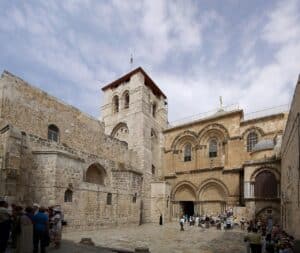
Before the Israeli occupation, the Greek Orthodox faithful in Palestine were able to gather from across the Middle East to celebrate Holy Pascha at the Church of the Holy Sepulchre. Since 1967, access to holy sites for both Christian and Muslim Palestinians has been shaped by a complex system of permits, security measures, and restrictions tied to the ongoing conflict.
With the escalation of regional tensions in 2026, security measures in Jerusalem have intensified. In early March, authorities temporarily closed the Church of the Holy Sepulchre, citing safety concerns amid fears of broader conflict. There have been missile alerts, air raid sirens, and moments when residents and visitors have sought shelter.
These heavy restrictions, surveillance, and militarization are not new. This has been implemented since the occupation of Jerusalem in the Six-Day War. The National Catholic Reporter reported an experience of a Palestinian Christian family on Easter 2024:
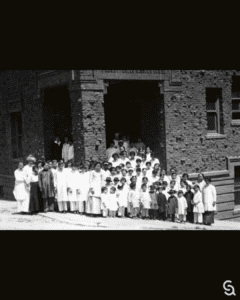
“After parking near the New Gate, Hani (who preferred not to disclose his last name due to personal reasons) and his family began walking toward the entrance — until he was stopped. Tension hung heavy in the air. ‘You can’t get in,’ said a policeman. ‘I’m with my wife and kids,’ Hani replied. ‘They’re already inside.’ His 8-year-old daughter burst into tears, reaching for him. It was only her second time attending with the Orthodox scout group, and she wanted her father beside her.”
After his family pleads, he is able to enter. The reality of Israel’s occupation and ongoing structures of colonization has a profound impact on the ability of Greek Orthodox Palestinians to access, preserve, and share their sacred spaces and communal memory.
Before this war in early February 2026, the Greek Orthodox Patriarch of Jerusalem, His Beatitude Theophilos III, raised concerns about settler violence and restrictions on worship for the Palestinian Christian population. His Beatitude brought attention to attacks conducted by Israeli Jewish extremist groups in the occupied West Bank, which he and others have connected to the expansion of Israeli settlements widely considered illegal under international law.
As Orthodox Christians in the international community, we are called not to indifference, but to awareness and moral clarity in the face of what many describe as war crimes and crimes against humanity. The current international distribution of power is often described by critics as neocolonial. It calls for transformation toward a more peaceful and multilateral world order where each State is subject to fairness, accountability, and equality before the law.
Unfortunately, in the United States, public discourse surrounding support for the State of Israel is often constrained.
There is a continuity in military assistance for Israel across administrations of both political parties (Republican and Democrat). Scholars and young adults who raise concerns about this are at times labelled as anti-Semites. At the same time, governments involved in arms exports to Israel, including the United States, the UK, and Germany, are, in the view of some critics, seen as shaping public narratives in ways that can limit accountability.
The ongoing violence and humanitarian crisis facing Palestinians raise profound moral and theological concerns. The destruction of innocent life stands in direct opposition to the teachings of the church. Moreover, invoking Christianity in ways that could be perceived as justifying or legitimizing violence against Palestinians risks distorting the core message of the Gospel.
For Christians around the world, the Lenten season is not simply a time for personal piety, but a time for spiritual awakening. The disciplines of fasting, prayer, and almsgiving invite believers to examine issues of social sin. This is also a period of time for the faithful to reflect and repent not only from individual sins, but from their participation in systems that perpetuate violence and oppression. Holy Pascha speaks directly to this reality.
Our Lord and Savior, Jesus Christ, was born in Palestine and was rejected by the people of power. The Savior was also crucified by a system of imperial power that sought to silence the truth and preserve its authority. Yet, Christ’s holy resurrection does not sanctify the powers of empire. Instead, it reveals that the self-emptying love of our Savior matters more than the coercion of an empire.
When Orthodox Christians embark on the journey of Great Lent and Holy Pascha, they are called to cleanse their hearts and align themselves with mercy, justice, and suffering. During the Israel and Palestine conflict, Palestinians — both Christians and Muslims — have endured profound suffering, including displacement, hunger, and violence. As Christians, we “mourn with those who mourn” (Rom. 12:15), even as our Greek Orthodox faith proclaims the Holy Resurrection and victory over death.
During this Lenten season, let us pray as in Psalm 140:1-2.
“Rescue me, O Lord, from the evil man; from the unjust man deliver me, who devised injustice in their hearts; all day they prepared wars.”
May our Lord and Savior, Jesus Christ, look upon the children and families in Palestine and protect them from every danger, comfort them in their sorrow, and protect them under the veil of the Holy Mother. Grant peace to the land, healing to the wounded, and hope to every child. Amen.
 Giselle Soares is an Orthodox Christian currently serving as an Ambassador Warren Clark Fellow for Churches for Middle East Peace (CMEP).