
In a world shaped by invisible systems of control and conformity, the call to worship often looks like productivity, power, and performance. But what happens when we reclaim liturgy—not just as ritual, but as resistance? In her timely new book, Liturgies for Resisting Empire (Brazos Press), Kat Armas invites us to unmask the underlying ideologies of empire and rediscover communal rhythms of belonging, liberation, and hope.
Below, Armas shares about the origins of these ideologies, how they infiltrate our theology and daily lives, and how the gospel invites a radically different way of being together. She offers practical wisdom for readers of justice-oriented faith communities—inviting us to ask: What liturgies are shaping us? And how might we respond with alternative patterns that reflect the reign of Christ instead of the reign of empire?
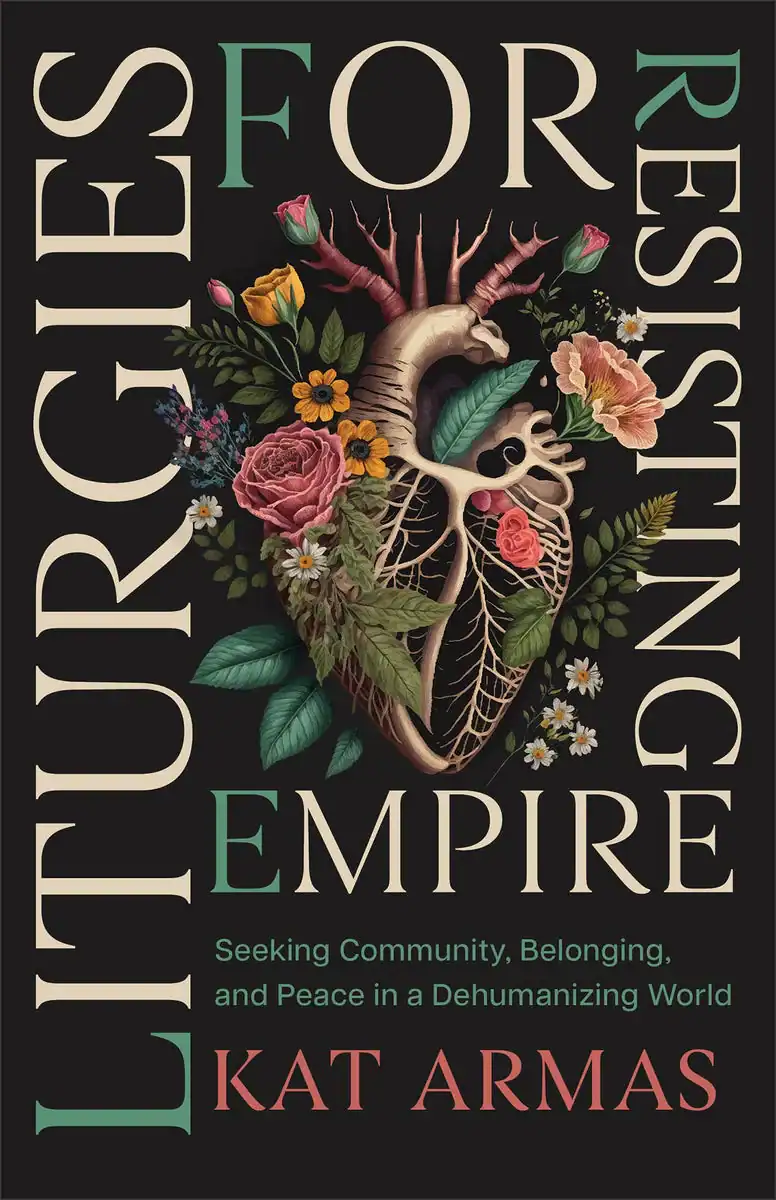 In Liturgies for Resisting Empire, you argue that empire isn’t just a political reality but also a daily, spiritual one. What’s an example of an “ordinary liturgy of empire” you see Christians practicing without even realizing it?
Armas: The ideologies of empire have become so normalized that we barely recognize them—dualism, hierarchy, domination, violence, scarcity. These aren’t abstract ideas; they were shaped by the logic of conquest, by the need to claim land and control people. Over time they’ve seeped into our language, our theology, our work ethic, even our sense of self. Eventually empire’s logic begins to feel like God’s truth, as if the way things are is the way things must be—as if the systems we inherited are the only imaginable world.
One ordinary liturgy of empire is the belief that we must always be producing, always optimizing. Empire teaches us our worth is measured by our output. Another is the assumption that power must always flow from the top down. Empire trains us to fear difference, to believe that strength requires domination, and that peace comes through the sword. It flattens nuance and divides the world into binaries—saved/lost, sacred/profane, worthy/unworthy—until even our spirituality is shaped by categories that distort the divine image in us all.
 You’ve written before about how your abuelita shaped your theology. How does the wisdom of women like her show up in this book about resisting empire?
Armas: In Abuelita Faith, I argued that survival is sacred—and survival is creative. I wrote about the arpilleristas in Chile who stitched the stories of their disappeared loved ones into cloth under Pinochet’s regime, and about Las Madres de la Plaza de Mayo, who showed up week after week, refusing silence. Their wisdom is the fruit of resisting empire: using whatever tools you have—thread, presence, persistence—in creative and nonviolent ways.
In this new book, I take that question even deeper: What is wisdom? And who gets to say? For so long, dominant culture has set the rules for what counts as wisdom and which bodies are deemed wise. But the wisdom that resists empire rarely comes from the center. It comes from the margins—from women like the arpilleristas and las madres, from our abuelitas whose lives testify that another way of being is always possible. Their wisdom is the spark beneath this book: the insistence that liberation begins in the places empire has taught us not to look.
The word “belonging” is everywhere these days—from marketing campaigns to church slogans. How do you distinguish the kind of belonging empire offers from the belonging God calls us into?
Armas: Belonging, as empire defines it, is always conditional. You belong if you look like empire, sound like empire, fit its mold. In the “Christian empire,” belonging is measured by whether you follow the right theologians, sing the right worship songs, hold the right doctrines. It’s the same colonial logic missionaries used—conversion as conformity, belonging as assimilation.
But the belonging God calls us into is utterly different. It’s a belonging where, by Roman standards, the foreigner and the citizen, the rich and the poor, enslaved and free, male and female—even the so-called barbarian—all share the same table. It’s a belonging where dignity isn’t earned, bought, or proven, but received as grace. It’s not only “welcomed” but necessary to the community.
Early Christians found creative ways to resist Rome’s dominance. If a 1st-century believer were suddenly dropped into our world, what do you think would most shock them about how empire still shapes the church today?
Armas: The Early Church was just as entangled in empire as we are. They resisted it and, at times, bent a knee toward it. You see that tension all over Paul’s and John’s writings—a constant tug-of-war, because empire was everywhere and shaped everything.
Like us, they were struggling to understand what it meant to belong—not to Caesar’s world but to Christ’s body. In the Roman Empire, identity was everything. Citizenship, gender, ethnicity, class—these determined your worth, your rights, your very survival.
Hierarchy was the air they breathed, structuring the marketplace, the temple, and especially the household. It trained people to see each other through a lens of worthiness: who counts and who doesn’t, who leads and who follows, who matters and who can be discarded. Not too different from today.
They wrestled with the same questions we’re still wrestling with: What does it mean to belong? How do we live as a people not shaped by domination or exclusion but by love? If anything would shock them, it might be that we still haven’t figured it out—and that empire has only grown bigger and more sophisticated through technology, globalization, and capitalism. And honestly, if I think about it too long, I feel that same shock, too.
Many Christians feel paralyzed by the enormity of injustice. In your own life, what small, embodied practice has most grounded you in resistance when despair feels easier?
Armas: I wrote this book because of this question. Empire feels so big, so vast, so overwhelming that real resistance can seem impossible. But the truth is, if empire shows up everywhere, then there are countless ways to resist.
And it starts with dismantling the empire within—the ideologies we’ve absorbed so deeply they feel like common sense. Our relationship to time and money. How we treat our bodies. Our disconnection from the land. Our constant need to hustle and rush. When we pay attention to where we feel the most tension, longing, or dissonance in our bodies, we begin to see where empire has tangled itself around us. That looks different for everyone and might change depending on the season of life.
For me, my longing to live slower—especially as I entered a new season of parenting littles and asked what I wanted to pass on to my children—led my family to move out of the city and into the woods, to get to know the land and her creatures. That won’t be everyone’s path, and it may not be mine forever, but it’s what this stage of life is asking of me.
My desire not to put more money into the pockets of billionaires has also led me to boycott or divest from certain corporations. This asks me to spend my money with care and integrity. But I also hold this with compassion: for many people—single mothers, for example—those same corporations are affordable and even necessary. There’s no “right” way to do this work. There’s only the honest way.
So I try to build my days with intention: not rushing out the door so I don’t pass on the gospel of hustle to my kids, allowing friction to interrupt my day, tending to the earth around me, showing up at local activist meetings in my city for encouragement and to see how else I can get involved. There are so many small, daily steps—taken consistently—that become our own quiet forms of resistance.
Your work weaves together decolonial readings of Scripture and communal spiritual practices. What has surprised you most in bringing those two worlds together?
Scripture and communal spiritual practices were never separate to begin with; they’re intertwined at the roots. The early church didn’t understand the “self” the way we do today; identity wasn’t an individual project but a communal reality. So whenever they sought to critique, resist, or subvert empire, that resistance was necessarily communal—and, in many ways, inherently decolonial.
When you read Scripture through that lens, you start to see how the earliest Jesus-followers were already doing this work. They gathered at tables that defied Rome’s hierarchies. They shared resources in ways that disrupted imperial economics. They formed communities where belonging wasn’t earned by status, citizenship, or purity. Their spirituality was collective, embodied, political.
So bringing these two worlds together in my work hasn’t felt like stitching two separate threads. It’s felt like remembering what was already there—recovering a way of faith where liberation is communal, resistance is shared, and wisdom arises from the margins rather than the center.
If readers finish your book and want to take just one courageous step toward resisting empire this week, what would you hope that step is?
Armas: Get to know these ideologies—where they come from, how they’ve seeped into your mind and life—and then take stock of yourself. Pay attention to how they shape your days, your habits, your ways of thinking and being, and then notice where you feel the discomfort. Where are you feeling bogged down? What are your longings? Start there.
Resisting empire is a deeply personal journey, so there isn’t one practice I can recommend for everyone. Decolonizing begins within us and then pulses outward—shaping the choices we make, the communities we form, and the way we show up in the world.
—
Kat Armas (MDiv, MAT, Fuller Theological Seminary) is a Cuban American writer and podcaster and the recipient of Fuller Seminary’s Frederick Buechner Award for Excellence in Writing. She is pursuing a ThM at Vanderbilt Divinity School. In addition to Liturgies for Resisting Empire, Armas is the author of Abuelita Faith and Sacred Belonging. She has written for Christianity Today, Sojourners, Christians for Biblical Equality, Fuller Youth Institute, Fathom magazine, and Missio Alliance.