
 (Editor’s note: This is Part 1 of a four-part series exploring Christian faith, theology, and peacemaking in the Holy Land. In this opening article, Dr. Mae Cannon invites readers into a biblically grounded vision of shalom — challenging common assumptions about conflict in the region and examining how Scripture has often been misread in ways that obscure God’s purposes for peace. The remaining articles will explore lived realities on the ground, the Church’s theological witness, and faithful Christian responses rooted in justice, prayer, and love. We will be publishing the companion pieces over the coming weeks.)
____
Concepts of peace are present in all three of the Abrahamic traditions of Judaism, Christianity, and Islam.
In fact, in the Middle East, one greets someone in Arabic by saying “salam alaykum” (السلام عليكم), meaning “peace be upon you.” On days of Shabbat, from sunset to sunset, Jews around the world say the same in Hebrew, “shalom aleichem “ (שָׁלוֹם עֲלֵיכֶם), a way of invoking blessing and an invitation to peace.
And yet in parts of the world where people say those greetings of peace most prolifically, decades of violence, unrest, and hostilities have run rampant. The lands of the historic Holy Land extend far beyond the contemporary geopolitical boundaries of the State of Israel and include ancient Mesopotamia, from the Tigres to the Euphrates River; the Mediterranean coastline and the lands that surround it from Lebanon to the Sinai Peninsula; and Egypt, Iraq, Syria, and other parts of the Levant.
These places are written about in both the Hebrew and Christian Scriptures, and are home to Christian and Jewish communities that have lived in those places for thousands of years. Broad sweeps of history often categorize the Holy Land as never having had peace, highlighting the conquests by Roman emperors and the “holy wars” of the Crusades between the 11th and 13th centuries.
Nonetheless, for the majority of the last millennium, under the reign of the Ottoman Empire, the historic Holy Land enjoyed hundreds of years of pluralism and a lack of war and violence. In fact, until the division of the Middle East by Western powers after the First World War, the land of Ishmael, Isaac, and Jacob existed mostly in peace.
So where did these ideas of a land “wrought with conflict” and “shattered by violence” come from? For Western Christians, particularly those reading the Old and New Testaments in English, there has been a significant fallacy about how the “descendants of Abraham” have been at battle throughout history. It is fundamentally not true that Arabs and Jews have been at war for thousands of years and that their discord was written by God in the text of the Bible.
Consider the well-known story of Abraham, promised by God to have descendants, we read about in Genesis 12:1-3:
“The Lord said to Abram, ‘Go from your country, your people, and your father’s household to the land I will show you. I will make you into a great nation, and I will bless you; I will make your name great, and you will be a blessing. I will bless those who bless you, and whoever curses you I will curse; and all peoples on earth will be blessed through you.’”
But, Abraham and his wife, Sarai, being old in age, didn’t trust in the promises of God, and instead Abraham sought to have a family with their Egyptian slave, Hagar. Christian interpretations have assumed that Hagar was rejected by God — telling the story of how the descendants of Isaac, born to Sarai and Abraham, were privileged by God, while the son of Hagar, Ishmael, was rejected. However, that is not the story that the Scriptures tell.
In fact, Genesis 16 tells of how Sarai “mistreated” Hagar (16:6), and Hagar fled into the desert. When we read about this encounter, we must ask, how did God respond to Hagar in her distress? The first thing we read is that an “angel of the Lord found Hagar” (16:7). Then the angel of the Lord says to Hagar that Ishmael will be a “wild donkey of a man” who will live in “hostility toward all his brothers” (16:12). An English reading of the text seems pretty clear: Ishmael would live in conflict.
However, a more thorough reading of this passage is required, including in the original language and text. That comprehensive exegesis is beyond the scope of this essay, but I would encourage you to reread the biblical story carefully. “Wild donkey of a man” is widely understood to mean that Ishmael would be fiercely independent and live his life with autonomy — i.e. not a slave — which could be viewed as a great asset.
Many scholars say that God’s promise was actually a blessing, quite the opposite of a curse! Sunday school teachers throughout the United States and the West have taught that Genesis 16 means that Arabs and Jews would be at battle until the Second Coming of Christ and the end of days.
What in fact happened when Hagar was in the wilderness?
God gave her the name for her unborn son, saying, “You shall name him Ishmael” which means “God hears” (16:11). Hagar responded and identified God as “El Roi,” the God who sees. God revealed himself to Hagar in the wilderness. He did not abandon her; he did not tell her she and her descendants would be cursed. Rather, God appeared and responded to Hagar’s needs.
There is a profound book by biblical scholar Dr. Tony Maloof of Dallas Theological Seminary called Arabs in the Shadow of Israel: The Unfolding of God’s Prophetic Plan for Ishmael’s Line that talks about the promises of God to Hagar and how these chapters in Genesis are so often interpreted in light of Western anti-Arab prejudices.
How does the story of Isaac and Ishmael end?
God promises Abraham that he will bless Ishmael and his descendants (Gen. 17:20), and after Abraham’s death, the brothers come together to bury their father (25:9). The following verses then tell the account of the family line of Ishmael and the account of the family line of Abraham. These brothers were not battling upon their father’s death, but rather, side by side they buried their father in peace. The contemporary story of Israelis and Palestinians is just that — a story of modern times.
In the 19th century, Western anti-Semitism and nationalist movements gave rise to the Jewish Nationalist movement that, in the late 1800s, set a goal to restore the Jewish people to their historic homeland. At the time, the indigenous people of the Holy Land included Jewish, Christian, and Muslim people, including Arabic-speaking Jews and people of the land whose ancestors had been present for thousands of years.
At the turn of the 20th century, the new Jewish Zionist movement brought the immigration of Jewish people from various locations around the world, predominantly Europe, long before the horrors of the Holocaust and Nazi Germany. The detailed history of this contemporary geopolitical conflict extends beyond the scope of this short introduction, but what is most important to understand is that the decades of war, violence, and occupation ongoing today began in the 20th century.
Local Arab communities revolted against both Jewish immigration and the British mandate instituted after the First World War. Many call 1948 the “year it all began.”
In Arabic, the events are known as the Nakba, or Great Catastrophe, referring to the more than three-quarters of a million local Arab Palestinians who were displaced from their homes and land. Hundreds of Palestinian villages were destroyed, thousands killed, and the modern nation-state of Israel was established.
That population of Arab refugees became the Palestinian refugee population, many of whom still today long for the Right of Return, and live in refugee camps in Gaza, Jordan, Lebanon, or other parts of the Middle East. For Jews coming out of the Shoah, with the catastrophic horrors of more than 6 million Jews and millions of Eastern Europeans and other minorities killed, the newly established State of Israel was considered a miracle. The world rejected the Jewish people after World War II, and the struggle for a safe place where there would be no discrimination or violence against them was real.
Throughout the first decades of the State, Israelis feared another catastrophe at the hands of neighboring Arab countries, which supported the Palestinian cause. After the 1967 Six-Day War between Israel and its neighbors, Israel took control of East Jerusalem and the West Bank. The country annexed parts of Jerusalem, while the West Bank became occupied. A military occupation, with Israeli security and civil control ruling over the vast majority of the territory, continues to this day. Peace may still be far off in the future of the Holy Land.
But we must understand the contemporary history in order to be able to find ways to move forward that address unresolved issues that have only arisen in past decades. This history is short. Less than 100 years have passed since the time of the establishment of the Israeli state.
Today, Palestinians long for the same self-determination, freedom, and equality that Jews sought for themselves decades ago. The dehumanization and destruction of Palestinian lives and culture must be brought to an end if there is ever truly going to be peace and security for all of the people of Israel and the occupied Palestinian territories. Mother Teresa saw things very clearly when she said,
“If we have no peace, it is because we have forgotten that we belong to each other.”
The futures of Israelis, both Jewish and Palestinian citizens of the state, and Palestinians living in the occupied territories remain inextricably linked. Contemporary solutions must be sought to address decades of human rights violations and injustices. The common humanity of Palestinians must be respected if there is ever to be peace for all of the people of the land. The futures of the two peoples of the Holy Land continue to be inextricably linked. Might it be a future of true peace.
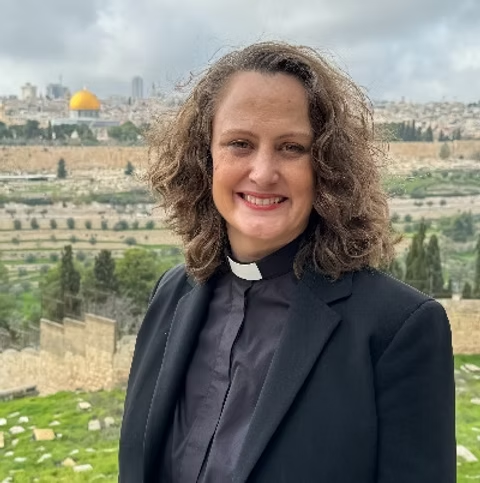 Rev. Dr. Mae Elise Cannon is Executive Director of Churches for Middle East Peace (CMEP) and is ordained with the Reformed Church in America (RCA). Cannon formerly served as the Senior Director of Advocacy and Outreach for World Vision U.S. on Capitol Hill in Washington, DC; as a consultant to the Middle East for child advocacy issues for Compassion International in Jerusalem; as the Executive Pastor of Hillside Covenant Church located in Walnut Creek, California; and as Director of Development and Transformation for Extension Ministries at Willow Creek Community Church in Barrington, Illinois.
Cannon holds an MDiv from North Park Theological Seminary, an MBA from North Park University’s School of Business and Nonprofit Management, and an MA in bioethics from Trinity International University. She received her first doctorate in American History with a minor in Middle Eastern studies at the University of California (Davis), focusing on the history of the American Protestant church in Israel and Palestine, and her second doctorate in Ministry in Spiritual Formation from Northern Theological Seminary. She is the author of several books, including the award-winning Social Justice Handbook: Small Steps for a Better World, and editor of A Land Full of God: Christian Perspectives on the Holy Land. Cannon was recently ordained with the Reformed Church in America (RCA).