 Two days after the United States began bombing Iran, I dropped my oldest son at the airport in Portland, OR. He was headed to National Guard boot camp, and will be gone for 10 weeks.
This is my son’s second enlistment, after completing a stint in the Navy last year, getting married, and starting a family. I’ve written elsewhere about my son’s decision to join the military, how being raised in a peace church and having two parents who are ardent pacifists could not sway his decision. Releasing him to pursue what he feels is a calling has been one of the hardest, most humbling experiences I’ve had as a parent. Saying goodbye this time was especially challenging, given that the U.S. seems to be stumbling and fumbling into another forever war that might someday directly imperil my beloved son.
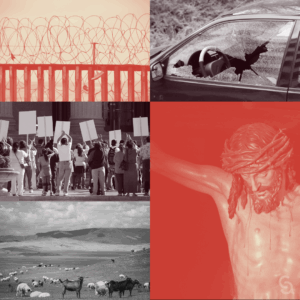
My broken heart had already been shattered, though, even before my son left for boot camp, even before the country entered this latest unnecessary war. Like so many others, I wake up each morning to more bad news, more institutionalized cruelty:
- Immigration enforcement officers violently removing people from their homes and throwing them into overcrowded and unsanitary containment facilities.
- Peaceful protesters killed in Minnesota and California.
- A powerful network of men evading responsibilities for raping and abusing girls.
- USAID contracts cancelled, resulting in needless suffering and death for half a million children.
- The Cuban people starving because of our country’s blockade.
- A genocide in Gaza, and wealthy developers dreaming of resorts built atop Palestinian graves.
- Over a million Russian soldiers lost to impetuous whims of a brutal dictator, whose war has also taken more than 500,000 Ukrainians.
- And two weekends ago, the United States reportedly dropped a Tomahawk missile on schoolchildren in Iran. Federal leaders are evading responsibility, the Department of Defense secretary asserting that military rules of engagement meant to minimize civilian causalities are “stupid” and “politically correct.” As if war itself is a kind of game, and any attempts to protect innocent loss of life gratuitous and silly. AI-generated videos posted on government websites posit that for some federal leaders, war is a game, rather than a tragedy with immeasurable costs.
When the News Breaks Your Heart
It’s easy to become overwhelmed by all the chaos, often caused by people who seemingly thrive on perpetuating harm through a “maximum lethality” (in the words of the Secretary of Defense) approach to governance. Facing a barrage of catastrophic news, day after day after day, we may become numb to the world’s suffering. How many more grieving mothers do I need to see in the news? How many more flag-covered coffins? How many more powerful men gloating from podiums, proud about the decisions they’ve made—decisions they see as God-blessed, but which seem to be destroying the world?
I hear their delight in others’ pain and wonder, “O Lord, how long shall the wicked triumph?” (Psalm 94:3).
In the void, the seeming lack of an answer to the heart’s cry, we are compelled to go on with our prosaic routines. Calamity continues, but so does the need to work, feed our families, do laundry, all while the world burns.
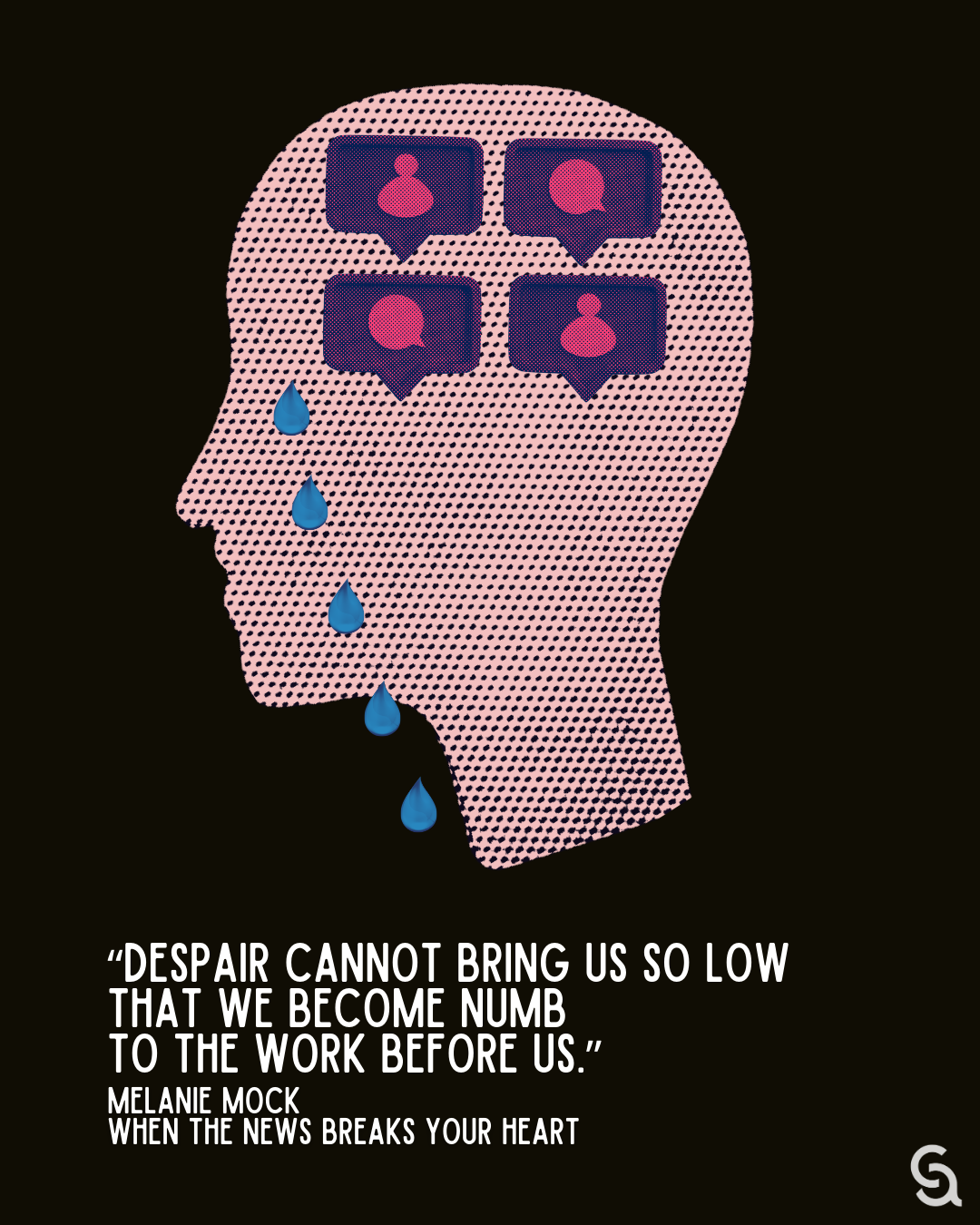
Our nervous systems were not designed for so much bad news, given to us by social media and the constant thrum of news outlets, competing for our attention. Health professionals have noted that the persistent cycle of crises has significant impacts on our physical, emotional, and mental well-being. It’s no wonder that so many good-hearted people in the United States and around the world are struggling to feel hope.
While my mind and body buzz with despair this spring, I’m on sabbatical from my teaching job and working on a book about how Christian nationalism bloomed in my hometown, nearly destroying our public school system.
Writing a book when so many people are suffering has been challenging, but also revelatory. Because as I’ve researched my hometown and home state, I’ve been reminded of the ways cruelty and violence have had deep, deep roots in our country. Those roots were seeded by colonialism and Manifest Destiny and a belief in American Exceptionalism. The seeds were watered by the blood of enslaved people, by Jim Crow, and in Oregon, by Black exclusion laws that made it illegal to live as a Black or mixed-race person within Oregon state lines.
So much of what is happening now, as the United States continues to perpetuate a myth of American strength and power, can be tied to violent, oppressive ideologies that have never been pruned from our national identity, and that have caused significant pain and suffering for some people groups. As one recent essay points out, the United States has been the bad guy plenty of times in history. Some Black voices on social media have affirmed that the misogyny and racism perpetuated by our federal government isn’t exactly new but is being brought to the light now, in part because privileged groups are experiencing oppression for the first time.
What Is Revealed Can Be Changed
But what is revealed can be changed. This alone should give us hope.
In my hometown, a far-right school board tried to reshape education to their Christian nationalist image. They scapegoated teachers as indoctrinators of gender and racial ideologies, banned Black Lives Matter and Pride flags from classrooms, fired a much-loved superintendent, then hired another who had been disciplined at two other schools for racism and for shielding sexual misconduct.
Over 200 educators left our district, taking their wisdom and institutional knowledge with them. School board meetings became hostile battlegrounds, and community social media groups spread disinformation, causing significant rancor and division between neighbors.
Instead of ceding to despair, though, folks in our community organized. They formed alliances with people of different backgrounds, challenged school board decisions, combatted disinformation, volunteered in schools, raised money, and then, finally, after two years, worked to elect a slate of five new nonpartisan board members who weren’t beholden to right-wing ideologies. Despite the damage already done to our school district, those efforts helped rewrite Newberg’s future.
The alliances have also provided networks for other difficulties facing our community, including the incursion of violent immigration enforcement officers. Those ICE officers have now had to reckon with volunteers protecting school children, churches, and homes, similar to what has happened in communities across the United States.
What is revealed can be changed through radical neighbor-love. This should also give us hope.
When I see so much catastrophic news unspooling before us, and when everything feels chaotic and wrong, and when it seems impossible that justice will prevail, I want to remember my Newberg neighbors, whose love for others is changing our town. I want to remember the resilience of people in Minneapolis, Chicago, Vermont, and elsewhere, standing between ICE agents and immigrants who deserve safety. I want to remember those who marched in Selma and on Washington, together proclaiming that Black Lives Matter, which had been a contested statement in my hometown. I want to remember all those who are fighting this administration in courts, and in the media, and in political campaigns.
The recently-deceased Rev. Jesse Jackson often spoke about Martin Luther King Jr.’s idea that “the arc of the moral universe is long, but it bends towards justice” by reminding listeners that we are called to provide the loving action needed to redirect the moral arc. Here is what he said:
“The arc of the moral universe does bend toward justice, but only when our hands, our hearts, and our voices help bend it.”
Despair cannot bring us so low that we become numb to the work before us. In the moral universe’s long arc, cruelty and corruption will not win.
Easter celebrates this truth. On Good Friday, we remember that Jesus was crucified by powerful leaders practicing maximum lethality because they were threatened by the gospel message: that love conquers hate, that the meek and poor are blessed, that we are called to make peace, not war.
Easter Sunday and Jesus’ resurrected form affirm that goodness will always overcome empire, and those who use violence will never have the last word. Love wins when He is Risen. This reality should give the heartbroken hope.
 Melanie Springer Mock is professor of English at George Fox University, in Newberg, Oregon, where she primarily teaches first-year writing, memoir, and journalism courses. She is author or coauthor of six books, including Finding Our Way Forward (Herald Press, 2023). Her essays and reviews have appeared in Ms. Magazine, The Nation, Christian Feminism Today, Chronicle of Higher Education, and Anabaptist World, among other places. Mock is a CSA pundit.