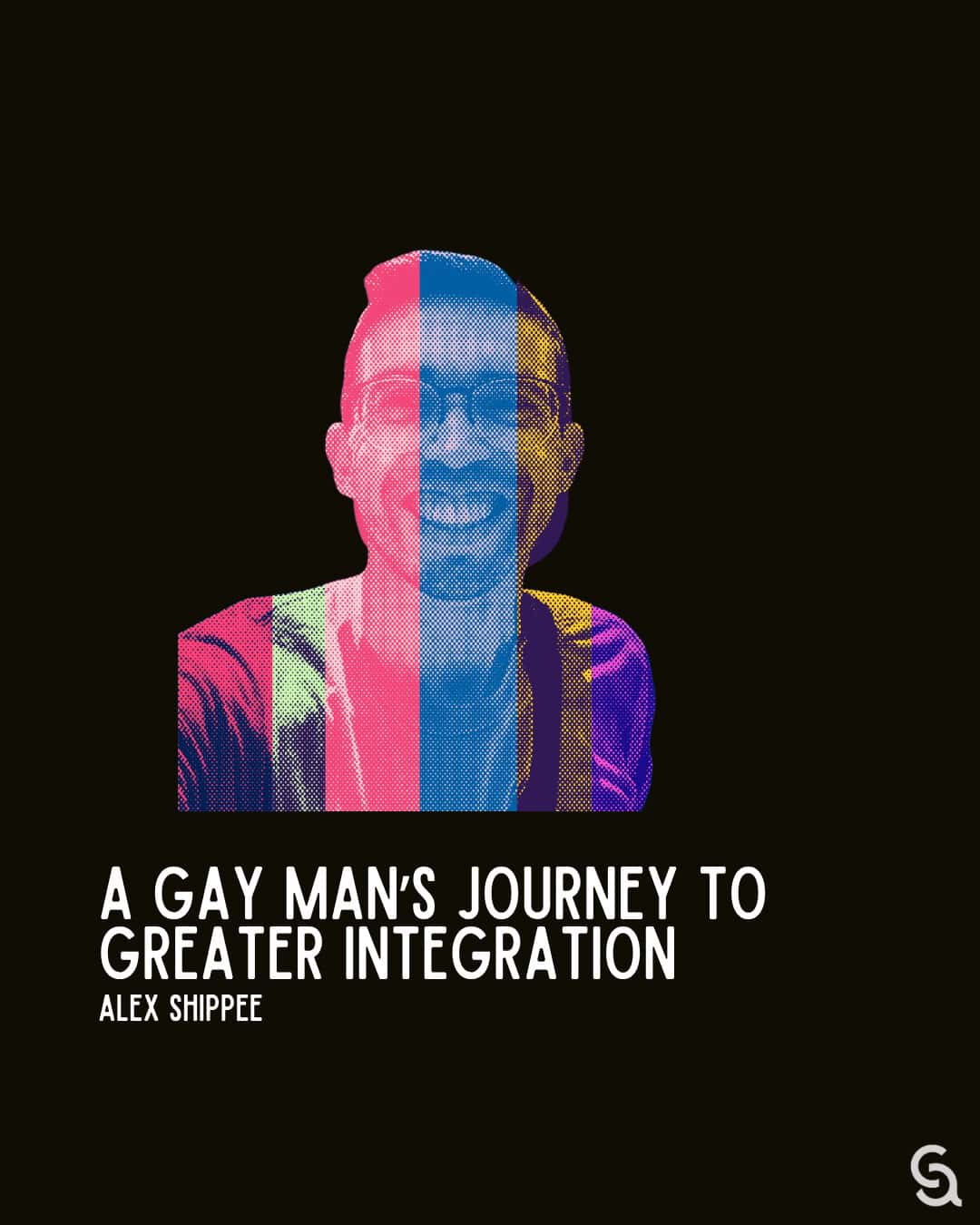
 Alex Shippee describes himself as “your average half-White, half-Latino, gay, former-missionary-in-the-Middle-East-turned-urban-planner.” These experiences, while also growing up in a Jesus-loving, theologically traditional family, have profoundly shaped his journey with his sexuality and his faith. Wrestling to find the integration of these two has produced both deep grief and rich insights, painful growth and surprising joy. In this thoughtful Q&A, Alex shares what he’s learned about God, himself, and his relationships. (Read our interview with his father, Tom: “Love Across Deep Difference: A Father’s Journey with His Gay Son.” You can also download a pdf of the full interview with Tom, along with the companion interview with Alex.)
What has your journey been like as a young gay man growing up in a traditional/conservative church/family?
In some ways I am tempted to downplay the painful experiences growing up in a traditional church/family, because I have heard stories from others that are truly grievous. My journey wasn’t easy, but it could have been much worse and has included some really good moments: moments of healing, of learning more of who God is and how to appreciate how God has made me. The following are snippets that hopefully help capture a bit of what my journey has been.
Age 5: It’s kindergarten. A lot of the boys are too rowdy for me. I’d rather compete with the girls in reading. I’m always trying to beat Laura as the top reader.

Age 11: I’m becoming friends with this guy at church. We’re about the same age. He’s an Air Force brat, and his family started coming to church when they moved to the area. He tells me about his crush. It’s hard because I don’t really have crushes. But the girl he mentions is cute, I guess? But if I say I have a crush on her, I think it’s more because he likes her. Even more though I’m just grateful to have a good guy friend.
Age 12: I have discovered that you can find pictures of naked guys on the internet. It started more as curiosity, but right after, I feel both strangely intrigued and grossed out. There’s an instinct to pray. To apologize to God. There’s something off about what’s happened, but I have no language for it. In my journal, I write prayers asking God to help me with my secret.
Age 14: My friend has moved away, his dad reassigned elsewhere. I haven’t really found any other good friends. I feel lonely. I’ve also hit a point where I just need to tell someone about the porn. It comes and goes, but there’s a growing inner drive to confession. So, perhaps foolishly, I talk to my parents.
Age 18: I haven’t talked to anyone about my sexuality since telling my parents. But after a sermon at my college fellowship, that inner drive to confession pushes me to ask for prayer. I know this might lead me to be kicked out of the fellowship, but the burden to share outweighs the risks. I tell a senior that I like guys and have started having trouble again with porn. I wait for the hammer to fall, but hear only a gentle, “We should find you an accountability partner.” Nearly a decade later, I learn this senior is gay, too. Coincidence or God’s mercy?
Age 22: I have finished college and am doing an urban ministry internship. College has had its ups and downs—like going to my Christian fellowship (mostly to avoid a girl), actually sharing with others about my sexuality, forming and losing a codependent friendship, and doing inner healing prayer for the first time about my sexuality. It is still hard to find language, but as I step into this internship, I need to come to terms with my sexuality.
I start counseling. But perhaps the most therapeutic things are biking to the beach and slowly starting to believe that God is not afraid of my sexuality. And the faintest glimmer that maybe who I am is a gift even if I like guys.
Age 25: It’s my birthday. I’ve hiked a full day on my own at Catalina. I am processing. I had hoped that pursuing a serious relationship with a woman could work. But now as I stretch out on the beach to rest my legs, I know that our relationship of a year and a half is over. I simply can’t create feelings of attraction for her. It won’t work. Rather than moving forward with the engagement she desired, we break up. I was honest with her about my sexuality from the beginning, but somehow I still feel like crap. Deficient as a man because I am unable to return the kind of “love” she feels for me. There really is something wrong with me.
Age 26: I get a text from another queer person seeking to offer comfort after the Pulse Nightclub shooting, but I have dissociated from my pain as a queer person. I do not need comfort, because I have pushed pain away. In the past year, three people have come out to me, yet I have become more resolute about not dating men. Increasingly, as I have shared my story around sexuality, others who are queer have quietly quit our friendship because of conflict around the traditional perspective on sexuality. Conclusion: I’m not gay, because the LGBTQ community doesn’t really want me—I just like guys.
Age 28: There’s more to my life than my sexuality. At 25, I embraced my family’s ministry heritage, and at 28, I finally get to go overseas. After all the prep of learning a new language and fundraising, now it’s a reality, and I’m finally here in the Middle East. This is a demanding but thrilling adventure. For as out of place as I am, I feel comfortable here. Perhaps this is truly God’s calling for my life.
Age 31: Three years in the land of deserts and Islam. I am different. Challenging faith questions emerge as I befriend devout Muslims. I am deeply grateful for my friends; I wouldn’t have survived the pandemic without them. But the questions about marriage and the limited community force me to acknowledge that I cannot stay long term. This was my chance to be excellent—to do what others don’t—to be in missions. My world is crumbling.
Age 32: I am back home now discerning what’s next for my life. We are trying to rebuild a world that fell apart. And though the questions are about ministry, they mask the questions about sexuality underneath.
I am watching season one of the series Love, Victor. He’s a high-achieving gay Hispanic high schooler navigating his sexuality journey. Somehow, I both am and am not watching my life on screen. Like Victor, I remember trying to integrate everyone’s (including my own) high expectations, culminating with international missions work. But rather than a triumphant Christian war hero, I come back licking deep wounds. The reality of a God willing to “tolerate me” through my accomplishments comes crashing in. I thought I’d come to terms with my sexuality a decade ago, but now the flood gates open and I see that shame is much more deeply rooted than I believed.
Age 33: I have decided to engage Jesus’ unconditional love and wrestle with what dating a man might mean. I have been dating this guy for about 3 months. He shows up one day and pulls a bouquet out of his car. No one has ever bought me flowers before, though I’ve wanted them. Something tender is touched deep inside me. I am seen. In prayer I have pictured Jesus as a gardener who tends to the flowers in a cemetery of things that have died in my life. Lost relationships, unfulfilled ministry hopes, old ways of compensating, and old ways of blaming my younger self. As Jesus nurtures and prunes the flowers, he honors both life and grief.
My parents simultaneously smile and grieve as I search the cupboards for a vase for the flowers. They’ve been on their own journey, and it’s been years since our don’t–ask–don’t–tell phase. They grieve the death of their fantasy family while finding joy that someone clearly cares for me. Flowers, a symbol of life, death, growth, beauty, grief, and joy. Yet after flowers wilt, the journey continues.
How do you describe your own theological position? What labels, if any, do you feel comfortable embracing?
My theology around sexuality, like my mixed ethnic identity, do not fit neatly into any single category. Over the past few years, my many queer Christian friends have helped me see the wide spectrum that we exist along. I agree with many people who hold a traditional, or what is sometimes called the Side B, sexual ethic and believe that the ability of a straight couple to create life is something undeniably unique and special. But I don’t believe that God calls all queer Christians to life-long celibacy or a mixed-orientation marriage. Like many Side A (progressive) folks, I believe God does not condemn a monogamous same-sex union/partnership bound by a covenant. But I would not call that a “marriage” in the traditional sense. The truth is, our stories around sexuality are so unique and varied that I think God longs more to meet us in the midst of the story rather than prescribe a one-size-fits-all model.
One analogy (and a joke) came from a conversation with my dad (who is an avid blood donor) when we thought about the theological “sides” as blood types. I mused, “My place in the middle is neither Type A nor Type B. Maybe I am an AB.”
My dad, who is always down to get the most out of a metaphor, shot back with a smile, “… or perhaps type ‘O ’ for ‘open’.” If you doubt God has a sense of humor, consider that my actual blood type is O+ and Dad’s is an O-.
Some people may critique my middle-of-the-road stance as lukewarm and throw in Revelation 3 to back it up. But two things help ground me in the middle space. One is that so much of how I operate in the world is in-between. I don’t think that the middle space is where everyone should be. Some people need to be in a more traditional/Side B space, and others need to be in a more affirming/Side A space. But I have often seen people who migrate between those spaces having to navigate a no-man’s land between sometimes contentious sides. Friends have shared that they can feel isolated or even ostracized when they consider the possibility of one side or the other. So, it feels significant to be someone who can be present in the middle ground as people figure out what they themselves think about their own sexuality.
I also hope my middle ground position helps reflect God’s presence in this difficult space. If I don’t cling to either a traditional or a progressive theology, you might ask, then what do I hold on to? Articulating values that run deeper than just my theology of sexuality has been key for this. Three biblical values—hospitality, non-violence, and discernment—have helped ground me and allowed me to see worth and truth in both traditional and progressive perspectives.
- Hospitality—Sexuality is often used as a place of exclusion. We are tempted to hide behind simplistic masks that obscure our true selves. The key to hospitality is a welcoming posture. I may not agree with all of your words or actions, but my openness to you is not contingent on your meeting my standards. Jesus welcomed and hung out with sinners, tax collectors, and even Pharisees wherever he found them, taking time to listen more than he spoke. As we engage the topic of sexuality, I believe we must follow Jesus’ model, learning to meet ourselves and others, in the current moment and circumstance, on this challenging journey.
- Non-violence—Queer people are unfortunately well-acquainted with violence. Sometimes queerness is a place of doing violence to yourself (whether physical or emotional). Often, pressure to conform to or reject certain group expectations is weaponized. This use of camps, sides, and we-they thinking promotes a war-like mentality, and violence becomes the quickest and most efficient tool to win. But in reality, this only leads to a loss for all. More than being traditional or progressive, I want to be someone who brings a spirit of non-violence and peace to conversations around sexuality.
- Discernment—God speaks to us. And has given us multiple avenues of learning to hear his voice and his call to us particularly in the context of other people. God has spoken through Bible verses, images, even through others. Because everyone has such a unique story, it’s not my job to tell you how to live your life. But it is my job to help create space for you to hear how God is calling you to live. I truly have no agenda of where I want people to land. I’m still trying to learn the critical balance between not being too passive or too pushy in a person’s life as they attempt to hear God’s leading voice.
What have you lost in shifting your theological perspective? What have you gained?
Initially I believed that coming out and dating would result in the loss of many relationships. I expected rejection from others, being cut off, and ultimatums. While I’ve experienced some uncomfortable tension, no relationships have been fully broken. I recognize how lucky I am in that. Key relationships in my life with my parents and good friends have continued and even grown through this time, which has allowed me the space to really discern what I think about sexuality.
What has been more difficult for me is the loss of honor and respectability that I enjoyed as a missionary and Side B Christian dedicated to strict moral excellence. In the past, I had sometimes felt like the church’s war hero—highly esteemed at home for doing what so few others are even willing to consider. Shifting my perspective has changed that, and it has been humbling to navigate. Now when I tell people I’m dating a guy, there’s usually an awkward, “Oh, … How has that been?” or “I’m happy for you,” but it’s clear their response carries hesitancy.
For me the intentional decision to explore my sexuality outside of those boxes has been difficult for me to justify, even to myself. I know that at least some family members, ministry workers, and friends perceive my choice as lax, self-serving, and unbiblical. But it has meant engaging directly with Jesus—and finding him in surprising places. This has allowed me to give teeth to the statement that God’s love for me is unconditional, both directly in prayer/journaling and through key family members and friends. In giving up a rigid moral certainty, I remain open to the possibility of being wrong. But rather than standing outside like a soldier defending the gateway to truth or the moral high ground, I find myself surprised by the challenging yet engaging conversations I have with God in the “far country.”
I have also lost the comfort of group belonging. There’s something reassuring when your beliefs resonate with those of “your tribe.” The sense of belonging to something greater than yourself is very comforting. So when you move toward the middle, you need to adjust to being on the outer ring of group belonging.
In terms of what I’ve gained, perhaps the most significant thing has been freedom from the need to “perform.” While this pressure came most strongly from within, it was heavily reinforced by family, church, and cultural patterns. I felt I had to compensate for being gay by being a “super-Christian.” Even small failures highlighted the shame I felt and were reinforced with a “never good enough” drill-sergeant mentality. But shifting theologically and embracing a complex and nuanced reality where I may be wrong has slowly loosened the grip of shame. My relationship with God is no longer make-or-break depending on how well I perform.
I have also gained a greater compassion and growing hospitality. As I have had to come to terms with the ways I don’t measure up to the Eden paradigm, I’ve grown in compassion for those in a similar place. As I recall with gratitude those who have welcomed me, it’s been important to create that space of hospitality for others who are figuring things out along their own paths. I have also gained a deeper appreciation of being human. I’m naturally more of a thinker than a feeler. This, coupled with my attraction not matching the norm, led to often feeling deficient or sub-human. But as I have allowed greater space for my sexuality, particularly in dating, I see that I am not deficient. I do have emotions, affection, and care to meaningfully offer in a relationship.
Finally, I have gained a new sense of courage. Courage to be more visibly queer as I date a guy. Courage to pursue relationship with others in the midst of disagreement. This is particularly difficult because of my natural tendency not to ripple the waters. I have found courage to create space for myself even if it means the loss of respectability, and to just be more honest. I have also grown to really appreciate relationships with people who are willing to stick it out through difference. And with that comes a deeper reassurance of the relationship—that our connection is not just based on my ascent to a certain belief, that something even deeper binds us.
What do you think is at stake for the church if we don’t keep navigating the kinds of conversations you and your dad have made room for?
A few months ago my dad asked me what I think the benefit of our conflict is. I took some time to journal and think about it. I realized some more challenging things, but I also feel like in the midst of reflecting, I stumbled into some unique gifts that arise from conversations that happen with my dad. I believe that this could expand to the church at large.
What is the benefit of our conflict?
- It forces us to articulate difficulties with both our perspectives when we might otherwise minimize them. Also, when we are tempted to focus only on the positives, our conflict, prompting us to look at our perspective more critically.
- A humbling reminder that no one “wins,” which does carry some grief. But it pushes us to articulate goals that are bigger than the current perspectives we have. What do we long for beyond our conflict?
- Our discipline of love in the midst of disagreement is shared between us rather than one person forcing “rightness” onto the other person. These conversations and the disagreement in them allow for mutual autonomy rather than principled subjugation.
- It obliges us to confront our and the other person’s humanity. It tempers our self-righteousness.
- It keeps both the dreams I have for my life and my dad’s dreams of me tied to reality.
- It forces me to own my choices. Rather than just giving in to make someone else happy or playing the victim, I have the chance to exercise agency.
Particularly the point about no one winning struck me as poignant for some reason. But I was also a bit frustrated with it, so I moved to this next question: What is the good news in our conflict?
I have to believe that God is neither for me nor for the other person in a competitive sense (Joshua 5:13-14). And this is good news, because God ceases to be a weapon I use over another person. But when God is bigger than just my friend or foe, I am invited into a deeper humility, one that cannot grow in a silo of single-minded thinking. I must hold my perspective with the understanding that I might be wrong. And I learn to hold it in communication with the other person’s perspective. In this, I learn how much bigger God is than I realized. Although it’s painful, the gift of humility and liberating God from my and the other person’s perspective is actually really good news—particularly in today’s world. And that’s why I think pushing through the pain of the conflict is worth it.
I think these truths apply to the church at large. Without these conversations from differing perspectives, we lose the gifts of humility, of releasing God from our attempts to control, and of a growing discipline of love for those who think differently. The process of leaning into these gifts is not comfortable, but it is vital if we want a church that is brave and relevant to the discussions and conflicts present in our culture and world. A church that cannot engage thoughtfully with others who differ misses the chance to be a community of deep transformation for all.
Alex Shippee previously worked with a small missions organization focused on urban ministry (Servant Partners) in Los Angeles and the Middle East. He is now pursuing a master’s in urban planning degree while working for the local bus agency. Alex currently lives with his family in Southern California and is excited to see what the next adventure holds.