
 This past year, I transferred my ordination in Word and Sacrament from the Evangelical Covenant Church (ECC), where I had been ordained since 2008, to the Reformed Church in America (RCA). My decision to leave the ECC (a denomination to which I devoted nearly 20 years) was the outcome of deep discernment, prayer, and inner turmoil; it was painful but principled.
One of the core tenets of the ECC is the belief that the body of Christ must learn to faithfully “walk hand-in-hand without seeing eye-to-eye.” As the executive director of Churches for Middle East Peace (CMEP) and a leader of a peacebuilding organization committed to an end to violence in Palestine, Israel, and the entire Middle East, I believe it is imperative that the church be willing to roll up our sleeves, have challenging conversations, and commit to positive actions in response to some of the most controversial issues of our day.
I left the Covenant because I love the denomination—and I could not with integrity stay when the denomination was not willing to enter into those most challenging discussions about controversial issues, not the least of which includes wars and violence in the Middle East.
In my prayer and discernment process, I was introduced to the Belhar Confession, one of the creeds and confessions of my new denomination, the RCA. In many ways, the Belhar Confession became an answer to the prayers of my heart because of its commitments to reconciliation, unity, and the demand that in order to be faithful to Christ, we must not ignore the injustices of the world.
Born during apartheid South Africa, the confession was drafted in 1982 by leaders from the Dutch Reformed Mission Church. Today, the confession is one of the “standards of unity” in the Uniting Reformed Church of Southern Africa (URCSA).
I have come to believe that the Belhar Confession serves as a roadmap, not only in South Africa, but for the world, about how we, the church, may work together to end apartheid, racism, and stand against wherever there is injustice in the world. The late Anglican Archbishop Desmond Tutu once said,
“If you are neutral in situations of injustice, you have chosen the side of the oppressor.”
The Belhar Confession states the belief that,
“the church must therefore stand by people in any form of suffering and need, which implies, among other things, that the church must witness against and strive against any form of injustice, so that justice may roll down like waters, and righteousness like an ever-flowing stream.”
The Belhar Confession is all about unity, but not a false type of unity, not a unity that buries differences, but a unity that wrestles together in the midst of the Holy Spirit to discern a common way forward.
This is the type of unity we seek within the broad and diverse ecumenical coalition of CMEP, which consists of 37 member communions, denominations, and organizations with constituents in the United States of more than 88 million Christians. While the communions are diverse in theology and creed, they have committed to coming together across differences in pursuit of justice, peace, equality, and human rights for all people in the Middle East. We are committed to holistic peace-building and working to end all violence; the sustainability of the church in the Middle East; respecting the narratives and stories of all people, be they Jewish, Christian, Muslim, or any other religious tradition; pursuing economic and humanitarian assistance while differentials in power, access, and resources might be addressed; and advocating for human rights and an end to all violence so every person living in the Middle East might have hopes for a prosperous future where peace and justice prevail.
The opening words of the Belhar Confession come from Ephesians 2:11-12. These verses talk about how Christ’s work of reconciliation is made manifest in the church as a community of believers who have been reconciled with God and with one another. The confession talks about this type of unity becoming visible so that the world may believe that separation, enmity, and hatred between people and groups is sin, which Christ has already conquered (John 17:20-23). This unity can be established only in freedom and liberation, where all have the opportunity to use their gifts and flourish. This is the virtue of being reconciled in Christ to God and to one another.
Unity does not mean an unwillingness to talk about the hardest and most challenging issues of the day.
Rather, the gospel of Christ demands that we put differences on the table and seek unity, reconciliation, and justice as individuals and communities.
The United States today, particularly among Christians, is acutely divided. This includes the extremes of partisan politics between Republicans and Democrats, the vitriol and hatred of immigration policies that rip communities apart, and the allegiances to nations and countries, including the State of Israel as it continues its decades long occupation and ethnic cleansing of the Palestinian people.
My hope and prayer is that the body of Christ would be willing to enter into conversations and struggles with both curiosity and courage. May the body of Christ seek to learn from one another and collectively discern the will of God together so that we might live out the words of the Lord’s Prayer that say, “Thy Kingdom come.” May we not be afraid to open our eyes and give witness to the injustices that are being perpetuated in the Middle East and in other parts of the world. That is the heart of what the Belhar Confession is all about.
May we not be afraid. The work demands courage and hard work. But God has promised not to us more than that which we can handle (1 Cor. 10:13). The Belhar Confession provides a roadmap for the church in ways to address issues of the 21st century that continue to divide. While the emphasis is on true unity, the confession does not ignore the biblical mandate for justice to be pursued. How might we walk hand-in-hand without seeing eye-to-eye, while seeking to follow the Prince of Peace and pursuing and advocating for justice?
We grieve our own brokenness and the brokenness in the Middle East. We grieve all of the violence, pain, and injustice that has occurred during the past decades of occupation and displacement of the Palestinian people. We grieve the atrocities committed on October 7, 2023, and the nearly daily attacks and horrors perpetrated in the two years that followed. October 7 was not the day that violence between Hamas and Israel began, but it was a day that changed history.
On that day, Palestinian militant groups, led by Hamas, carried out dozens of attacks in the south of Israel, killing approximately 1,200 people and taking 251 hostages. That day was an atrocity against God, and the majority of those killed that day were Jews.
It is also critically important to understand the context in which October 7th occurred. Palestinians in East Jerusalem, the West Bank, and Gaza had been living under a brutal military occupation that began in 1967.
The nearly 2 million people living in Gaza lived under a siege for 16+ years before the attacks of October 7 occurred. Since then, in the following months, there were almost daily bombardments and attacks on the population of Gaza, the overwhelming majority of whom were not guilty of the crimes of Hamas. The Israeli government and military acknowledged that the number of those killed is not in question and that at least 70,000 people have been killed. The vast majority of experts around the world say that today, there is a genocide in Gaza. Even after the October 10, 2025, ceasefire agreement, there continue to be attacks and deaths in Gaza daily at the hands of the Israeli military. These are realities that people of faith cannot and must not ignore.
We must grieve the trauma experienced by each and every person who was killed, every person who lost a family member, all who have lost children, and for the tens of thousands of children who have been orphaned.
We must grieve the trauma caused by thousands of pounds of bombs dropped on the Gaza Strip, many of them manufactured in the United States. In the first few weeks after October 7 alone, more bombs were dropped in Gaza than the Americans dropped in World War II on Hiroshima.
As a part of our work, as we seek to follow the Prince of Peace, we must ask the question of how God is calling us not only to grieve, but also to respond to and end the atrocities. Perhaps the Belhar Confession, birthed out of apartheid, may help guide and point the way forward. The very witness of the Good News of the Gospel of Christ is at stake.
How can we be faithful to the gospel of Christ? The good news must be good news for the world, wherever people may be. All are created in the image of God. The work of seeking peace and pursuing justice is the hardest work we will ever do, but it is also among the most rewarding.
May we diligently pursue Christian unity. The type of unity that the Belhar Confession speaks of—unity that embraces justice and where righteousness and justice kiss (Ps. 85:10). And as we seek to walk hand-in-hand, even when we don’t see eye-to-eye, may we enter into the conversation with curiosity and with courage, and may we have compassion towards one another, particularly to those with whom we disagree. And then let’s do the critical wrestling of asking the question of how we might work together toward justice and peace in the Middle East and around the world.
May God go before us.
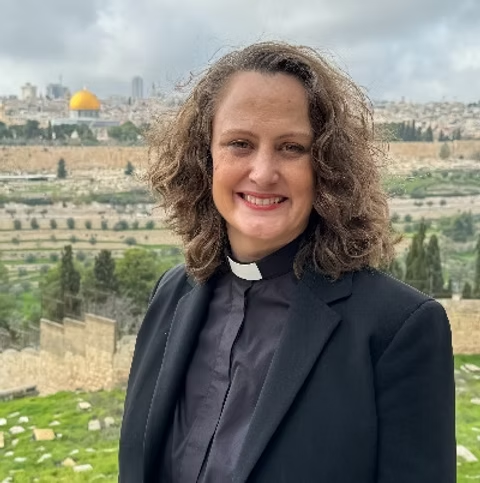 Rev. Dr. Mae Elise Cannon is Executive Director of Churches for Middle East Peace (CMEP) and is ordained with the Reformed Church in America (RCA). Cannon formerly served as the Senior Director of Advocacy and Outreach for World Vision U.S. on Capitol Hill in Washington, DC; as a consultant to the Middle East for child advocacy issues for Compassion International in Jerusalem; as the Executive Pastor of Hillside Covenant Church located in Walnut Creek, California; and as Director of Development and Transformation for Extension Ministries at Willow Creek Community Church in Barrington, Illinois.
Cannon holds an MDiv from North Park Theological Seminary, an MBA from North Park University’s School of Business and Nonprofit Management, and an MA in bioethics from Trinity International University. She received her first doctorate in American History with a minor in Middle Eastern studies at the University of California (Davis), focusing on the history of the American Protestant church in Israel and Palestine, and her second doctorate in Ministry in Spiritual Formation from Northern Theological Seminary. She is the author of several books, including the award-winning Social Justice Handbook: Small Steps for a Better World, and editor of A Land Full of God: Christian Perspectives on the Holy Land.


2 Responses
I agree with much of your principles as described and as biblical foundations for seeking peace in the Middle East. I also support a 2-state solution, or something like it, for Israelis and Palestinians to have independence and freedom to both exist and flourish without fear of extinction. But your own biases show a strong anti-Israeli “bent” – blaming them for years of “occupation and ethnic cleansing”… not mentioning that most of the countries around Israel and especially Hamas do not even recognize Israel’s right to exist and have pledged to kill Israelis and drive them out. I do not support Israel’s current policies and leadership – I agree that the killing & war must stop, including Hamas in Gaza – not just Israel… but so must the talk of “genocide” as though that is an Israeli practice and not what all the enemies are supporting. If Christians are going to be peacemakers in the Middle East, then they must embrace a more balanced analysis.
Thank you for sharing this sacred discernment. May you find greater coherence between your new community, ordination and vocational calling.I would be delighted to cross paths again in the Grand Rapids Holland Michigan corridor.