 (Editor’s note: We’re honored to welcome Rev. Dr. Mae Elise Cannon as a regular contributor to Christians for Social Action moving forward. Dr. Cannon is an author, scholar, and activist who has spent decades working at the intersection of faith, justice, and peacemaking in the Middle East. She serves as the Executive Director of Churches for Middle East Peace [CMEP].)
___
October 7, 2025, marked two years since the Hamas attacks on southern Israel that killed roughly 1,200 people and took more than 150 hostages into Gaza. That day changed history — but it was not where the story began.
Israelis and Palestinians have been in conflict for much of the 20th century. The late 19th-century influx of tens of thousands of Jewish immigrants to historic Palestine came as many fled antisemitism and rejection around the world. The Jewish Zionist movement sought to establish a homeland in what religious Jews believed to be historic Israel — a land tied to their ancient faith and identity.
The history of Israel and Palestine requires entire books and college courses. The nuances and details matter deeply for telling a multi-narrative story that honors both peoples’ historic connections to the land. I encourage readers to explore A Land Full of God: Christian Perspectives Toward the Holy Land, which offers a starting point for understanding the history, politics, and ideologies still shaping the region after more than 70 years of war, violence, and oppression.
It is beyond the scope of this article to recount the full mechanisms of Palestinian resistance — including horrors like suicide bombings — or the numerous injustices both Israelis and Palestinians have committed against civilians caught in the middle. Yet it is crucial to recognize that “conflict” is too small a word for what Palestinians have faced since the Israeli government’s military occupation of East Jerusalem, the West Bank, and Gaza began after the Six-Day War in 1967.
Two years after October 7, 2023, experts around the world now describe the displacement, destruction, and deaths of more than 68,000 people in Gaza — mostly civilians — as genocide. For Palestinians, these events represent a continuation of the Nakba, or “Great Catastrophe,” when nearly a million Palestinians were displaced during the establishment of Israel in 1948. The Nakba resulted in the destruction of more than 350 villages and the displacement of over three-quarters of Palestinians from their homeland — a reality that, for many, continues today.
Palestinians in East Jerusalem, the West Bank, and Gaza have lived under Israeli military occupation since 1967. This means hundreds of checkpoints — not only along the borders, but throughout the territories themselves. The separation barrier — called the “security fence” by Israelis and the “apartheid wall” by Palestinians — is twice as tall and three times as long as the Berlin Wall. Much of it cuts through private Palestinian land, dividing communities and severing access to olive groves and farmland. In 2004, the International Court of Justice ruled the barrier illegal under international law and called for reparations. Twenty years later, little has changed.
As of October 2025, there are more than 850 checkpoints across the West Bank — dozens within the Bethlehem governorate alone. For 2.8 million Palestinians, ordinary life means passing through militarized checkpoints simply to reach school, work, or the market. These are not routine “airport-style” security checks. They are daily sites of humiliation, restriction, and fear, often overseen by armed Israeli soldiers barely out of adolescence.
In the West Bank between October 7, 2023, and and October 9, 2025, 999 Palestinians were killed by Israeli forces or settlers, according to the United Nations; 41 Israelis were killed by Palestinians in the West Bank during the same period. Violent settler extremism has escalated, including attacks on Christian villages like Taybeh near Ramallah.
The cumulative effect of occupation — displacement, militarization, land confiscation, restrictions on movement — has made life unbearable for many. Palestinians with means often emigrate, seeking safety and opportunity elsewhere. Among them are Christians, whose numbers have dwindled to less than one percent in Jerusalem, the West Bank, and Gaza. If current trends continue, Christianity may all but disappear from the land of its birth.
The human rights violations experienced daily in the Occupied Palestinian Territories pale in comparison to the devastation in Gaza over the past two years — relentless bombing, starvation, military incursions, and mass displacement. Churches for Middle East Peace (CMEP) has described these actions as ethnic cleansing. Israeli-born scholar Omer Bartov, professor of Holocaust and Genocide Studies at Brown University, has gone further — concluding, after deep reflection and personal military experience, that genocide is taking place.
Bartov identified the Rafah offensive of May 2024 as a turning point. Despite President Biden’s warning that an invasion of Rafah would cross a “red line,” it proceeded. The city — then sheltering over a million displaced Palestinians — was razed, forcing survivors once again to flee. In an article I co-wrote with Rev. Dr. Ron Shive for Unbound: An Interactive Journal of Christian Social Justice, we called it “Biden’s Unclear Red Line on Rafah: Gazans Perish, U.S. Credibility Reaches a Nadir.”
Bartov argues that the Israeli army’s actions “intended to make Gaza completely uninhabitable for its population,” amounting to ethnic cleansing and, by extension, genocide. He cites the “General’s Plan” of October 2024, which deliberately starved remaining residents of North Gaza, declaring that anyone left behind would be considered an enemy combatant and targeted.
The Present Moment
As of mid-October 2025, the Trump 20-Point Plan has been agreed to by both the Netanyahu government and Hamas. All living hostages have been released, and a fragile ceasefire is in place. Yet violations continue — Hamas has not yet returned all bodies of deceased hostages, while Israeli airstrikes have killed 38 Palestinians since the ceasefire began.
Analysts describe the situation as “touch and go.” The next 30 days are critical as the United States directly oversees implementation. According to Axios, five priorities remain:
-
Stabilization to allow rebuilding to begin
-
Return of hostage remains still held by Hamas
-
Humanitarian access via agreed UN and Israeli mechanisms
-
Creation of an international stabilization force to govern Gaza in the interim
-
Demilitarization of Hamas and the establishment of a “New Rafah”
Bartov’s words remain urgent: “We must not deny what is happening, but allow that realization to compel us to stop it — and to bring to justice those responsible for the genocide unfolding before our eyes.”
May the atrocities end swiftly, and may all who have endured unimaginable trauma find healing, justice, and peace.
___
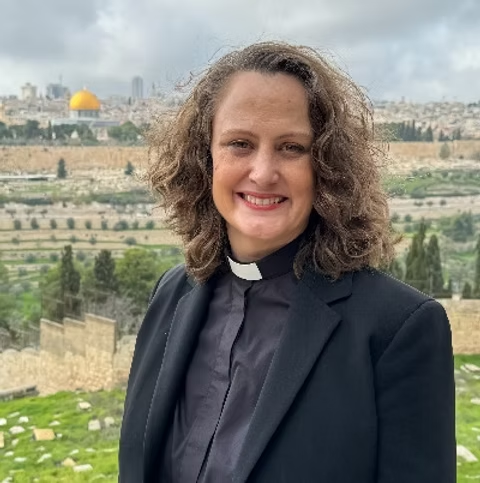 Rev. Dr. Mae Elise Cannon is Executive Director of Churches for Middle East Peace (CMEP) and is ordained with the Reformed Church in America (RCA). Cannon formerly served as the senior director of Advocacy and Outreach for World Vision U.S. on Capitol Hill in Washington, DC; as a consultant to the Middle East for child advocacy issues for Compassion International in Jerusalem; as the executive pastor of Hillside Covenant Church located in Walnut Creek, California; and as director of development and transformation for extension ministries at Willow Creek Community Church in Barrington, Illinois.
Cannon holds an MDiv from North Park Theological Seminary, an MBA from North Park University’s School of Business and Nonprofit Management, and an MA in bioethics from Trinity International University. She received her first doctorate in American History with a minor in Middle Eastern studies at the University of California (Davis) focusing on the history of the American Protestant church in Israel and Palestine and her second doctorate in Ministry in Spiritual Formation from Northern Theological Seminary. She is the author of several books, including the award-winning Social Justice Handbook: Small Steps for a Better World, and editor of A Land Full of God: Christian Perspectives on the Holy Land. Cannon was recently ordained with the Reformed Church in America (RCA).