 As Senior Director of Global Mission and Church Movements at World Relief, I work to equip churches and Christian organizations to embody the biblical mandate to welcome vulnerable immigrants and refugees. For years, I’ve seen congregations across the U.S. transform into places of profound hospitality, reflecting God’s heart for the sojourner as described in Deuteronomy 10:18–19.
Yesterday, December 16, 2025, I traveled by train from my home in Aurora — a Chicago suburb about 45 minutes west of the city — to Little Village (a neighborhood of Chicago) for what was intended to be an encouraging planning and prayer meeting.
Partners from World Relief, Christian Community Development Association (CCDA), New Life Centers, and local pastors had gathered to discern next steps: How might more churches mobilize to support immigrant families navigating this intensely challenging season?
The atmosphere shifted dramatically as we began.
Phones buzzed relentlessly with alerts from New Life staff: Customs and Border Protection (CBP) Commander Gregory Bovino had returned to Chicago after a brief absence, and agents were already active just blocks away. His return marked a resumption of highly visible operations that had paused amid legal scrutiny and seasonal shifts.
Whistles soon pierced the cold air — the community’s established warning system signaling federal presence. CBP vehicles converged on South 27th Street and Ridgeway Avenue, directly adjacent to an elementary school and New Life Centers’ facility. There, 800 grocery bags prepared for distribution to mostly immigrant families remained largely untouched as attention turned to crisis response.
A small group from our meeting hurried to the scene. I was one of them, phone in hand, documenting what was unfolding — seeking to bear witness calmly, without interfering or escalating.
Bearing Witness at the Street Level
What we encountered was heartbreaking and disorienting. We arrived moments after agents detained a young Latino father, later described as married with young children, including a daughter in the classroom across the street. Witnesses reported he was sitting in his car eating tamales when approached.
Chicago police provided crowd control, but no organized protest was underway — this was an organic, real-time response from neighbors to an unannounced enforcement action.
Commander Bovino was visibly present, with a rifle slung across his chest and surrounded by agents, some recording the operation. For many in the community, the scene was experienced as deeply intimidating rather than routine enforcement.
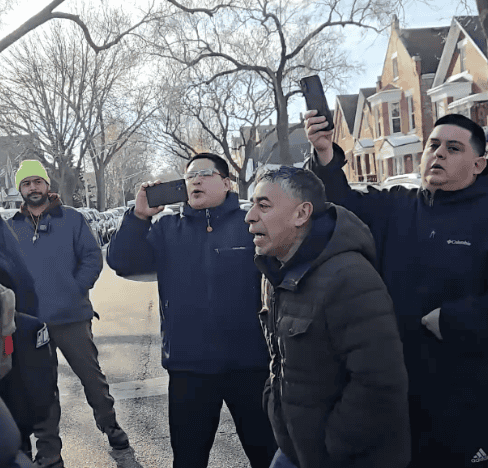
As he passed close by, Paco (a New Life pastor and one of my friends) engaged him with remarkable grace and firmness, urging repentance and declaring, “God loves you and will forgive you.” Bovino replied, “Jesus loves you” — a phrase that, in that moment and setting, landed painfully for those gathered amid fear and confusion.
In the surge of adrenaline and grief, I found myself speaking directly to agents. I pleaded with them to consider the long-term weight of their actions and to reckon with how these moments would shape their own lives and consciences.
This single detention was part of a broader sweep. Reports later confirmed multiple arrests across Little Village, nearby Cicero, and beyond, with agents deploying pepper balls as residents reacted in distress.
Community organizers estimated at least 17 detentions that day, including day laborers and street vendors. Investigative reporting from earlier phases of these operations reveals a stark pattern: of hundreds arrested in the Chicago area, only a small fraction — around 16 in one documented list of over 600 — had histories posing serious public safety risks. The vast majority were nonviolent individuals, many long-term residents contributing to their communities.
In Little Village, a vibrant neighborhood rich with Mexican heritage and home to tens of thousands, these actions intensified fear — especially just days before Christmas.
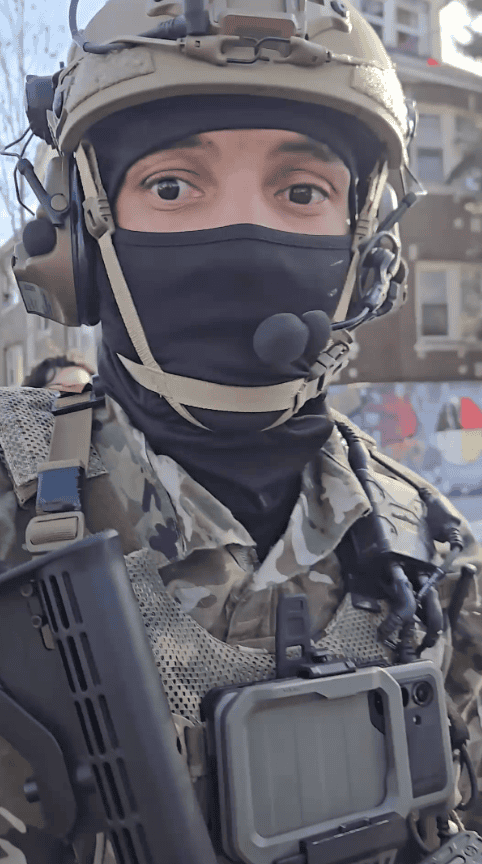
As a follower of Jesus, I could not help but notice the agents’ humanity as well — their eyes visible behind masks, revealing young men and women, someone’s sons and daughters, embedded in a system larger than themselves.
I urged them to remember that they still had moral agency and that choosing differently was possible.
One brief exchange with Pastor Paco ended with a quiet “God bless you,” a moment that suggested the presence of inner tension rather than certainty. These encounters recalled biblical figures like the centurion at the cross or the Philippian jailer in Acts — people enmeshed in oppressive systems yet not beyond God’s redemptive reach.
The Church That Stays After the Sirens Fade
What humbled me most, however, was the church’s embodied response. As media departed and agents moved on, New Life pastors remained long after. They consoled the distraught wife when she arrived, coordinated towing for the abandoned car, connected with the school regarding the children’s needs, and offered ongoing support.
This is not new.
It is the long-practiced “muscle” of the Latino-American church — responding to immigration enforcement not with spectacle or coercion, but with presence. Knowing names. Providing resources. Walking alongside families through trauma.
It is incarnational faith at work, and I pray it multiplies across the American church, echoing Jesus’ words in Matthew 25:35–40.
In my daily work with World Relief, we partner with churches because Scripture portrays God’s mission as encompassing all nations (Rev. 7:9). Yesterday reinforced how urgent that calling is. This is not abstract policy debate. Families are separated and fear saturates daily life. Too often, enforcement unfolds in ways experienced as performative and dehumanizing, with cameras rolling and communities left reeling in the aftermath.
That tension deepened when I recalled a video Commander Bovino had posted the day prior, quoting Isaiah 6:8 — “Here am I. Send me” — overlaid with dramatic imagery and martial themes.
Seeing prophetic language associated with armed enforcement raises profound theological questions for me. When Scripture is invoked to frame coercive power, faith risks being conscripted into nationalism rather than witness.
The Christian story does not culminate in dominance, but in costly presence — pastors lingering long after the cameras leave, bearing hope amid rubble.
My plea to fellow believers is simple:
First, believe this is happening to sisters and brothers in Christ, to image-bearers seeking safety and a future.
And then, move beyond belief to action. Mobilize your congregation for radical hospitality. Host know-your-rights trainings. Provide legal accompaniment. Distribute aid. Advocate for humane reforms, including pathways like the DREAM Act and expanded refugee resettlement. Vote with justice in mind. And always, pray fervently — for families’ protection, for communities’ healing, and for the consciences of those wielding power.
In this Advent season, as we await Emmanuel — God with us — may we recognize Christ especially among the marginalized. May the resilience of Little Village, forged in trial, disciple the broader American Church toward deeper faithfulness.
For in welcoming the stranger, we welcome Christ himself.
 Daniel Yang serves as the Senior Director of Global Mission and Church Movements at World Relief and is a CSA Pundit. Prior to that, he was the Director of the Church Multiplication Institute at the Wheaton College Billy Graham Center. Daniel has been a pastor, church planter, engineer and technology consultant. He has planted churches in Detroit, Dallas, Toronto, and Chicago, either as the lead planter or through recruiting, training, assessing, and mentoring church planters. Daniel is a sought-after conference speaker, missional strategist, consultant, and co-author of Inalienable: How Marginalized Kingdom Voices Can Help Save the American Church (InterVarsity, 2022) and Becoming a Future-Ready Church: 8 Shifts to Encourage and Empower the Next Generation of Leaders (Zondervan, 2024).