 (Editor’s note: This is Part 2 of a four-part series exploring Christian faith, theology, and peacemaking in the Holy Land. In this installment, Rev. Dr. Mae Elise Cannon turns from history and biblical interpretation to lived experience, examining how physical barriers, borders, and political structures shape the daily realities of Palestinians and Israelis alike. Through personal encounters and historical context, this reflection invites readers to consider how separation, fear, and restricted movement have transformed relationships, perceptions, and possibilities for peace. You can find Part 1 here.)
In Spring 2024, I spent time at the Gaza border in an Israeli kibbutz community that had been attacked on October 7, 2023. Amidst the horrors and atrocities of that day, and the months that followed, one of the women said to me, “I grew up swimming off the beaches of Gaza.” She lived only a few short miles away from the Mediterranean, which could be seen on a clear day. “Those were different times,” she said.
For those of us paying attention to Gaza over the past 27-plus months since 2023, it is hard to understand what life was like in Israel, East Jerusalem, the West Bank, and Gaza in the decades prior to the Second Intifada that occurred during the early 2000s.
I’ve heard stories from Palestinians all the way north in the city of Jenin about how “Israelis used to always shop in our markets in the occupied territories.” When I asked why, they explained that products were, as they continue to be, significantly cheaper. The West Bank and Gaza boast beautiful natural areas for hiking or swimming, in addition to including many of the historic Jewish sacred places and sites. Only 25 years ago, it was not uncommon for Jewish Israelis to spend time not only in various parts of East Jerusalem, but in the West Bank, and yes, even in Gaza.
Why did this end? Where did the divisions come from?
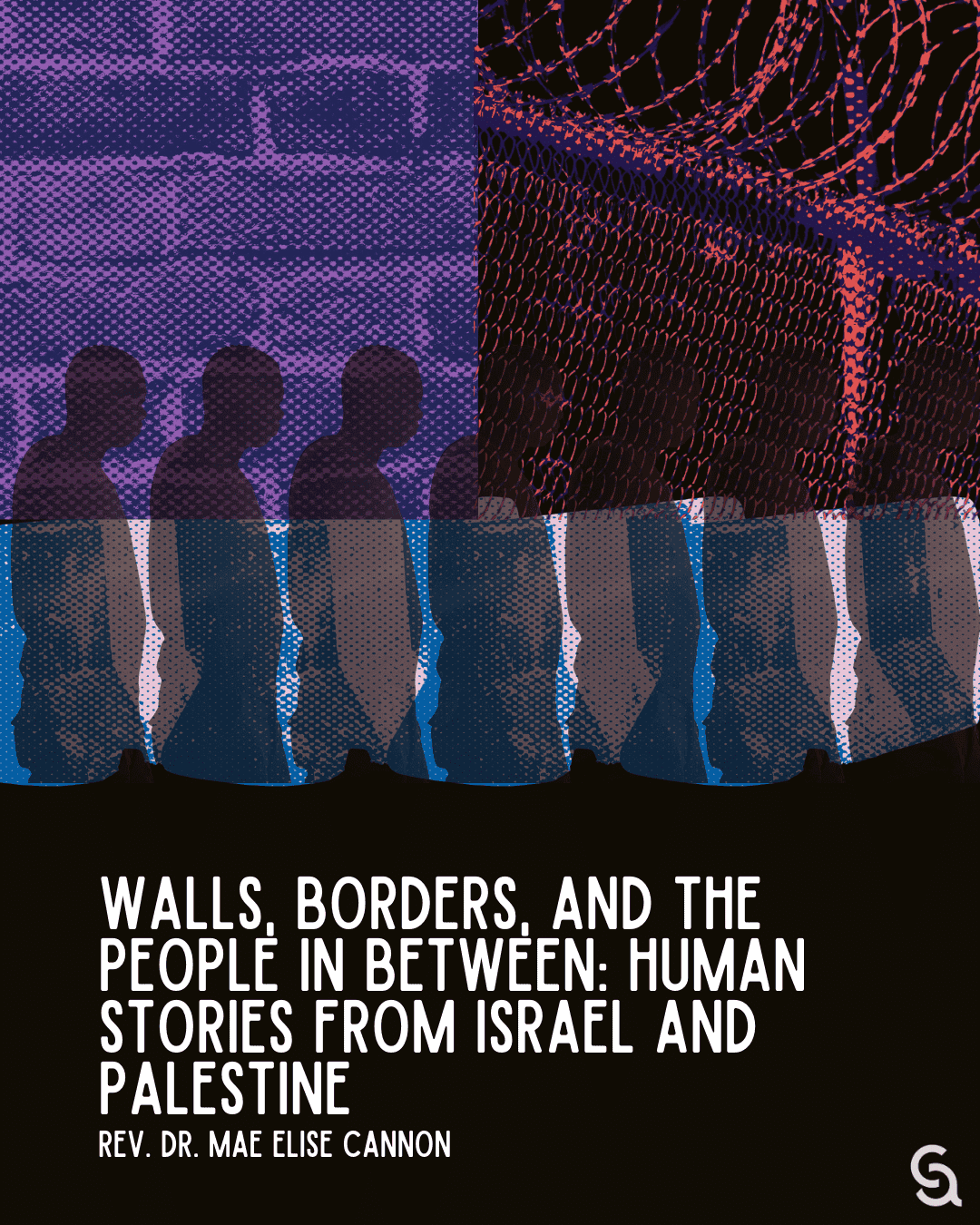
While fear and even hatred play a role, the separation between Israelis and Palestinians today is also due to literal, physical, man-made walls. Since the early 2000s, Israel has built more than 900 barriers internal to the West Bank. These walls divide Palestinian communities from Palestinian communities, and Palestinians from Israelis.
The main separation barrier is called the “apartheid wall” by Palestinians. Israelis call it the “security fence.” The separation wall runs twice as tall in cities and is three times as long as the Berlin Wall. International visitors and Palestinians who wish to cross the wall have to go through security checkpoints. Giant red signs are posted at these checkpoints warning Jewish Israelis not to enter, telling them the area is “dangerous to your lives.” In July 2004, the International Court of Justice (ICJ) deemed the separation barrier illegal.
These barriers emerged out of the Oslo Peace Agreement of the early 1990s.
While they were intended to be a temporary agreement facilitating the creation of a Palestinian state, the Oslo Accords created many of the separations and divisions that we see physically, creating barriers between Israelis and Palestinians today. One of the fundamental assumptions of the agreement was that Palestinians and Israelis needed to be “further separated” (i.e., segregated) in order for the Palestinian Authority to be able to build up the capacity for self-governance.
The entire area of the West Bank continued to be under Israeli authority and decision-making in its entirety since 1967; thus, the internationally understood political term of “occupation” applies. Under the Oslo Agreement, in 1995, the West Bank was divided into three territories of control: Areas A, B, and C.
The main Palestinian cities, including Bethlehem, Ramallah, and Hebron, were under Palestinian civil and security control in Area A. While this is what things look like on paper, it is not uncommon for the Israeli military to conduct raids and military missions in Area A. Area B constitutes the areas surrounding settlements and outside of the cities and is, again, at least on paper, under Palestinian civil and Israeli security control.
And Area C, constituting more than 60 percent of the West Bank, is entirely under Israeli civil and security control. More than three-quarters of a million settlers living in the occupied West Bank live in Area C. While formal annexation of the West Bank has been discussed and received preliminary votes in the Knesset, Israel’s parliament, today, few dispute that the West Bank is already de facto annexed by Israel.
The history of Gaza and its de facto “borders” can be a bit more complicated. But Gaza’s most recent history includes an almost complete blockade by Israel via land, sea, and air that began after Hamas succeeded in the January 2006 elections for the Palestinian Legislative Council (PLC).
Hamas received 44.45 percent of the vote, winning 74 of the 132 PLC seats, and Hamas’s candidate, Ismail Haniyeh, became Prime Minister. Hamas refused to recognize the State of Israel and the Oslo Accords Agreement, and the United States considers it a terrorist organization because of its history of suicide bombings and other violence against Israeli civilians. In response to the success of Hamas, the United States, United Nations, European Union, and Russia (the Quartet) imposed an economic embargo on Gaza, and Israel withheld millions of dollars of tax revenue from the Palestinian Authority.
Later that year, armed militants from Gaza entered Israel via a tunnel and attacked Israeli troops, killing two Israeli soldiers and taking a 19-year-old wounded Israeli soldier named Gilad Shalit into Gaza at gunpoint.
At that point, Israel instituted a complete blockade of Gaza: the military cut off access to Gaza via sea, land, and air. Gilad Shalit was held in Gaza for more than five years. Shalit was released in 2011 in a prisoner exchange where more than 1,000 Palestinian prisoners were released in return. The checkpoints at Gaza’s borders with Egypt and Israel are tightly controlled by the Israeli military, which permits very few people to enter or exit the territory, and only then with Israeli permission.
The blockade of Gaza, now two decades long, has meant untold hardships for the more than 2 million people living in the Gaza Strip, even prior to the Hamas attacks on the South of Israel on October 7, 2023, that killed roughly 1,200 people, and an additional 245 were taken captive into the Gaza Strip.
In 2012, the UK independent news outlet The Guardian published an article about how the Israeli government had been accused by critics of “intentionally limiting” the calorie count allowed into Gaza during the blockade. Reports released from the Israeli defense ministry under a court order showed that the Israeli military had made “precise calculations of Gaza’s daily calorie needs to avoid malnutrition” as a part of their implementation of the blockade between 2007 and 2010.
And these accusations came years before the charges of using intentional starvation as a weapon of war were levied against Israel during the 2023 to 2025 atrocities in the Gaza Strip. The death toll of the Israel/Hamas War as of December 2025 was 71,269 individuals killed and 171,232 people injured. By September 2025, the majority of the world’s experts declared the atrocities in Gaza as genocide.
These physical barriers between people have created some of the largest divisions between Israelis and Palestinians in modern history. The days of Israelis swimming on the seashore near Gaza seem unfathomable given the degree of violence, hatred, death, and destruction carried out between Israel and Hamas over the past two years.
The majority of news, stories, and the exposure of suffering of the “other side” has also never been more limited, with Israeli news outlets being described by an Israeli human rights activist as “propaganda not unlike that of Russia under communism,” and Palestinian and Arab news sources are no less biased. Indeed, as the ancient Greek playwright Aeschylus said,
“Truth is the first casualty of war.”
While walls and checkpoints prevent Israelis and Palestinians from meeting or mingling, powerful voices, including both the Israeli government and Hamas leaders, urge each community to see the other as a dangerous enemy.
The few years immediately after the Oslo Accords in the 1990s felt like a time of great hope, where programs and people-to-people initiatives between Israelis and Palestinians flourished.
More than a quarter of a century later, the climate for peace and reconciliation, let alone the application of human rights and justice, seems to have never been further away on the horizon. Yet, we must remember times in the past where Jews, Christians, and Muslims have lived side by side in peace.
Only when the common humanity of all people is recognized and protected, when there is equality, human rights, and self-determination for all of the people of the land, will there be peace.
____
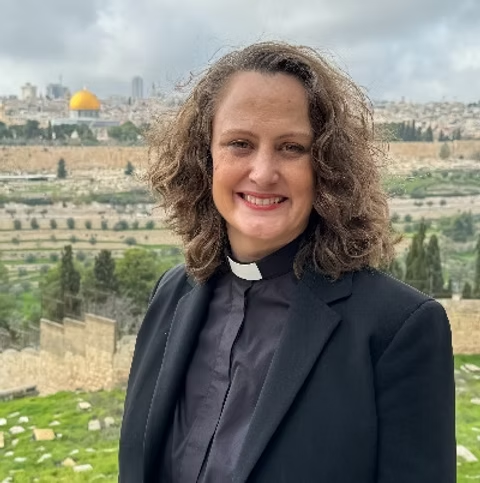 Rev. Dr. Mae Elise Cannon is Executive Director of Churches for Middle East Peace (CMEP) and is ordained with the Reformed Church in America (RCA). Cannon formerly served as the Senior Director of Advocacy and Outreach for World Vision U.S. on Capitol Hill in Washington, DC; as a consultant to the Middle East for child advocacy issues for Compassion International in Jerusalem; as the Executive Pastor of Hillside Covenant Church located in Walnut Creek, California; and as Director of Development and Transformation for Extension Ministries at Willow Creek Community Church in Barrington, Illinois.
Cannon holds an MDiv from North Park Theological Seminary, an MBA from North Park University’s School of Business and Nonprofit Management, and an MA in bioethics from Trinity International University. She received her first doctorate in American History with a minor in Middle Eastern studies at the University of California (Davis), focusing on the history of the American Protestant church in Israel and Palestine, and her second doctorate in Ministry in Spiritual Formation from Northern Theological Seminary. She is the author of several books, including the award-winning Social Justice Handbook: Small Steps for a Better World, and editor of A Land Full of God: Christian Perspectives on the Holy Land.