
 Embracing the Both-And
During my time at divinity school, I interned as a hospital chaplain. I worked at a Level I trauma center, meaning many of the patients who came into our emergency room had severe and often life-threatening injuries. Due to the intensity of the work, I was heavily supervised and required to meet weekly with the Director of Spiritual Care. One day, after a particularly hard week of back-to-back patient deaths, I was really struggling to keep it together. I asked to meet with my supervisor, Kendall.
“Something I’ve noticed over the past several months is that you tend to be really harsh on yourself,” he began. “You constantly dwell on your mistakes and judge yourself so severely. I’m curious: How do you think God sees you?”
I paused before answering.
“There’s a part of me that feels like maybe God is disappointed when I get overwhelmed and struggle so much. As a follower of Jesus, I’m supposed to be stronger than this, aren’t I?”
Philippians 4:13 — “I can do all things through Christ who strengthens me” — ran through my mind as I spoke.
Kendall responded with something I’ve never forgotten: “Nia, please be careful not to strip yourself of your humanity.”
As a hospital chaplain, I was trying to do all the things and hold in all the feelings, but I was failing miserably; as it turns out, I’m only human. At the conclusion of our conversation, Kendall encouraged me to take some time to reflect on my faith tradition and meditate on Jesus’ relationship with his humanity.
I went home and immediately journaled. For hours. I soon began to realize how easy it is to strip not only ourselves, but even Jesus, of his humanity. I attributed much of how Jesus made it through such intense suffering to his being the Son of God, as if that negated his humanity. Yet throughout Scripture, Jesus is referred to as both the Son of God and Son of Man, highlighting the coexistence, not contradiction, of his humanity and divinity.
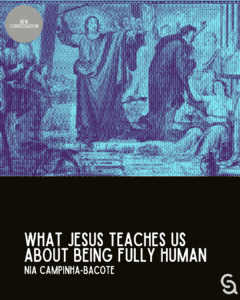
Jesus was a man who didn’t deny his humanity, but embraced it. All of it. While enraged at injustice and flipping over tables (Matt. 21:12-13), Jesus still prioritized finding time to slow down, eat, and rest in community, allowing food and friends to nourish his soul (Luke 15:1–2, Mark 2:15, Matt. 26:26, John 2:1–10).
He nurtured his spirit by making time for solitude in nature, sometimes waking up early and spending time out on the water (Mark 1:12, 1:35; 6:46). Jesus was also intentional in embracing the messy and not-so-easy parts of being a human, as he wasn’t afraid to cry or make room for his sadness (John 11:35).
Even on the cross, Jesus embodies what it means to risk opening ourselves up to experiencing the fullness of our humanity, using his last breath to express deep anguish alongside wholehearted trust in and surrender to the plan of the Divine — the both-and.[1]
Reflecting on my time as a hospital chaplain, the majority of my work was the work of accompaniment: sitting alongside patients and their families as they experienced the fullness of what it means to be human. In the midst of tragedy, perfect words don’t exist. In the midst of celebration and joyous surprise — like the birth of a child or receiving news of the miraculous disappearance of a former diagnosis — words can feel insufficient. All we have in these moments is our presence, and the most healing thing we can do is offer people the space and grace to embody the fullness of their humanity as they feel deeply.
Crying, wailing, and shaking in their joy.
Crying, wailing, and shaking in their grief.
Free of shame.
A reminder that our humanity is not a curse, no matter how painful it might feel at times.
An Embodied Pause
Before continuing, I invite you to pause and take a moment to be present with your humanity. Give your eyes a break from the screen, closing them or gently gazing downward. Adjust your body, if needed, to feel more supported or comfortable. And just breathe. Take three breaths. No need to rush.
…
…
…
Bodily Wisdom
I’ve spent over a decade committing myself to studying and engaging in the work of soul[2] care, only to be reminded of what several Indigenous, Black/African, Latiné, Asian, and Pacific Islander communities have always known to be true: the human body is a sacred source of wisdom worthy of our attention. When Divine Creator breathed life into human beings, They birthed an inextricable connection between mind, body, and spirit/soul. Nourishing that connection is what allows us to say, “It is well with my soul.”[3]
Our soul is what connects us with Creator and all of creation, and physical sensations can clue us into its condition. For example, have you ever been around a person and found yourself thinking, “Wow, that person has such a beautiful spirit”?
Or perhaps, after attending an event or spending time in a new place or community, you leave saying something like, “Wow, my soul feels so at peace.” What physical sensations accompanied those experiences? Did you feel at ease in your body? Perhaps an openness or lightness in your chest? Or maybe you noticed the absence of tension or constriction your body normally experiences when meeting someone new.
What about when your soul or spirit feels troubled? How do you know something is off? Throbbing headaches? Nausea? A sinking feeling in your belly?
I invite you to take another moment to pause. This time, as you breathe, reflect on how your body has been feeling over the last month.
…
…
…
How is your body feeling today? How is your spirit?
Making Space for Our Humanity
Being in touch with the fullness of our humanity in 2026 can feel like a lot.
As I write this, my loved ones in Colombia are doing all they can to make it in the aftermath of a devastating 7.4 earthquake. Just two months earlier, on June 24, 2026, Venezuelans experienced two back-to-back earthquakes of 7.2 and 7.5 magnitude, finding themselves alongside Colombians in the slow and painful process of rebuilding and healing.
As of August 28, nearly 2,000 people have been reported missing in the Nepal-China border flash flood due to the collapse of a Himalayan glacier. In the United States, midterm elections approach as global wars continue and gas and grocery prices rise — not to mention the various realities we experience individually: housing and employment instability, difficult relationships, and the loss of loved ones (pets included).
Sorrows roll in alongside anger and overwhelm, rising like thirteen-foot sea billows, and we’re all doing our best to make it through.
It is important to name that sometimes we don’t have the capacity to feel the fullness of our humanity. Sometimes our nervous systems are too dysregulated, and it isn’t safe for our bodies to fully feel and acknowledge the weight of all that we’re experiencing. That’s okay. Times of dissociation or feeling numb can be our body’s attempt at protecting us, placing us in survival mode.
Forcing ourselves to push past these coping mechanisms or going deep into our bodies or emotions without proper support and resources can sometimes overwhelm us in ways that do more damage than help. The most important thing we can do is remain curious and compassionate about what our bodies are communicating to us.
Instead of judging or forcing yourself to “be okay,” be kind and gentle with your whole self—mind, body, and spirit. Listen to your body. Even in the midst of the heaviness, where might there be sensations of ease or something that brought joy to your soul? Just as Jesus’ divinity coexisted alongside his humanity, so can our grief coexist alongside our joy. Call a friend. Find a therapist. Drink some tea. Stay hydrated. Make a gratitude list (I used to resist this one so much, but it really works, y’all!).
As we end, I invite you to imagine what it might look like to create individual and communal infrastructures and systems that nourish our humanity. Get creative. I mean it. Use your imagination. As I tried using my imagination, I found myself thinking about those pro wrestlers who have that tap-in and tap-out system, allowing for rest.
What would it look like to replicate something like that? Maybe once a month, someone offers to babysit for friends with kids (or pays for a babysitter), allowing parents to nap. Or maybe start with something simpler, like taking six breaths to start your day and six breaths before going to bed, checking in with your mind, body, and soul.
So here’s to sighing more and crying more. Here’s to laughing and eating more nourishing meals with others. And here’s to seeing what might happen to our world and our souls when we create more space to honor the fullness of our humanity.
Endnotes
[1] Matthew 27:46; Luke 23:46 (“My God, my God, why have you forsaken me?”; “Into your hands I commend my spirit.”). There are different accounts of Jesus’ final words. But who is to say these weren’t uttered under the same breath?
[2] For the purposes of this article, I use the words soul and spirit interchangeably.
[3] A reference to Horatio Spafford’s hymn, “It Is Well with My Soul.”
 Nia Campinha-Bacote, MDiv, RYT-200, is a budding theologian, lover of dark chocolate, and seeker of joy. She received her Masters degree from Yale Divinity School and certification from Yale’s Institute of Sacred Music for her work in music thanatology, through which she co-produced Gilead, a Sonic Healing Album blending Afro-diasporic melodies with the sounds of nature, offering a healing presence to listeners. Nia dedicates her life to the work of emotional reparations on a global scale, collaborating with Afro-diasporic grassroots collectives, faith communities, and healing practitioners across Brazil, Colombia, Cape Verde, and the United States. Whether through writing, salsa dancing, or facilitating grief rituals, Nia’s passion remains rooted in her desire to curate spaces where grief, joy, and liberation can coexist. She is a CSA Pundit.
One Response
I am thankful for this rich reminder of our humanity. I am thankful for the tears while reading this beautifully written piece. Thank you Nia .