
 (Editor’s note: At the time of this writing, rhetoric around a potential U.S. escalation with Iran has intensified, with language that frames overwhelming military force as decisive and necessary. In moments like this — when calls for power grow louder and the stakes feel existential — Christians are again faced with an old and urgent question: What does faithfulness to Jesus require of us?)
Imagine Christians in one country believing it was their biblical duty to fight in a war against Christians of another country. And imagine that those on both sides of the war believed God wanted them to kill Christians on the other side of the conflict and backed this up with Scripture? That’s the story of World War I. Theologians in the U.S. and Great Britain were convinced it was biblically justified to kill Christians from Germany and Austria-Hungry in order to “make the world safe from tyranny.”
They were God’s liberators, freeing people from Austro-Hungarian oppression.
Meanwhile, on the other side of the Atlantic, Christian theologians in Germany and in the Austro-Hungarian Empire believed they had the moral high ground. After all, it was their archduke who was brutally assassinated in an act of violence by Serbians trying to gain independence. This was a “just war,” because the other side was the aggressor. The “other guy” had thrown the first punch. They were simply defending the Empire from violent agitators. The rulers of Empire were the “governing authorities” whom God commanded Christians to obey.
The Memes of World War I
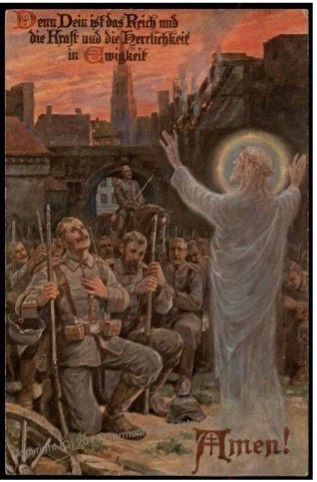 In World War I, propaganda took the form of postcards, or single-frame graphics illustrating the moral righteousness of their cause. These postcards were the memes of the early 20th century. In a German postcard, blonde Jesus blesses German troops who kneel in reverence before him with the ravishes of war all around. Above the image are the words,
“For yours is the kingdom and the power and the glory forever.”
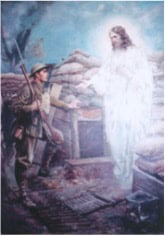 Meanwhile, in a British painting entitled, “Abide with me,” Jesus stands in the trenches of the Allied forces, blessing an Allied soldier.
Both illustrations were designed to embolden Christian soldiers to kill other Christian soldiers for the glory of Christ, being assured that the Prince of Peace was on their side, baptizing their acts of violence on behalf of their countries.
Some have estimated that World War I generated 40 million casualties when taking into account the casualties of war as well as casualties due to starvation and disease shortly afterwards. With a global population of only 1.7 billion people, this was not an insignificant loss. The brutalities of that war, which birthed the horrors of chemical warfare, had a profound impact on the church.
Massive numbers of Christians stepped away from the faith, and Christianity began its steep decline in Europe. Christians committing acts of violence against other Christians stirred doubts about the faith. The war also sowed seeds of doubt about the righteousness of national causes. This is the result when Christians serve two masters. In the end, both the Lord of God’s kingdom and the lord of the empires of men lost.
The Pawns of War
Christians have been the pawns of war for centuries.
Kings, emperors, presidents, and prime ministers have co-opted Christianity to rally Christian populations to kill for the sake of the state. To do so has meant re-interpreting Jesus’ call to love enemies and turn the other cheek. Jesus rebuked Peter when he drew his weapon for the ultimate “just” cause: that of defending the Son of God from an angry mob.
“’Put your sword back in its place,’ Jesus commanded, ‘For all who draw the sword will die by the sword.’” (Matt. 26:52)
The ancient church father Tertullian (160-220) said,
“In disarming Peter, Christ disarms all Christians.”
In the Epistle to the Romans, Paul charged 1st-century Christians, “Do not repay evil for evil” (Rom. 12:17), and Peter used the very same phrase in 1 Peter 3:9. Many Christians in those early centuries took these things seriously and suffered dire consequences for refusing to fight in the empire’s wars.
But what if Jesus’ command to love enemies was only ever meant to be applied narrowly — confined to our personal lives and relationships? What if we are called to love our personal enemies, but not the enemies of the State?
Some have interpreted Jesus’ words — “Give to Caesar what is Caesar’s” — to mean that our ultimate allegiance in matters of war belongs to the state, even when it requires our lives or asks us to set aside moral objections.
The problem is that Jesus refused violence not only in private life, but also in defense of himself and his mission in the face of political power. Standing before the Roman governor, he declared,
“My kingdom is not of this world. If it were, my servants would fight to prevent my arrest.” (John 18:36)
And, of course, he had already stopped his followers from doing exactly that, forbidding violence on behalf of any kingdom — even his own.
While Christians have long debated the role of violence in relation to the state, there is little debate that political leaders have repeatedly drawn on Christian language and loyalty to rally support for war. In our own moment, as tensions with Iran escalate and the language of overwhelming force grows louder, we are hearing echoes of this same pattern — where national interests are framed in moral or even spiritual terms, and where the lines between the kingdom of God and the ambitions of nations begin to blur.
Whether we consider Iran the “neighbor” we are commanded to love (Mark 12:31) or the “enemy” we are commanded to love (Matt. 5:44), the path of following Jesus remains the same — we are called to love the people of Iran. But what if some believe that loving the people of Iran means bombing the current regime out of existence? Could killing the oppressor ever be considered an act of love toward the oppressed?
Jesus and the Roman Oppressor
The Jewish people — and early Christians — suffered tremendously under the Roman Empire. If God were ever to endorse the righteous destruction of a political state, surely Rome would have been at the top of the list. Nero was as cruel to Christians as any dictator we might name today.
And yet, we find no grounds in the Gospels or Epistles for responding to such oppression with violence. Instead, we see early Christians facing execution at the hands of empire rather than taking up arms in its name. If Jesus did not endorse the use of force to overthrow Rome, it is difficult to justify doing so against any political oppressor today.
While some early Christians did serve in the Roman army, it was more often the case that believers refused military service in the centuries before the Edict of Milan. Even after empires began to identify themselves as “Christian,” a significant tradition persisted within the church — the conviction that the use of violence stands in direct opposition to the tenets of the Christian faith.
Empires will always center their own interests in their calls to war. But those interests often run counter to the way of Jesus, who consistently centers those on the margins and calls his followers to love “the other” as the guiding principle of their lives.
What about Iranian Oppression?
The claim that war is an altruistic effort to liberate an oppressed people deserves careful scrutiny. Yes, people are protesting their government — but so are Americans. We would not view Russia as a liberator if it began bombing the United States and inflicting widespread civilian casualties.
So how, then, should we respond to governments that oppress their people? Is the violence of war truly the answer to freeing the world from injustice?
Look beneath the surface of most conflicts, and you will often find the self-serving interests of empires driving the engine of war. Killing others in the name of our nation’s mixed motives does not nullify the clear call of the Christian faith: “Do not repay evil for evil.” Nor does it release us from the deeper invitation to move beyond the deeply human instinct of “an eye for an eye.”
In fact, many theologians understand that phrase not as permission for retaliation, but as a restraint — an attempt to limit retribution that would otherwise spiral far beyond the original offense.
Other Forces Besides Violence
Gandhi led a movement that succeeded in overturning British rule without violence. The military dictatorship in the Philippines fell through largely peaceful means, and so did Soviet control in parts of Eastern Europe. History reminds us that one nation exerting violence on another does not necessarily result in freedom from oppression; sometimes it simply replaces one form of oppression with another.
Other forces have proven capable of bringing about liberation. At times, that may take the form of economic pressure from the international community, but often it is the steady, courageous work of nonviolent resistance from within a nation itself.
If the example of Jesus teaches us anything, it is the power of giving one’s life rather than taking the life of another. I recognize that some have suffered — and even died — with the conviction that deadly force was necessary to protect the innocent. Military forces have, at times, also helped rebuild what war has destroyed. Others have served as conscientious objectors, placing their own bodies in harm’s way in order to serve without using violence.
But to take the life of someone made in the image of God — whether a neighbor or an enemy of the state — is to choose to serve another master.
The interests of nations are rarely the interests of God, and the ways those interests are pursued are almost never the ways of God.
“For my thoughts are not your thoughts, neither are your ways my ways,” declares the Lord. “As the heavens are higher than the earth, so are my ways higher than your ways.” (Isa. 55:8–9)
Those who seek to follow Jesus are called to teach the nations to obey what he taught: to love enemies, to refuse vengeance, and to embody a different kind of power. It is time for the church to reclaim its role as the conscience of government, rather than its servant — refusing to echo the demands of the State when they stand in direct contradiction to the teachings of Christ.
_____
 Scott Bessenecker is Director of Global Engagement and Justice for InterVarsity. Look for his forthcoming book, Bad Religion, Good News: An Honest Guide for the Spiritually Disappointed, from Herald Press.


5 Responses
Thank you for your thoughtful reflection on this, Scott. As a life-long pacifist and a student of World War 1, I especially resonated with your perspective. I just finished reading Scott’s newest book (and reviewed it for Anabaptist World), and highly recommend it for those who are finding themselves disappointed (despairing, even) with our current government’s co-opting of Christianity to further an agenda that seems so far from Christ.
Thanks, Melanie. Good to connect with a kindred spirit.
Thank you Scott for elucidating what already should be clear to all of us Christians but get swayed into nationalistic and worldly fears.
Thanks for the affirmation, Jocely.
well put Scott. Same sort of situation was present during WW2. Many fighting in the German Wehrmacht believed God was on their side and vice versa (to some extent). As always happens those who are asked to give their lives for the cause are ones who end up loosing it while those who could have avoided the conflict in the first place stay comfy cosy in the safety of their home/bunker.
It is such a challenging decision for a follower of Jesus. If I had been alive as a young man and follower of Jesus, in Poland let’s say, on Sept 1, 1939 (and in time subsequent) I would be hard pressed to deny taking up arms to defend against fascism as my country was steamrolled by a purely evil invader. And of course there’s always the oft used argument as to what one would do if someone entered your home and was going to rape, assault or perhaps kill your wife and children?
I think there would need to be some sort of contexualization for me to determine my actions. The debate will never end, I’m sure. I think the Church started along this path when it lost its edge when Constantine gave her favored status. The path to using the Church for nationalistic purposes was lurking just around the corner. and she went down it quickly. DeCort goes a bit further I think when he suggests religious nationalism was present even when Moses was leading the Jewish nation!