
 Every 4th of July, my family follows the same ritual. As evening settles in, we carry blankets into the backyard and wait for the sky to turn dark. From our home, we have a clear view of downtown Pomona’s (CA) annual fireworks display just beyond the wall that borders our yard. My wife, daughter, and I bundle up together while our French bulldog sprints back and forth across the grass, barking furiously at every explosion in the sky as if he alone has been tasked with defending our country.
As bursts of red, white, and blue illuminate the night, it’s easy to see how this is our most distinctly American holiday. We celebrate freedom with explosions that echo the cannon fire of the Revolutionary War. We commemorate the time our ancestors rejected the rule of a distant king and claimed the right to govern themselves. This story of freedom is one of America’s founding myths. It shapes our identities and imagination. It carries a significance that feels almost religious.
Yet it is precisely here that an important question emerges: Is this the same kind of freedom that God intends for human beings?
The answer is not as obvious as we might assume.
Our Western society and the Bible have two very different concepts of what “freedom” means.
When Americans talk about freedom, for instance, they usually mean the ability to make their own choices without interference. Just as our founders wanted Americans to shape their own lives according to their own preferences, we have come to understand freedom as our “personal autonomy” to decide what we want for ourselves.
This idea of freedom is deeply woven into modern democratic societies, where freedom begins with the individual. Society is healthiest, so the thinking goes, when autonomous people voluntarily come together and agree on how to live alongside one another.
But the Bible tells a very different story about freedom.
What the Bible Says About Being Truly Free
Rather than grounding freedom in the autonomous self, Scripture roots freedom first and foremost in our relationship with God. As I’ve argued in my book The Problem and Promise of Freedom, the Bible presents freedom not as independence from all authority, but as a covenantal, life-giving dependence on our Creator.
For starters, only God is absolutely free. As the infinite Creator, God alone exists without limitation or dependence. Everything else, including us, derives its existence from God. This is why the Apostle Paul writes,
“For from him and through him and to him are all things.” (Rom. 11:36, NRSVUE)
Likewise, Luke records Paul saying in Athens,
“In him we live and move and have our being.” (Acts 17:28)
Our lives are not self-generated. We exist because God gives us life, sustains us, and holds all things together. Any freedom we experience is therefore not autonomous, but a gift from God (Acts 17:24-25).
Our freedom is derivative, which means that we are not free in the same way that God is free. We are creatures, not the Creator (Gen. 2:7). We participate in God’s freedom as it is given to us (James 1:17). The biblical story begins with a God who gives life, meaning, and the capacity to choose. Hence, we are fundamentally receivers before we are decision-makers.
Yet we are decision-makers because God preveniently gives us the free will to choose or reject God (Phil. 2:12-13). This biblical sense of freedom is best understood as a “covenantal freedom” where we willingly choose to enter into a covenant with God as God’s people (Josh. 24:15), and then in the covenant we freely share in God’s abundance (John 10:10).
A clear image of covenantal freedom is marriage. Entering into marriage is a voluntary act of commitment. Yet marriage also reveals something important about the nature of freedom.
When two people marry, they willingly limit certain freedoms to gain deeper ones. They give up the freedom to pursue other romantic relationships, but they gain the freedom of lifelong intimacy, trust, companionship, and shared purpose.
They become accountable to each other (Eph. 5:21). Their lives are no longer defined by radical independence but by mutual commitment. In a true sense, the husband and wife belong to each other. As 1 Corinthians 7:3-4 states,
“The husband should give to his wife what is due her and likewise the wife to her husband. For the wife does not have authority over her own body, but the husband does; likewise, the husband does not have authority over his own body, but the wife does.”
In other words, mutual submission means some freedoms are surrendered so that greater freedoms can be received. This is covenantal freedom.
Biblical freedom is covenantal like this. It invites us to freely place our lives in God’s hands, trusting that our surrendering does not diminish our humanity, but fulfills it. Freedom entails Jesus bringing us into God’s covenantal family as a beloved child (Rom. 8:15-17). As John 8:35-36 states,
“The slave does not have a permanent place in the household; the son has a place there forever. So if the Son makes you free, you will be free indeed.”
When we relinquish the illusion of autonomous freedom, we discover a deeper freedom: the freedom to become who we were always meant to be in God’s family. True freedom is not found in having no commitments, but in committing ourselves to the right covenant.
Covenantal Freedom Is Freedom in Community
Biblical freedom is communal. When we enter into covenant with God, we become part of God’s community. Our identity is no longer built solely on our personal goals or preferences, but on a larger, communally shared narrative of God’s redeeming work in the world (Mark 3:33-35).
This means God’s people are more than isolated individuals who happen to live near each other or share similar interests. We are children of God, united by blood (Gal. 3:26-29). Not the blood that courses through our veins, but the blood that flows on us from the cross.
This understanding shapes how we should think about freedom and personal responsibility. Since we are God’s people in covenant, we bear a responsibility to not only seek our own good but also to work for the good of those who share the same covenant. As Paul tells us,
“Let each of you look not to your own interests but to the interests of others.” (Phil. 2:4)
And we are told over and over again that part of our covenantal responsibility is to help seekers enter into God’s covenant (Gen. 12:2-3, Isa. 49:6, Matt. 28:19-20, Acts 1:8, 2 Cor. 5:18-20). Hence, being faithful in God’s covenant means caring about others and desiring for them to thrive in God’s covenant, too.
This is where the biblical principle of mutuality becomes so important.
Mutuality recognizes that our lives are interconnected (Rom. 12:4-5). It calls us to share both the blessings and responsibilities of communal life (Ps. 133:1). Instead of encouraging constant competition or the pursuit of self-interest above all else, mutuality invites us to cooperate, serve, and share resources so that everyone can flourish (Acts 4:32-35).
Paul tells us there should be no dissension in the body, and that we should care for one another:
“If one member suffers, all suffer together with it; if one member is honored, all rejoice together with it.” (1 Cor. 12:26)
In God’s covenantal community, the well-being of one person is tied to the well-being of others.
What Should Freedom Mean for Us Today?
If Jesus is our Lord and our identities are shaped by God’s covenantal community, then we should consider what kind of life God envisions for us. The biblical idea of shalom offers a broad perspective on God’s purpose for humanity.
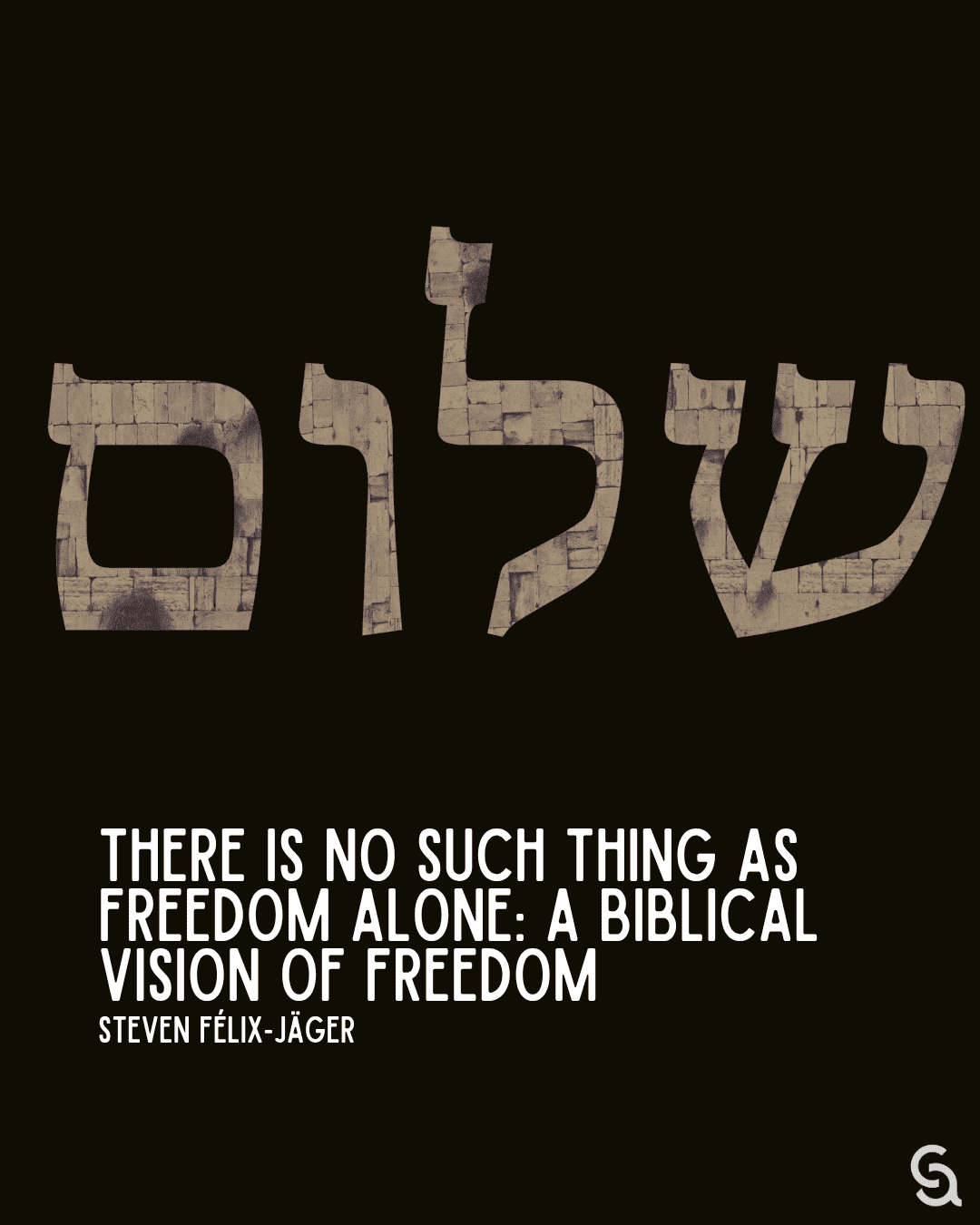
Although shalom is often translated simply as “peace,” it means much more than the absence of conflict. It describes a world where relationships are healed, justice is established, creation is cared for, and people flourish in every dimension of life.
Shalom is spiritual, relational, social, and even environmental (Rom. 8:19-23). It reflects God’s desire to restore and reconcile all things (Col. 1:19-20). It invites us into right relationship with God, with each other, and with the created world both now and in the age to come. This is the ultimate goal of God’s covenant.
The story of Scripture moves toward the day when God’s kingdom is fully realized and shalom reigns forever. Sin, suffering, and death will be no more. God will make all things new, and the New Jerusalem will become the dwelling place of God’s perfect peace and flourishing (Rev. 22:1-5). That’s freedom!
God’s vision for shalom shows us how we should live today.
We are invited to freely enter into covenant with God and to help others do the same. It is within this covenantal community that true freedom becomes possible, in the age to come and in the here and now.
So instead of asking, “What are my rights?” or “What am I free to do?” we should ask, “How can I use my freedom to love God and serve my neighbor?”
Despite what our Western society would like to tell us about freedom, there is no such thing as freedom alone. Biblical freedom calls us to resist the cultural temptation to make ourselves the center of the story. It invites us to become deeply committed to a local church, to bear one another’s burdens, to sacrifice for the good of others, and to seek the flourishing of our broader communities. In a world that loves autonomy, Christians are called to practice covenant.
We bind ourselves to God and to one another because we trust that true freedom is found in communal belonging. The more we learn to live for God’s shalom rather than our own self-interest, the more we discover what freedom was always meant to be.
 Steven Félix-Jäger (PhD, MFA) is associate professor of Systematic Theology at Vanguard University. A visual artist, songwriter, and music producer, Félix-Jäger is also the author of several books including How to Worship For All Its Worth, The Problem and Promise of Freedom, Renewal Worship, and the co-authored volume Renewing Christian Worldview. He has also written numerous articles and book chapters on theology, philosophy, culture, and the arts. He is as an associate editor for Pneuma, co-hosts the TikTok Theology podcast, and serves as worship pastor at Pasadena Foursquare Church. He lives in Pomona, CA with his wife, Connie, and daughter, Mila.