
 (Editor’s note: This is Part 3 of a four-part series exploring Christian faith, theology, and peacemaking in the Holy Land. In this installment, Rev. Dr. Mae Elise Cannon examines how theological frameworks — particularly those connected to Christian Zionism and dispensationalism — shape Christian attitudes toward Israel and Palestine. This reflection considers how interpretations of Scripture can either reinforce division and injustice or contribute to peace, dignity, and reconciliation. You can find Part 1 here and Part 2 here.)
Zionism, historic and contemporary, is not monolithic. Nonetheless, both Christian and Jewish Zionism have their roots in the return of a Jewish nationalistic movement to the historic land of biblical Israel.
In the United States, a movement began in the mid-19th century that included American Christians who sought the “restoration” of the Jewish people to their historic homeland. Restorationists at that time included both conservative and fundamentalist Christians, alongside Protestant Liberals. The restorationist movement became a precursor to contemporary Christian Zionism and the belief that the Jewish people must be restored to historic Israel in order for the Second Coming of Christ to occur.
The First Jewish National Congress in 1897, defined the goals of Zionism to “recognize a legally secured homeland in Palestine for Jewish people.” The three primary tenets of Christian Zionism at that time included the restoration of the Jewish people to Palestine (as the territory was named under the Ottoman Empire), reconstitution of the priesthood, and the rebuilding of the ancient temple that had been destroyed in 70 A.D.
What are the theological assumptions that lead to these fundamental beliefs of Christian Zionists?
One of the foundations begins on the assumption that the Jewish people are the descendants of Isaac and thus, as Part 1 of this series discussed, are blessed by God.
In Genesis 12:2-3, God promises Abraham,
“I will make you into a great nation, and I will bless you; I will make your name great, and you will be a blessing. I will bless those who bless you, and whoever curses you I will curse; and all peoples on earth will be blessed through you.”
Most Christian Zionists assume that the “you” in this passage doesn’t refer to the international Jewish community, but rather refers specifically to the contemporary modern nation-state of Israel that was established in historic Palestine in 1948. This conflation of “biblical Israel” and the political state of Israel is deeply problematic.
The majority of the more than 7 million Jews who live in Israel are not observant, or particularly religious. In addition, roughly 20 percent of the modern nation-state of Israel are Christian, Muslim, or non-religious Palestinian citizens of the State (also known as Arab Israelis).
Another theological assumption of Christian Zionism rests on the belief that God gave the land of historic Israel to the Jewish people exclusively as the “promised land.”
Ardent Jewish Zionists adhere to the belief that the Jewish people should be restored to the whole or complete land of Israel, the Hebrew term Eretz Israel HaShlema, which refers to all of the territory from Eilat, along the Red Sea, to Euphrates, parts of Egypt, Lebanon, Syria, Jordan, Palestine, Iraq, Kuwait, and Saudi Arabia.
Ardent Christian Zionists would agree, often sending millions of dollars from around the world in support of the Jewish settler movement that establishes outposts and settlements on land in the occupied West Bank, the land that is designated to be the future state of Palestine.
While many Jews and Christians believe that God intended for Abraham’s descendants to share the land with other peoples, settlers and their supporters believe that God’s promise is that only Jews will live in the land. They affirm that Jews can and should take control of the land and remove all non-Jewish peoples by any means necessary, including through war and violence.
Numerous books have been written about the land promises of God and the theological implications. Consider further study in New Testament scholar Gary Burge’s books Whose Land, Whose Promise? What Christians are not being told about Israel and the Palestinians and Jesus and the Land: the New Testament Challenge to “Holy Land” Theology.
Churches for Middle East Peace (CMEP) hosted a very popular mini-course on the question of “How Strong Is the Biblical Basis for Christian Zionism?” with Dr. Colin Chapman and Embrace the Middle East. Chapman argues against restorationism and asserts that the New Testament shifts to a fulfillment theology focused on the spiritual kingdom of God, not the modern nation-state of Israel. He argues that the false theologies of Christian Zionism support a modern conflict rooted in the dispossession of land and instead advocates for the Bible to be used as a tool for peacemaking, not the justification of political claims. Chapman supports attempts toward peace that are rooted in justice, peace, and mutual respect for all people, both Jewish and Palestinian.
Dispensationalism can provide a theological undergirding for many Christian Zionists, even those who are not familiar with the term. Christian dispensationalism arose in the decades following the restorationist movement and asserts a theological framework that God works differently in distinct periods of time or “dispensations.”
Emphasis includes the literal interpretation of Scripture, with a significant focus on the end times. While God has separate and distinct plans for the people of God (Israel) and the church, a repercussion of dispensationalism is that prophecies about Israel (often applied to the modern nation-state) are taken literally and seen as a fulfillment of Old Testament prophecies.
These theological assumptions often result in political support for the State of Israel, rather than seeing the actions of the state as a secular political mechanism distinct from the movement of the global Jewish community.
One of the main complaints against Christian Zionism is the assumed ethnocentric superiority of one people group over another. Namely, the idea that God would deem some people (i.e., the Jewish people) to be privileged in his eyes over others. New Testament passages about the role of Christ in bringing salvation and forgiveness of sins must be theologically reconciled to theologies that are present in the Hebrew Scriptures of the Christian canon.
Take, for example, New Testament passages like Romans 3:23 that say, “All have sinned and fall short of the glory of God.” Other New Testament passages that have divergent interpretations and theological beliefs include Romans 11, which talks about the Old and New Covenants of God. Verses from Romans 11 refer to a “deliverer from Zion” quoting the prophets of Isaiah and Jeremiah. The passage also includes a description of the role of the Gentiles in receiving the promises of God.
The verses, at first reading, may seem quite obscure talking about how the Gentiles have been “grafted in among others and now share in the nourishing sap from the olive root” (11:17). This passage uses the metaphor of the olive tree to describe the relationship of God to both the Jewish people of historic Israel and the Gentiles who have come to faith because of their beliefs. The Gentiles (wild branches) have been “grafted in” because of their faith, suggesting that non-Jews might also share in the promises of God. The question of how the Old Testament promises of God to the Jewish people change, become fulfilled, or continue are the basis on which Christian Zionists and anti-Zionists have their disputes.
Those who oppose Christian Zionism often believe in a theological assumption called “fulfillment theology.” In Christ’s coming to earth in the person of Jesus, the promises of the Messiah of Israel have been fulfilled, including his life, death, and resurrection.
The Covenant of God made to the Jewish people is not repealed, but instead fulfilled and expanded upon, and the relationship between God and the Israelites becomes redefined (or transformed) by the reality of Christ having come. As Romans 11 referenced, the Gentiles are then invited into receipt of the promises of Genesis 12:3 so that not only will the descendants of Jewish people be blessed, but instead an emphasis is placed on the church, the body of Christ, which becomes “heir to the promises made to Israel.”
Many proponents of Christian Zionism accuse their opponents of a theology called “Replacement Theology.”
Replacement theology is the basic idea that the covenant between God and the Jewish people shifted in favor of the New Covenant, where the church replaces the favored position of the Jewish people. Critics of replacement theology argue that the assumptions can promote and encourage anti-Semitism and neglect to acknowledge the historic and favored role the Jewish people have had in relation to the Abrahamic covenant.
Fulfillment theology, on the other hand, acknowledges two Covenants: both the Abrahamic Covenant between God and the Jewish people and a new covenant between God and the church.
How does one make sense of these theologies related to the State of Israel?
In the New Testament, Jesus very clearly states,
“You will know them by their fruits.” (Matt. 7:15-20)
In other words, as other passages in the Scriptures reference, the actions and deeds of people will provide evidence of the Christian faith. James says,
“Be doers of the word, not hearers only…” (1:22)
He continues and says,
“Faith without works is dead.” (2:26)
In other words, what are the effects on people of our theological assumptions?
Conservative interpretations of the Scriptures demand that the Scriptures never contradict themselves.
Following that belief, would God ever demand that his people perpetuate injustice in the manifestations of his teaching? Through the Scriptures, both Old and New, God consistently calls for justice and love of not only neighbor, but enemy (Matt. 5:43, Rom. 12:9-21).
Would the God of justice call for Christians to support one people group over another (Israelis over Palestinians)?
All Christians, regardless of their theological assumptions and political beliefs, must be willing to ask the question, “What are the repercussions of my beliefs and how do they affect people?”
The belief in Jewish restorationism justified the displacement of almost 1 million Palestinians in 1948 as a part of “God’s divine plan.” That refugee population today continues to suffer displacement and occupation. Jesus came as the Prince of Peace (Isa. 9:6, John 14:27), not as someone who desired to create divisions between people.
Jesus calls for love of neighbor and of enemy. Might it be possible for the Jewish people to have a special role in God’s divine plan? And is it possible for that to be so without injustices being wrought against an entirely different people group?
Rather than supporting the aspirations of one people group over another, consider the parable of the Good Samaritan, the man considered an enemy to the Jews. Jesus tells the story of the Good Samaritan showing mercy, love, and kindness to the man on the side of the road in need of help. The commandment to followers of Christ is the same:
“Go and do likewise.” (Luke 10:37)
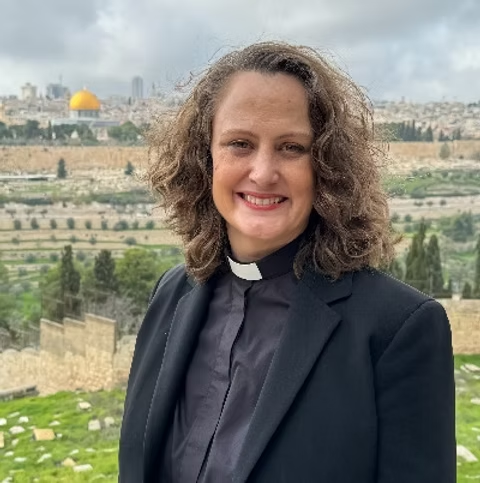 Rev. Dr. Mae Elise Cannon is Executive Director of Churches for Middle East Peace (CMEP) and is ordained with the Reformed Church in America (RCA). Cannon formerly served as the Senior Director of Advocacy and Outreach for World Vision U.S. on Capitol Hill in Washington, DC; as a consultant to the Middle East for child advocacy issues for Compassion International in Jerusalem; as the Executive Pastor of Hillside Covenant Church located in Walnut Creek, California; and as Director of Development and Transformation for Extension Ministries at Willow Creek Community Church in Barrington, Illinois.
Cannon holds an MDiv from North Park Theological Seminary, an MBA from North Park University’s School of Business and Nonprofit Management, and an MA in bioethics from Trinity International University. She received her first doctorate in American History with a minor in Middle Eastern studies at the University of California (Davis), focusing on the history of the American Protestant church in Israel and Palestine, and her second doctorate in Ministry in Spiritual Formation from Northern Theological Seminary. She is the author of several books, including the award-winning Social Justice Handbook: Small Steps for a Better World, and editor of A Land Full of God: Christian Perspectives on the Holy Land.