
 (Editor’s Note: In Part 1 of our four-part “Practicing Moral Courage” series, Dr. Terence Lester explored how moral courage is formed long before we reach the moments that require it, asking what happens when Christians refuse to let fear and othering shape how we see our neighbors. In Part 2, Dr. Emiola Oriola Jr. takes that question one step further: What happens when another person’s humanity interrupts us? Through compassion, hospitality, and truth, he invites us to resist the categories that make it easy to keep one another at a distance and instead become people willing to draw near, make room, examine our own certainty, and remain open to encounter. Because sometimes moral courage looks less like taking a dramatic stand and more like refusing to stop seeing the person in front of us.)
Proximity has never been easier, yet encounter has never been harder.
We live in a time where we are encouraged to see faces without knowing names. We can know what people believe before we know their stories, judge their decisions without understanding their options, and recognize their political affiliations, religious convictions, immigration status, sexuality, neighborhood, or voting record without ever being curious about what they are afraid of, what they’ve lost or even what they actually love.
Maybe this is one of the unique ways fear has formed us: convincing us that distance is discernment, suspicion is wisdom, and keeping people in their proper categories is simply knowing the difference between right and wrong.
However, the Bible illustrates a very different way of being human.
Hospitality, compassion, and truth were not merely private virtues in the world of Scripture. They were practices that shaped how people related to one another in a culture structured by kinship, status, honor, shame, responsibility, and boundaries. The stranger was not simply an anonymous person passing by. Their very presence could create an obligation to respond.
Now, I am not suggesting that we recreate 1st-century cultural norms. I am suggesting that we recover something that the ancient world understood that ours has easily forgotten: another person’s presence can and should ask something of us.
Somewhere along the way, hospitality became something we do when it is convenient, compassion became something we feel when the “right kind” of people are hurting, and truth became something we hurl at others when we think they need our corrections.
I wonder, though: What if the deeper invitation is a bit more disruptive, maybe even subversive? What if compassion asks us to let another person’s humanity interrupt our indifference? What if hospitality asks us to let another person’s presence interrupt our boundaries? What if truth asks us to let reality interrupt our certainty, not just others?
That kind of life requires a unique kind of courage, one that is committed to staying human when fear would rather make us demonize others and deify ourselves.
Following a “not-my-will-but-yours-be-done” Messiah doesn’t simply invite us onto the narrow path, but into encounters where we may have to listen longer, make room wider, see more clearly, and remain open to being interrupted. The question isn’t whether many of us have convictions; that’s easy to see if you look online. The question is whether our convictions have left us any room to encounter and be interrupted by another complicated, but fellow image bearer who is just like us.
In the biblical imagination, people in vulnerable situations were not simply neighbors to be generously accommodated when convenient. Their presence could interrupt plans, resources, schedules, boundaries, and, most importantly, assumptions about who deserved help and who didn’t.
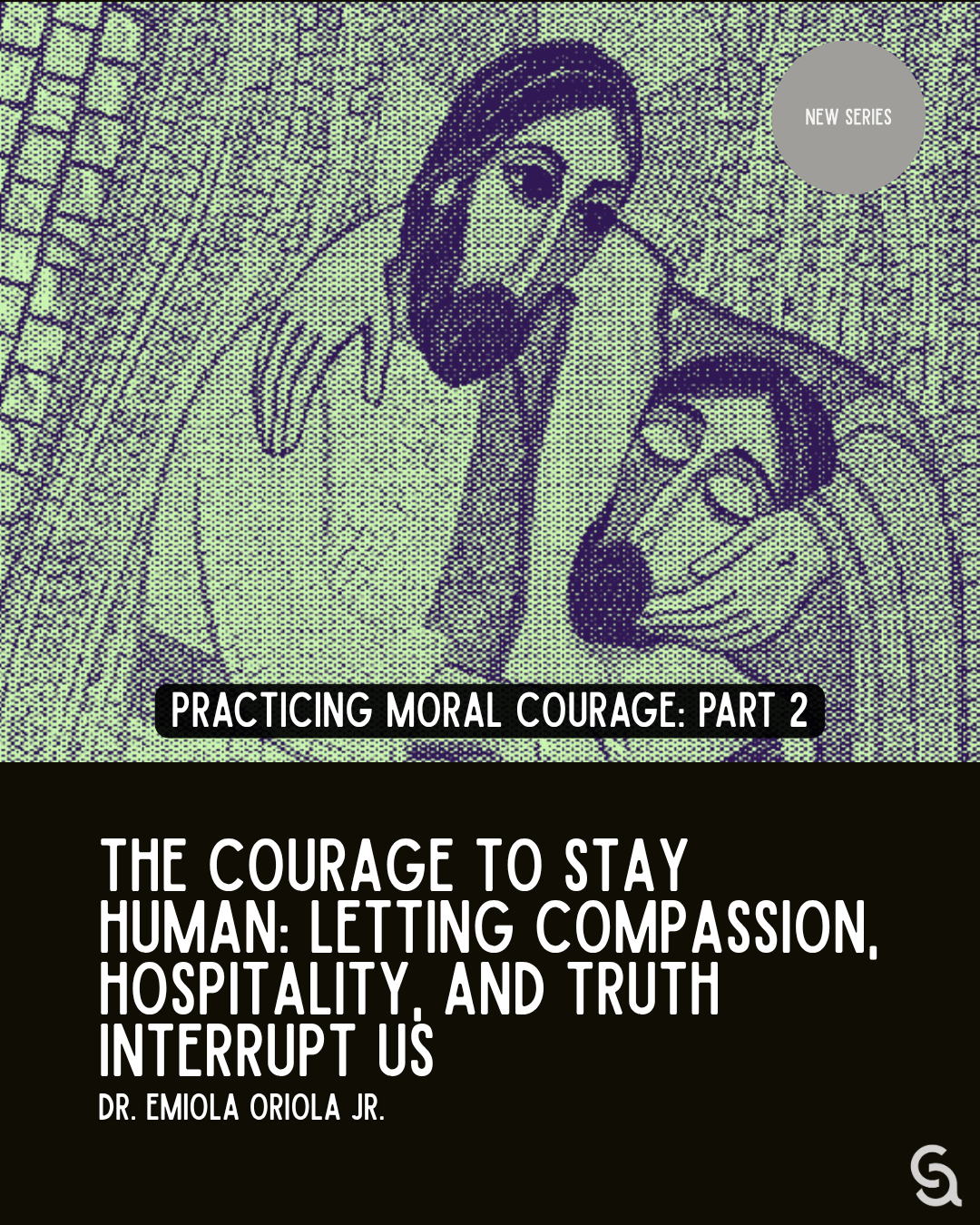
Jesus illustrates this kind of disruptive neighborliness in Luke 10:25–37. The Samaritan does not encounter the wounded man as a category and move on. He sees him, draws near, tends his wounds, uses his own resources, and rearranges his plans, knowing full well the risk. The shock of the story is not simply that a Samaritan becomes the hero. It is that Jesus makes the person whom the hearers might have been conditioned to categorize and distrust the one who embodies this courageous neighborly love. The Samaritan is human enough to allow another person’s vulnerability to interrupt him.
Hospitality becomes courageous when welcome costs us something.
It is more than making room for people; it is allowing people to make room in you. And that is only possible when hospitality is connected to compassion.
Now, most of us don’t wake up intending to become less compassionate. It happens, little by little, until our default response to another person’s suffering can become a sympathetic phrase, a sad-face emoji, or thoughts and prayers that never quite make it into our hands.
The New Testament uses a wonderfully peculiar image for the compassion Jesus often shows. It is related to the inward parts or bowels of a person, the place the ancients associated with deep emotion. The point isn’t that Jesus merely noticed suffering; it is that he was deeply moved by it. That is very different from our culture in which suffering can remain safely on a screen. We can witness enormous amounts of pain without ever allowing it to rearrange us.
And that may be the larger problem. Compassion that never internally rearranges us can become little more than sentiment.
We see something similar in John 8, where a woman is brought before Jesus not simply as a person, but as a test, a case, and a useful tool in a premeditated argument against a secret enemy. Jesus refuses to let the Pharisees’ certainty about her recent acts become the whole story about her humanity. He slows the entire encounter down, exposes the accusers’ own blind spots, and eventually, the stones fall not because truth no longer matters — quite the opposite.
Truth matters so much that it should be handled with clean hands and a pure heart, not with a hard heart and a handful of stones.
It’s easier to have compassion for a person until they become a position. Once that happens, their pain becomes evidence in an argument. True compassion says, Before you tell me what this person represents, can you see the person? Can you even see yourself?
We often think courage means having the guts to tell the truth, but sometimes the greater courage is having the humility to let the truth tell us something.
In Matthew 7, Jesus gives us a picture of truth that first turns toward the person holding it. Before removing the tiny speck from another person’s eye, we are invited to confront the enormous plank obstructing our own sight. What is this parable telling us? Jesus isn’t dismissing discernment; he’s questioning the person who is so certain about someone else’s blindness that they cannot see their own.
And that takes real courage.
This is part of what moral courage asks of us: not simply the courage to stand for something (absolutely needed), but the courage to remain open enough to be changed by what we encounter without surrendering our convictions. Because the goal is not to become people without convictions. It is to become people whose convictions have not made them incapable of seeing other people.
 Dr. Emiola Oriola Jr. is a scholar-practitioner, educator, and storyteller whose work explores belonging, dialogue, and what it means to remain human in a fractured world. His scholarship and leadership focus on global citizenship, experiential learning, cross-cultural engagement, and organizational culture, helping people and institutions cultivate deeper forms of connection and responsibility. He holds a Doctorate in Education from the University of Pittsburgh, where his research examined communal dialogue, out-of-school learning, and holistic human development.
Professionally, Dr. Oriola has led initiatives centered on dialogue and belonging, including serving as the inaugural leader of the Office of Interfaith Dialogue and Engagement and the Office of Inclusion and Belonging at the University of Pittsburgh. He has also served in executive leadership at Vibrant Pittsburgh and currently serves on the boards of the World Affairs Council of Pittsburgh and ARYSE, supporting global engagement, refugee support, and intercultural learning. Through teaching, immersive learning experiences, and public scholarship, he helps people and organizations navigate questions of identity, justice, and community with greater compassion and humanity.