 How would you react if the U.S. announced that it was going to run out of fuel in a matter of months?
We were in that exact situation, here in the Philippines, just a few weeks ago.
Following the outbreak of the U.S.-Israel war on Iran, President Bongbong Marcos declared a national energy crisis, as our country’s fuel supply will run out by July. And while U.S. Americans are themselves affected by the escalating gas prices and supply chain disruptions from the conflict instigated by their leaders, I have been witnessing firsthand how people in other parts of the world suffer suffer disproportionately from a war that we have nothing to do with.
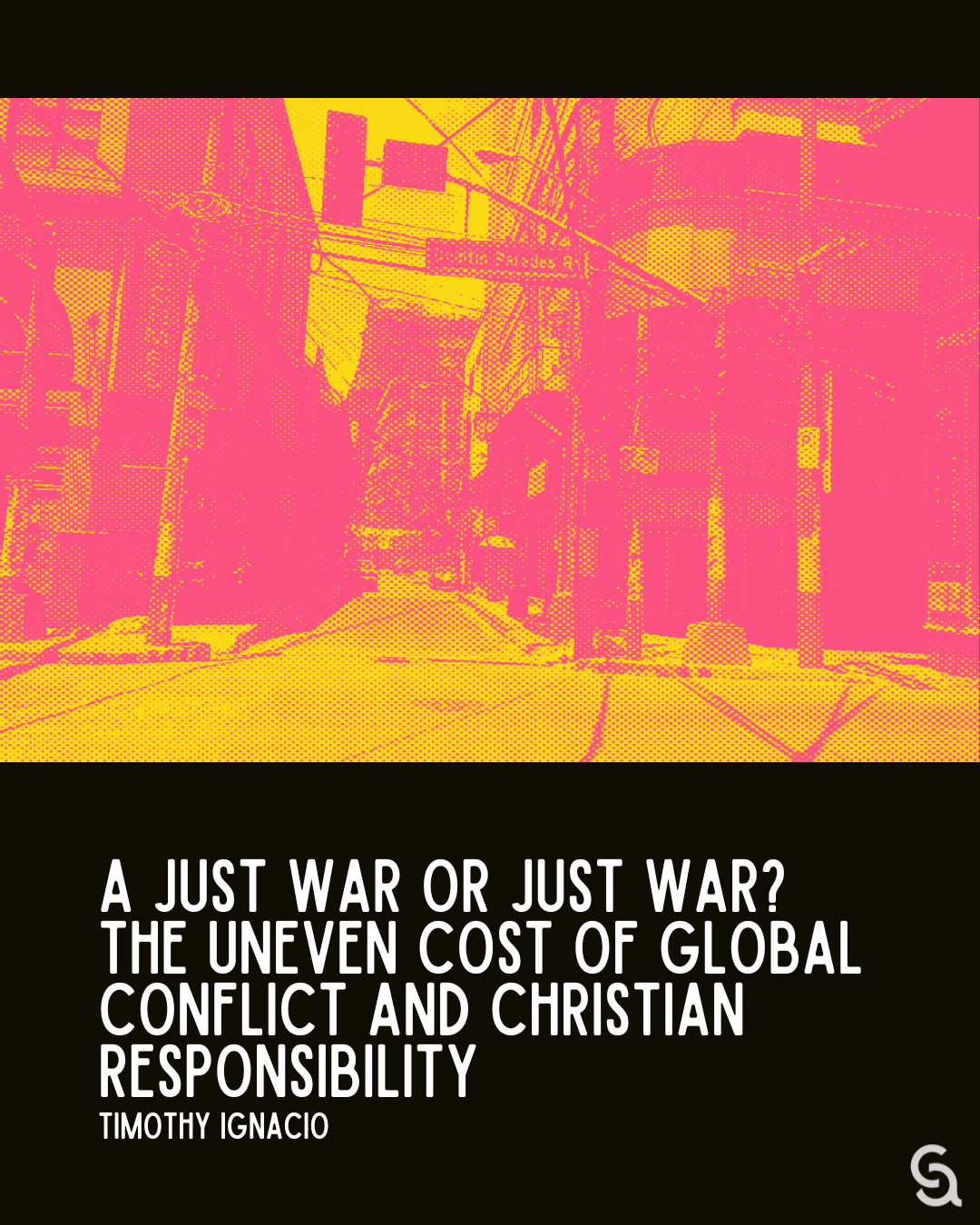
With the loss of Asia’s main source of oil amidst the conflict, escalating gas prices in the Philippines weigh most heavily on the nation’s public transportation workers. Due to government regulations against raising fare rates, jeepney drivers absorb the rising fuel costs and face stagnant earnings, with reports of their making as little as $3 for 14 hours of driving.
As most homes here lack a central gas system, working-class families and small businesses have been struggling to deal with the inflated prices of LPG tanks. This represents a heavy burden for countless Filipinos, who go through multiple tanks a month cooking their meals.
From their eating to their livelihood, this war has been taking a high toll on our nation’s vulnerable and marginalized.
The Uneven Cost of War
How did we end up in a world where a few nations make decisions while so many others are left to deal with the consequences? Is this the cost of a just war? Or is this really just war as U.S. citizens tend to know it?
From Korea to Vietnam and Iraq to now Iran, war for Americans often means watching from the comfort of our unscathed homes while others deal with the cost and consequences of our conflicts. Despite our insulation and privilege, what kind of responsibility might our faith practice call us toward during these times when we aren’t the ones paying the price of our nation’s actions?
In what has become a sort of Kendrick v. Drake-esque battle of words between Pope Leo XIV and the White House, much has been said about Christian responsibility towards an oppressed populace. Like Drake, Vice President JD Vance has been all too eager to verbally spar with someone out of his league, citing St. Augustine’s Just War Doctrine in his contribution to this Vatican-DC beef.
House Speaker Mike Johnson threw in a subtle insult of his own echoing Vance’s just war theologizing, while Secretary of “War” Pete Hegseth cited a line from the film Pulp Fiction to make his biblical-adjacent point. Pope Leo, an Augustinian, has outright rejected attempts to appropriate his order’s theological principles for the purposes of justifying any act of war, dismissing them as inherently opposing the purposes of Christ.
However, as haphazard as they were, I do believe that these attempts to evoke the thousand-year tradition of just war theory(1) point us back to the questions I posed earlier: What is our responsibility as Christians in the United States when our wars, even when we proclaim them as just, force others to bear the harsh consequences of our conflict? Whether it’s jeepney drivers in the Philippines struggling to feed their families or Sri Lankan manual laborers losing work, what do we owe those who are being forced to pay the price for our wars?
Or maybe we really don’t owe them anything – after all, some will say, this is just the reality of war, just or otherwise.
Maybe it’s our nation’s divinely ordained calling to be the sword-wielding savior while others have to deal with the casualties and externalities because they don’t have the luxury of being American. After all, “Blessed is he who in the name of camaraderie and duty shepherds the lost through the valley of darkness”(2), a la Hegseth, right?
When it comes to geopolitical conflicts, a few get to be the shepherds while the rest have to be sheep.
Matthew 25 and the Debt of Solidarity
If we look at actual passages of Scripture, I believe that we can find some guidance. Particularly when looking through the Gospels, we will be hard-pressed to find depictions of Jesus calling for any kind of violence in defense of himself or anyone else – he even rebuked Peter in his attempt to wage a just war of his own.
We will, however, repeatedly find ourselves confronted with principles of love, service, and solidarity. Love others, whether they be your neighbor or enemy (Matthew 5, 22) Instead of demanding service, as our consumerist culture would have us do, serve others (Mark 10). Give away your wealth (Luke 18). Choose people over religiosity (Mark 3). And in the singular instance when he could have practiced self-defense, when even St. Augustine himself might have approved, Jesus instead gave himself up to his oppressors. Christ did not choose the sword. He chose the cross.
Among these passages that fill our sacred text, I believe that Matthew 25 provides us with the most poignant and direct answer to the question of our responsibility amidst these uneven and unjust realities of international conflicts and economic crises. Here we find no grand commands calling Christian soldiers onward nor any beatitudes for would-be shepherds against “the tyrannies of evil men.”
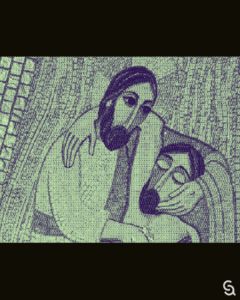
Instead, we find a descriptive telling of what it means to feed the hungry, welcome the stranger, and visit the incarcerated: To do these things for others is to do them for Christ himself.
Just as Jesus identifies himself in these people — but not in the AI sort of way — so we are called to practice this same solidarity with the vulnerable and marginalized of our times. It is this solidarity — a solidarity that sees our own Savior amongst the hungry, houseless, sick, and incarcerated — that I believe we owe to Filipino jeepney drivers and everyone else like them.
This is the way I believe Christians in places like the United States are called to posture their faith practice. At a time when the vulnerable and excluded of the world are bearing the burdens of our nation’s decisions, when our leaders would rather we put America first and forget all who come after, I believe that Matthew 25 shows us what faithfulness looks like for the privileged and protected.
Even though we can’t all go feed, clothe, and house these neighbors on the other side of the globe, the question of solidarity asks, “Do you see Christ in them?” When we bow our heads before a meal or lift our hands during Sunday worship, do we remember them?
Tagalog-speaking Filipinos commonly practice a custom of reciprocity called “útang na loób”, which is often translated as a “debt of gratitude.”(3) While it is usually understood on an interpersonal basis between a patron and beneficiary, útang na loób can also be about more than an exchange of favors.
Feminist theologian Agnes Brazal (2022) theologizes útang na loób as a debt of human solidarity, especially for the oppressed and marginalized, that we owe one another because we are all inextricably and inescapably bound to each other in the image (the “loób”) of the Divine. This is not a choice of charity. Útang na loób is the responsibility and indebtedness of imago Dei.
Even as the war and other unjust arrangements made by the few places with power will continue to unfairly harm the many elsewhere, we will always owe the indebtedness of our solidarity.
To share the image of the Divine is to share the debt of utang na loób. So while violence disguised as heroics can woo in the voting booth and sell at the box office, the way of Christ is something much less marvelous and consequential. Scripture does not call us to bear arms as saviors or liberators — or shepherds.
Instead, in the spirit of Matthew 25, we are called to be fellow sheep. This is true justice.
Bearing the Weight of What We Benefit From
I was a 9-year-old living comfortably in the suburbs of California when the U.S. invaded Iraq. Though I still remember some of the news coverage from back then, I was mostly ignorant of and completely unaffected by the actual consequences of this war that my government had started on the other side of the globe.
But this time around, during yet another misguided Western intrusion into the Middle East, I’m living in the Philippines — now over seven years into serving a working-class community that I’ve come to call home. Here, I see up close how the decisions made by the country of my birth implicate those without the power to choose otherwise.
From the COVID pandemic to the war in Iran, those of us in places like the U.S. do not know this vulnerability to the world’s crises and conflicts that are daily experiences for all too many throughout the Global South.
And to be blunt, it hurts like hell to witness.
Just a few days ago, a motorcycle taxi driver died while waiting in line for government cash relief in the unforgiving Manila heat alongside hundreds of other drivers seeking aid amidst the unbearable fuel costs.
Weeks prior, as if facing a national energy emergency and sudden inflation weren’t enough, some of my friends living and working in an informal settler community were hit by a fire and subsequently had their land illegally demolished. Even after living and serving here for several years, it feels as if nothing has changed.
Coincidentally, all of this has happened during my last few months here in the Philippines.
As my wife and I have had plans of moving back to California for a few years now, things were quickly set in stone when my wife’s visa was finally approved just over a week after the U.S. and Israel bombed Iran. This has been a time of handling both excitement for what’s to come and heartbreak over what’s still happening.
If nothing changes in Iran before June, we will be leaving our friends and family here as they continue to live with the consequences of a war started by the country we’re moving to.
If I have had much to say about the privileges and protections enjoyed by those in the U.S. during times of global turmoil, I confess that I will be returning to these soon myself. And yet, even as I work through the guilt and shame of leaving our loved ones behind, I remember Matthew 25. I remember útang na loób. I remember how Jesus remains with all of the left behind and forgotten.
So in praying and protesting for the end of this war and all the pains it brought, may we do so in remembrance of the debt we must pay to those unjustly burdened and harmed by our nation’s decisions.
May we not forget that our solidarity is owed. And perhaps, in whatever we may be able to do for the least of these, we might actually end up doing for Christ himself.
Endnotes
(1) It should also be noted that the White House’s multiple attempts to cry “just war” failed to address the numerous requirements that Catholic tradition demands for qualifying a war as being just.
(2) Todd Spangler, “Pete Hegseth Quotes ‘Pulp Fiction’ Fake Bible Verse at Pentagon Prayer Service,” Variety Magazine, accessed April 27, 2026.
(3) Útang” in Tagalog means debt.
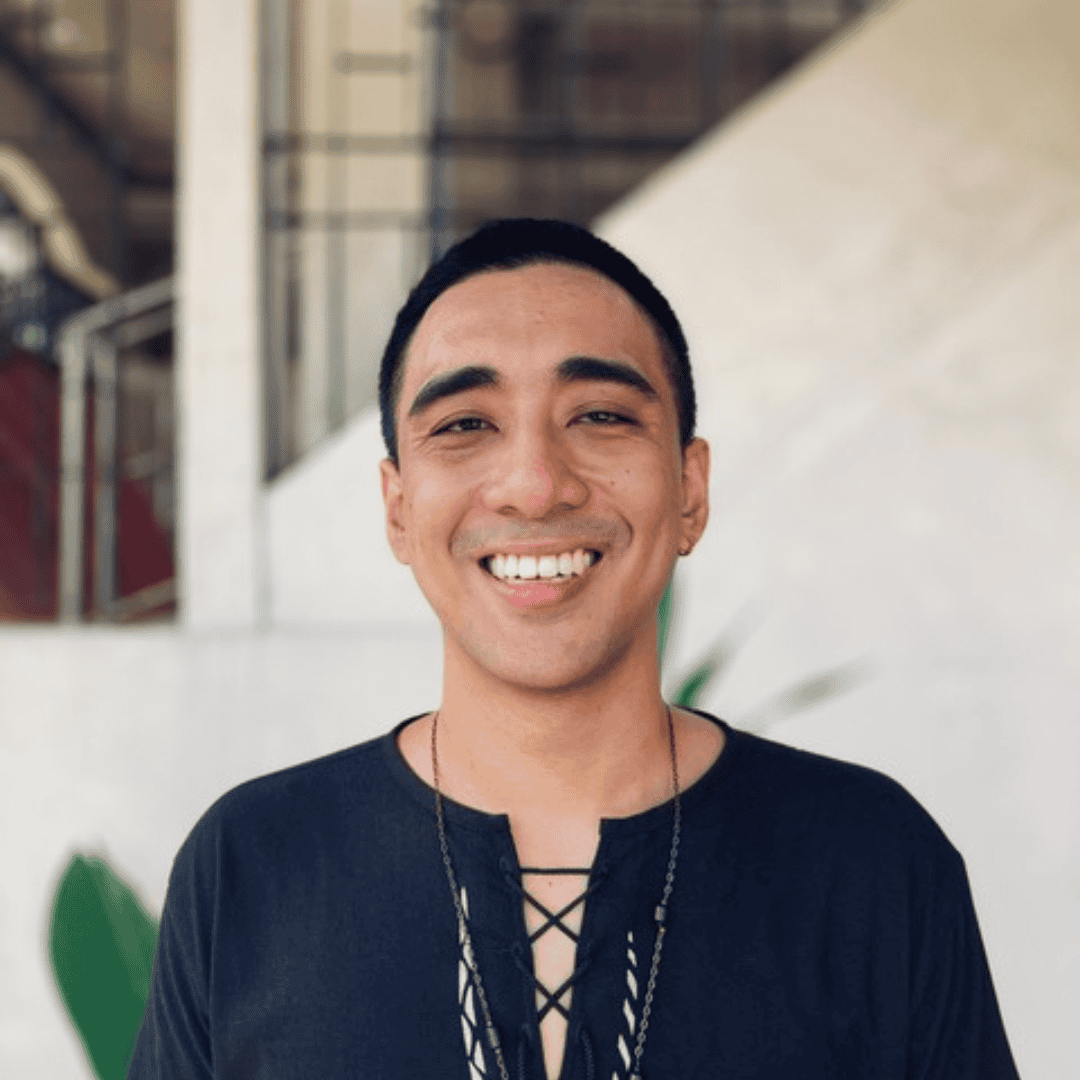 Timothy Sean Baluyot Ignacio (he/him) is a 2nd Gen Filipino-American from Northern California. In 2018, he moved to Quezon City, Philippines, to live alongside and serve a working-class community with the non-government organization Servants to Asia’s Urban Poor. As a creative and musical artist under the name “ITM” (reiteration of the Tagalog word, “itim” meaning “dark”), he also uses his creative work to express his musings and advocacies around his decision to move to his family’s Motherland as a “balikbayan not missionary”. He likes his coffee black, his whiskey neat, and his sports team in LA. Tim is a CSA pundit.