 I have said often that October 7, 2023, did not mark the beginning of violence between Hamas and Israel. But it was undeniably a day that changed the course of history. The human devastation of that day — and the immense suffering endured by Palestinians in Gaza in the years since — remains difficult to comprehend.
For Israelis and Jews around the world, October 7 has been described as the deadliest day for Jews since the Holocaust, a profound collective trauma that continues to shape Jewish life and memory.
The devastation in Gaza has likewise been staggering.
Palestinian health authorities reported more than 67,000 deaths by October 7, 2025, and the toll has continued to rise, with bodies still being recovered from beneath the rubble.
In January 2026, the Israeli military acknowledged that approximately 70,000 Palestinians had been killed during the war, broadly aligning with the Gaza health authorities’ cumulative figure at that time. By September 2026, Palestinian health authorities reported more than 73,000 deaths. More than 900 Palestinians have been killed since the October 10, 2025 “ceasefire” went into effect.
Behind these numbers are grieving families on both sides. Jews in Israel and around the world who lost loved ones on October 7 continue to mourn, just as tens of thousands of Palestinian families grieve those they have lost in Gaza.
And for Palestinians who remain in Gaza, the suffering has not ended with the ceasefire: Homes and communities remain devastated, hundreds of thousands remain displaced, and people continue to live amid profound humanitarian need. The human cost of this conflict remains almost impossible to comprehend — and this fact demands that we refuse to allow either Israeli or Palestinian suffering to become merely a statistic.
Over the past few years, Churches for Middle East Peace (CMEP) has focused on the reality taught in the Scriptures (Gen. 1:27) that all people are created in the image of God (imago Dei). Every life lost as a result of wars, violence, devastation, and genocide in the Middle East should be grieved. And, at the same time, we must acknowledge the astounding power differentials between the State of Israel, with its army and power structures, and the people of occupied Palestine, who have been living without self-determination and independence since 1967.
Today in Israel and Gaza, scores of families continue to grieve and to face the profound loss of the past several years. Still, realities on the ground cannot be ignored.
What Has Happened?
Jerusalem: Roughly 400,000 Palestinians live in Jerusalem. Most Palestinian residents of East Jerusalem do not hold Israeli citizenship; instead, they hold permanent-residency status that allows them to live in Jerusalem and travel to and from the West Bank. Families are often separated by the status they maintain.
For example, roughly 100,000 Palestinians from Jerusalem live on the other side of the separation barrier, called the “apartheid wall” by Palestinians and the “security fence” by Israelis. These Palestinians are isolated from their families, communities, and center of life and no longer have access to the city of Jerusalem.
Families become dispossessed and often maintain different legal statuses, which limits their ability to be reunified and to live together in the same location legally. Jerusalemites face housing and building restrictions, where only 13 percent of the city is zoned for Palestinian construction, much of which is already built to capacity.
Palestinian residents of Jerusalem face the threat of evictions and settler expansion, in addition to unequal access to infrastructure and municipal services. Nonetheless, Palestinians with Jerusalem identification face significantly more privileges than Palestinians living in other parts of the occupied Palestinian territories (i.e., the West Bank and Gaza).
The Occupied West Bank: The occupied West Bank — referred to by many Israelis and Israeli officials as ‘Judea and Samaria’ — has experienced a sharp escalation in settler violence in 2026. By mid-September, the UN Office for the Coordination of Humanitarian Affairs (OCHA) had documented more than 1,600 settler attacks resulting in Palestinian casualties, property damage, or both — an average of 6.7 attacks per day, compared with five per day in 2025 and 1.5 per day in 2021. These attacks had affected 275 Palestinian communities, nearly as many as during all of 2025.
The human toll has been devastating.
By August, 22 Palestinians had been killed in incidents involving settler attacks in 2026; OCHA attributed 12 of those deaths to settlers, seven to Israeli forces, and three to cases in which responsibility remained unclear. By July, approximately 850 Palestinians had been injured in the context of settler attacks, including nearly 690 injured directly by Israeli settlers.
But the violence extends far beyond the immediate casualties. Settlers have burned homes and vehicles, destroyed olive trees and farmland, damaged water and electricity infrastructure, attacked livestock, stolen or destroyed agricultural equipment, and damaged the property and resources on which Palestinian families depend for their livelihoods.
Repeated attacks and restrictions on access to land have also contributed to displacement and the isolation of entire communities. By mid-September, more than 2,600 Palestinians had been displaced in the context of settler violence and related access restrictions since the beginning of 2026.
The cumulative effect is a pervasive sense of insecurity and fear. Palestinians, including Christian communities, are increasingly concerned about their ability to remain safely in their homes and communities. When I joined a gathering of pastors in Bethlehem in September 2026, I heard firsthand about the pressures Christian families face.
I was told repeatedly that families either have a relative who has emigrated or are considering leaving themselves, amid what they described as the increasingly unbearable conditions of life in Palestine. These personal testimonies gave human meaning to statistics that can otherwise be difficult to comprehend.
Gaza: As horrific as the realities of ethnic cleansing continue to be in the West Bank, the situation does not compare to the ongoing challenges Palestinians experience in the continual destruction of the Gaza Strip.
Many of the concerns facing civilians in Gaza during 2023-2025 continue. As of mid-2026, roughly 90 percent of the population of the Gaza Strip (1.9 million people) remained displaced, the majority of whom live in makeshift tent communities in a few incredibly overpopulated centers without adequate water and sanitation. Since October 10, 2025, more than 1,350 Palestinians have been killed, an average of about four people a day since the ceasefire began.
Who Is Responsible?
These are just some of the facts and statistics that summarize the daily realities of settler expansion, occupation, and ethnic cleansing.
What is missing in this summary? A description of culpability and responsibility.
Hamas and other militant actors who perpetrated the October 7, 2023 attacks should be held accountable for their crimes, just as the Israeli military must be held accountable for the disproportionate number of civilian deaths in the Gaza Strip and the ongoing displacement of Palestinians in the West Bank. The brutal bombing campaigns in the Gaza Strip resulted in more than 70,000 deaths over the course of October 2023 through October 2025. They had a disproportionate effect on Palestinian civilians who were not guilty of the crimes of Hamas. Instead, more than 20,000 Palestinian children were killed during those two years, among them more than 1,000 children under the age of 1.
What Does Peace Require?
One of the great travesties of the 21st century is the inability for the majority of Americans to look at Israeli-Palestinian history without a zero-sum game mentality. There will never be peace until Americans, and the world, come to understand that the futures of the Palestinian and Israeli people are inextricably linked.
Israelis will never have peace and security until Palestinians have self-determination. Palestinians will never have self-determination and freedom until Jews living in Israel feel secure and safe. And peace will not come until there is accountability in response to the disproportionate abuse of power being perpetuated in the ongoing human rights violations and occupation of the Palestinian people.
May the words of Palestinian Christian Father Firas Khoury, a parish priest in the Palestinian village of Zababdeh, be an encouragement to us as we seek to understand these current realities:
“It is difficult to describe what it feels like to watch these events unfold so quickly around our community. Sometimes it feels as though we are living in small prisons inside one large prison.
There are also concrete barriers where people have written, ‘There is no future in Palestine.’
But as Christians, we cannot accept that fear and death should have the final word. We continue to pray, serve our people, visit the sick, and remain present in our community. We are trying to keep hope alive, especially for our young people and families who are struggling to imagine a future here.
Our hope is not because we ignore reality. We see it every day. Our hope comes from Christ, from the Resurrection, and from our belief that life is stronger than death.
Please continue to pray for Zababdeh and for all the people here. May the Lord protect you and bless you for standing with the people of this land.”
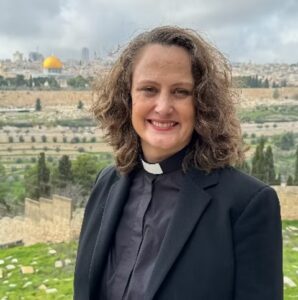 Rev. Dr. Mae Elise Cannon is Executive Director of Churches for Middle East Peace (CMEP) and is ordained with the Reformed Church in America (RCA). Cannon formerly served as the Senior Director of Advocacy and Outreach for World Vision U.S. on Capitol Hill in Washington, DC; as a consultant to the Middle East for child advocacy issues for Compassion International in Jerusalem; as the Executive Pastor of Hillside Covenant Church located in Walnut Creek, California; and as Director of Development and Transformation for Extension Ministries at Willow Creek Community Church in Barrington, Illinois.
Cannon holds an MDiv from North Park Theological Seminary, an MBA from North Park University’s School of Business and Nonprofit Management, and an MA in bioethics from Trinity International University. She received her first doctorate in American History with a minor in Middle Eastern studies at the University of California (Davis), focusing on the history of the American Protestant church in Israel and Palestine, and her second doctorate in Ministry in Spiritual Formation from Northern Theological Seminary. She is the author of several books, including the award-winning Social Justice Handbook: Small Steps for a Better World, and editor of A Land Full of God: Christian Perspectives on the Holy Land.