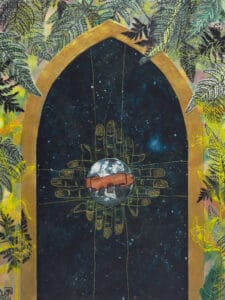
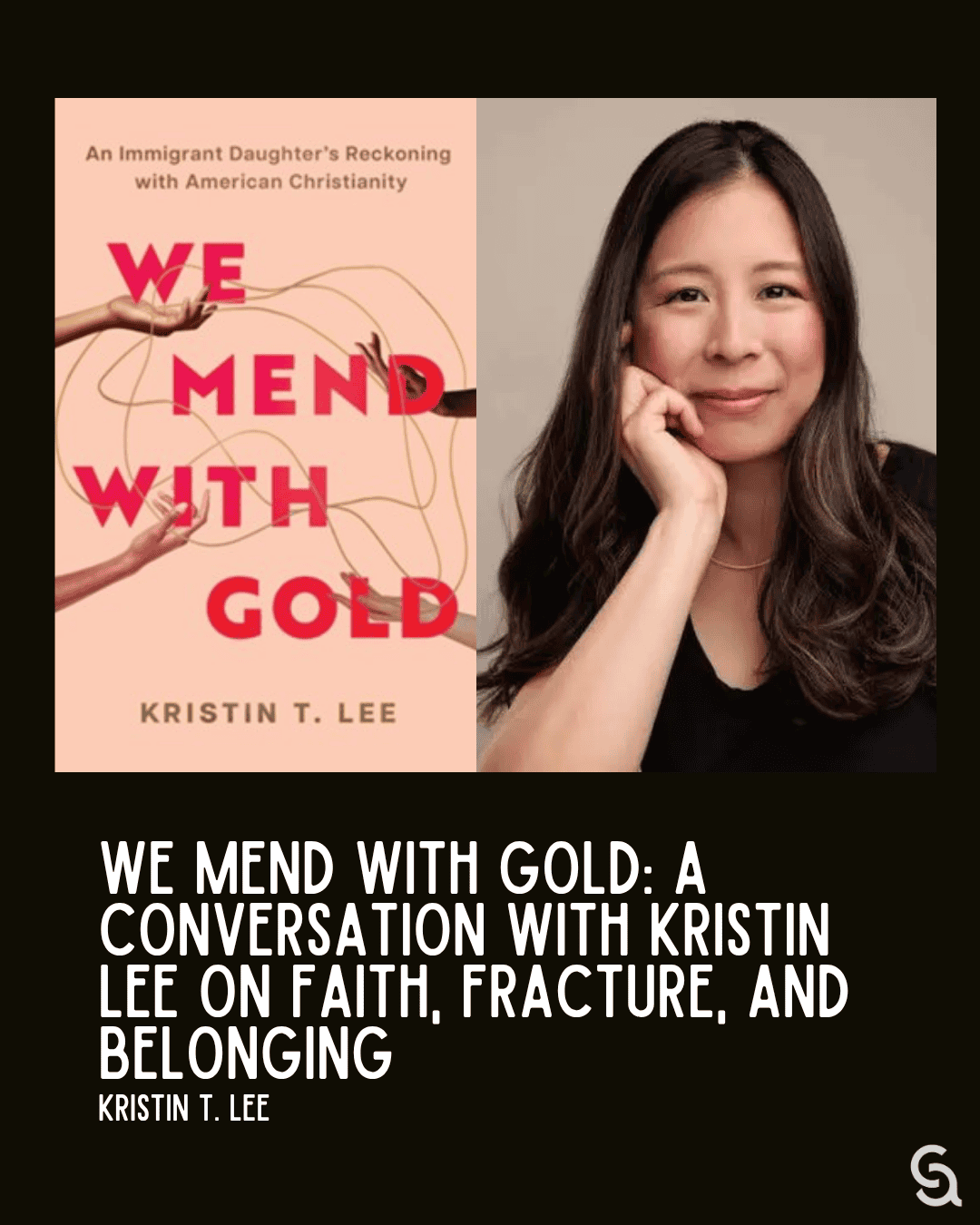
 In a culture that often prizes certainty, strength, and polished faith, what does it mean to acknowledge fracture not as failure but as the very place transformation begins? In her latest book, We Mend with Gold (Broadleaf Books), Kristin T. Lee draws on the Japanese art of kintsugi — repairing broken pottery with gold — to offer a vision of faith that makes room for grief, doubt, and complexity without losing hope.
In this conversation, Kristin reflects on what it means to hold both gratitude and critique within the church, how inherited theological frameworks shape our understanding of God, and why belonging instead of performance is at the heart of a healthy spiritual life. With honesty and depth, she offers an invitation to anyone whose faith feels fragile, unfinished, or in pieces.
Your book uses the image of kintsugi — mending broken pottery with gold — as a way of understanding faith. What first drew you to that image, and how has it shaped the way you think about brokenness in your own spiritual life?
I can’t recall when I first came across the practice of kintsugi, but it may have been through the writing of the artist Mako Fujimura. Kintsugi is such a powerful metaphor for the Christian life in how it acknowledges that life is full of pain, rupture, and even desolation, but that this doesn’t have to be the whole story. Jesus’ mending gold can fill those fractures and make something beautiful out of them. But it’s a challenging, time-consuming, and costly process; we can’t minimize that.
The flip side is that denying our grief, anger, and doubts prevents us from experiencing that transformation. I’m drawn to kintsugi because it’s a compelling corrective to the triumphalism of the American church and the need to “save face” that many Asian cultures espouse. When we don’t authentically acknowledge our brokenness, we can’t let Jesus into those places of pain.
To be marked by fractures is to be human, and to invite God into our frailty is the Christian life. Kintsugi is like 2 Corinthians 12:9–10 in art form:
“My grace is sufficient for you, for my power is made perfect in weakness.”
You write about your faith “breaking” in your twenties. For many people, that kind of rupture can feel like the end of faith altogether. What helped you recognize that it might instead be the beginning of something new?
Honestly, I was terrified that acknowledging the ruptures in my faith would be the end of it and would alienate me from Jesus entirely. But I found the witness of saints who had gone before me down this path to be immensely helpful — people who have stared at the chasm of human suffering, who have been harmed by the church, or mistreated by Christians, and yet have found a way to walk with Jesus and reclaim Christianity from those who’ve warped it into something unrecognizable.
 For example, the lineage of Black Christians like James Cone, Howard Thurman, Lisa Sharon Harper, and Lisa Bowens, and women like Rachel Held Evans, Mihee Kim-Kort, and Grace Ji-Sun Kim breathed fresh life into my faith. They taught me that those in authority don’t always get it right, and that it’s okay to question and push back. In fact, it’s imperative to resist when Christian leaders support sinful practices, from slavery and segregation to mass incarceration and unjust war.
I found such genuine faith in these spiritual forebears and contemporaries that I thought, Okay, maybe there is a way to stay.
One of the strengths of your book is how honestly you name both the gifts and the burdens of the immigrant church. How have you learned to hold gratitude and critique together without losing either?
Many of my peers have been so hurt by the church that they can only feel anger and resentment. I understand that. I’m fortunate that even though some of the theology I learned has been damaging or manipulative, I also experienced care, community, and sacrificial love in church spaces.
As I’ve moved through secular activist spaces, I’ve found that those are just as prone to the usual critiques we level at the church: hypocrisy, poor conflict resolution, intolerance, power struggles, and judgmentalism. We’re all just humans muddling our way through. Of course, we hope that the church and Christians can reflect the goodness and holiness of God as we’re shaped by Christ’s love, but we will always do so only in part and imperfectly.
So it only makes sense to be upfront about both the blessings and the baggage the church can bring, especially the immigrant church, but also the other Christian spaces that have formed me. It’s only by unpacking both that we can decide what we want to carry forward as we pursue healthy spirituality and community.
You explore how certain theological frameworks like scarcity, upward mobility, and duty can shape the way we understand God and ourselves. When did you begin to realize that some of what you had inherited wasn’t actually reflective of Jesus?
Even as a teen, I could sense a disconnect between some of the values upheld by adults in church and what my conscience or Scripture seemed to say. I was pushed toward academic excellence as a way to be a good witness for Jesus, and that felt counter to what Jesus actually lived and preached. He turned the values of this world upside down. He honored those with little to offer, such as children or those considered “sinners.” Bringing performance into Christianity robs it of its power and joy.
I also resonated with a passage by Professor Daniel D. Lee, in which he argues that if the relationship we see modeled between parent and child is one of parental sacrifice that demands dutiful obedience in return — love with strings attached — we tend to map that onto our relationship with God. This affects how we experience the cross: Rather than a gift of grace we can freely receive, it becomes a burdensome debt we feel we must repay.
That insight helped me see how important it is to untangle the ingrained beliefs we carry that aren’t actually the gospel.
You write that Asian American Christians are uniquely positioned to offer something vital to the broader church. What do you hope the wider church might receive if it truly listened to these voices?
Asian Americans occupy a liminal space in the racial imagination of the U.S., and that in-between state can give us empathy and inroads into multiple communities — if we take a humble, listening posture. This allows us to be bridge-builders and peacemakers, but we also bring our own cultural heritage and wisdom that I hope the church will recognize it needs.
Asian spiritual practices and concepts can offer much that is in synergy with Christianity, from contemplative postures to linguistic cues that remind us that God animates our very breath. And when we embrace our marginality, we can help the church see the creative possibilities and solidarity that arise in those spaces.
We remind one another that Jesus, too, was a marginal person, and that the road of discipleship means following him into those outsider places.
Throughout the book, there’s a deep emphasis on belonging not just culturally, but also spiritually. What does it look like, in your experience, to move from a faith shaped by pressure or performance into one grounded in belonging?
When our faith is motivated by outward performance, we end up constructing false fronts that become barriers to true connection with God and with others. We feel the need to maintain these outer veneers even when things are crumbling inside.
Conversely, when we are assured of our belovedness and belonging in God’s family, without prerequisites, it frees us from the need to prove anything. It allows us to receive God’s love without strings attached, and then extend that same kind of unconditional love to others.
Without that security, it’s easy to fall into unhealthy spiritual and emotional patterns.
If someone is reading this who feels like their faith is currently “in pieces,” what would you want them to know about what comes next?
I found a lot of comfort in the words of Simone Weil when I was in that place. She wrote,
“One can never wrestle enough with God if one does so out of pure regard for the truth… If one turns aside from him to go toward the truth, one will not go far before falling into his arms.”
That was deeply reassuring to me, because given how I was raised, I carried a lot of fear about what might happen if I really leaned into my questions and doubts. What if it was all a slippery slope I couldn’t come back from?
But Weil’s words and my own experience helped me see that an honest pursuit of truth cannot separate us from God, if God is indeed truth. And if God isn’t truth, it’s better to discover that sooner rather than later.
What I found instead was that letting my faith, as I had known it, fall apart made space for something more genuine and life-giving to emerge — something that allowed for both moral and intellectual integrity.
Kristin T. Lee is a writer whose work has appeared in Christianity Today and Sojourners, and a primary care physician serving Boston’s Chinatown community. She writes about faith, culture, books, and solidarity at The Embers and is a contributing columnist to The Covenant Companion. Her passion is highlighting literature written by Asian and BIPOC authors via book reviews and reading groups on Instagram. Lee’s work is informed by her experiences as an adoptive mother, host to refugees, and friend to those affected by incarceration.