 In October 2025, I spent a few weeks with family in South Korea, exploring Seoul and enjoying amazing BBQ and a lovely spicy noodle dish called bibim naengmyeon.
As I wandered through winding markets and repeatedly returned to my favorite street food stalls, it was easy to forget how precarious the geopolitical reality beneath the surface remains. Behind the bright city lights, capitalistic fervor, and semblance of peace and security, lay a terrible potential horizon. During a day trip to the Korean Demilitarized Zone (DMZ), I saw just how uncertain peace and stability were in this region. This zone represents the world’s most heavily armed borders, with security and soldiers at every checkpoint.
It was clear that the unresolved conflict continues to shape Korean memory, life, and faith. The year 1948, when the two Koreas were divided, also marked another global turning point — the establishment of Israel as an independent state.
While this is historically interesting on the surface, seen together, the divided Korean peninsula and Israel-Palestine reveal how borders, wars, and unresolved political histories continue to shape communities across generations. While these situations are not identical, they invite us to see oppressed and vulnerable communities across borders not as isolated political issues but as shared moral and theological concerns.
But what if, instead, we as the church continue to seek to expand our moral imagination and embody solidarity across the globe? In doing so, we can utilize the intellectual and theological resources of other movements to address our own and others.
What is Minjung Theology?
Out of South Korea’s fractured history emerged Minjung theology, often described as “the theology of the common people.” It developed in the 1970s as Korean Christians sought to understand their faith under colonial occupation, war, poverty, dictatorship, and the suffering of ordinary people. Rather than beginning with abstract doctrine, Minjung theologians began with the lives of those who had been pushed to the margins — workers, farmers, the poor, and communities wounded by political violence.
Central to Minjung theology is the idea of han, a Korean term that names the deep grief, resentment, and unresolved pain produced by injustice. A closely related idea within this theological system is dan, the breaking or release of that pain through healing, liberation, and transformation.
In this sense, Minjung theology is not theology from a distance. It is theology from below, shaped by the cries and hopes of the people.
One of the most important insights of Minjung is its attention to the crowds in the Gospels. Jesus does not minister in abstraction but instead has compassion on real people who are “harassed and helpless, like sheep without a shepherd” (Matt 9:36). For Minjung theologians, these crowds become a way of seeing the suffering people of Korea, especially those whose lives were ignored during South Korea’s rapid industrialization and political repression.
This also helps us understand why Minjung theology continues to matter beyond Korea. Its concern for oppressed people and wounded communities resonates with other liberation movements, including Palestinian liberation theology. Both traditions ask a deeply Christian question: What does it mean to speak of God’s justice, peace, and liberation from the perspective of those who suffer?
Learning the shared vocabulary of these theologies helps us to see how God’s action is connected throughout different contexts.
What Does Seoul Have to Do with Jerusalem?
At first glance, Seoul and Jerusalem may seem like distant worlds. But both are marked by histories of division, displacement, and unresolved conflict.
South Korea and Israel both emerged as modern states in 1948. Korea remains shaped by the legacy of war and armistice, while Israel-Palestine remains marked by occupation, dispossession, and the ongoing suffering of Palestinians. These histories are not identical, but they raise a shared theological question of how Christians should respond when whole communities live under the weight of political despair and suffering.
This is where Minjung theology offers an important gift.
Emerging from the suffering of ordinary Koreans under the historical conditions of colonialism, war, dictatorship, and economic exploitation, Minjung theology insists that Christian faith must be spoken from the perspective of those who suffer. Palestinian liberation theology also asks a similar question from another wounded place.
Both traditions remind the church that theology is never abstract and purely mystical but is formed among real people, under real conditions of oppression.
For U.S. Christians, this matters because our moral imagination is often too narrow. We tend to treat Korea, Palestine, and other global struggles as separate political issues. But Christian solidarity invites us to see suffering communities across borders as connected, not because their histories are the same, but because the God of Scripture hears the cries of the oppressed.
As CSA outlines in their initiative to address global poverty, this is not an isolated feature of our societies but inextricably connected beyond borders and nations. Our Christian tradition calls us to envision the world as relevant and not simply our own specific issues, as important as they may be.
We see the concrete effects of a transnationalistic approach to theology in different places. For example, observers have noted the ways Minjung theology informed and engaged with the Hong Kong protests of 2019–2020, where protesters sang the Korean protest song “March for the Beloved” in response to China’s growing authoritarianism in the region.
The shared connection offers conceptual language for resistance, solidarity, and collective hope. A transnationalistic approach to theology matters precisely because it remains contextual and mutually informative. Insights constructed in one place are not simply exported wholesale to another, yet bridges can be built across struggles.
Conclusion
One of the ways we can bridge builds across struggles is to hear from those suffering. Mae Elise Cannon provides a study to think about how our theology affects our reading and imagination of the story of Isarel and the plight of the Palestinians.
In it, she offers a simple guideline that “solidarity requires listening to those who are suffering.” Much of our western perspective and theology is shaped by a decontextualized understanding of the “promised land” in which the land as promised to Abraham extends far beyond Hebrew Scriptures, past Jesus, the church, to the modern-day geo-political Israel.
But listening to Palestinian voices shows us that these issues, as well as other issues that are related to oppression, are far more complicated than we initially realize, and our theological frameworks might be disrupting our ability to hear others. This is especially the case when we realize that Palestinians in the “promised land” are actively facing ethnic cleansing, forced removal, and often inhumane conditions.
Thus, we cannot let our theological and political lens cause us to deny the humanity of others, either Jew, Palestinians, or Korean. As Nikki Toyama-Szeto reminds us, North Koreans are just like us and many people around the world, where everyday people are not the same as the authoritarian ruler. She states,
“As we pray for our sisters and brothers in North Korea, let’s remember that policies are not people, and a single ruler does not speak for the entirety of a country. And let’s also remember that, as always, God has the final word.”
Our efforts should be focused on the oppressed and lowly in contexts like this and to avoid any lens that may diminish our view of the other. My hope is one day to enjoy bibim naengmyeon at a random restaurant in Seoul without thinking about the weight of the oppressed and the unjust conditions of a divided land.
Similarly, may we hope for a proper solution to Israel-Palestine where justice reigns and peace abounds.
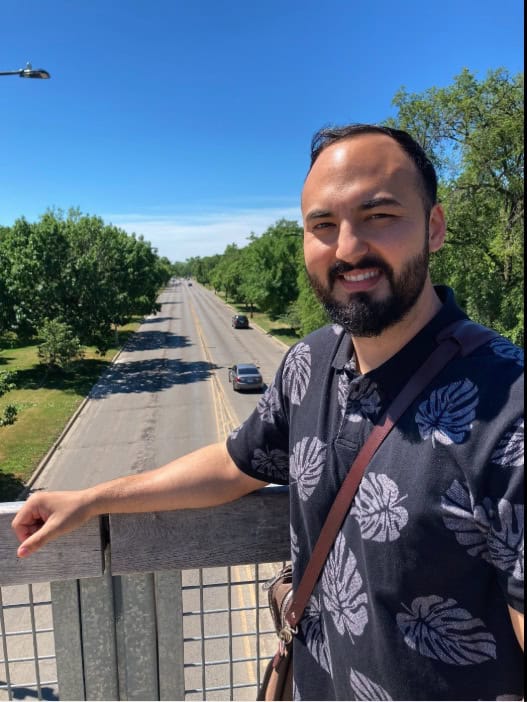 Rubin James Yi McClain is an Ambassador Warren Clark Fellow with Churches for Middle East Peace. He recently completed a PhD in New Testament at the University of Glasgow. His work explores how multiethnic identities were negotiated and utilized as fluid concepts in the ancient world, and how these dynamics continue to shape Christian theology and discourse today. He also writes about peacebuilding in the Middle East, with particular attention to Israel and Palestine. Beyond his writing, Rubin is deeply committed to ecumenical engagement. He regularly organizes outings to visit and learn from different liturgical traditions, cultivating dialogue and appreciation for the diverse and vibrant expressions of the Christian faith.