
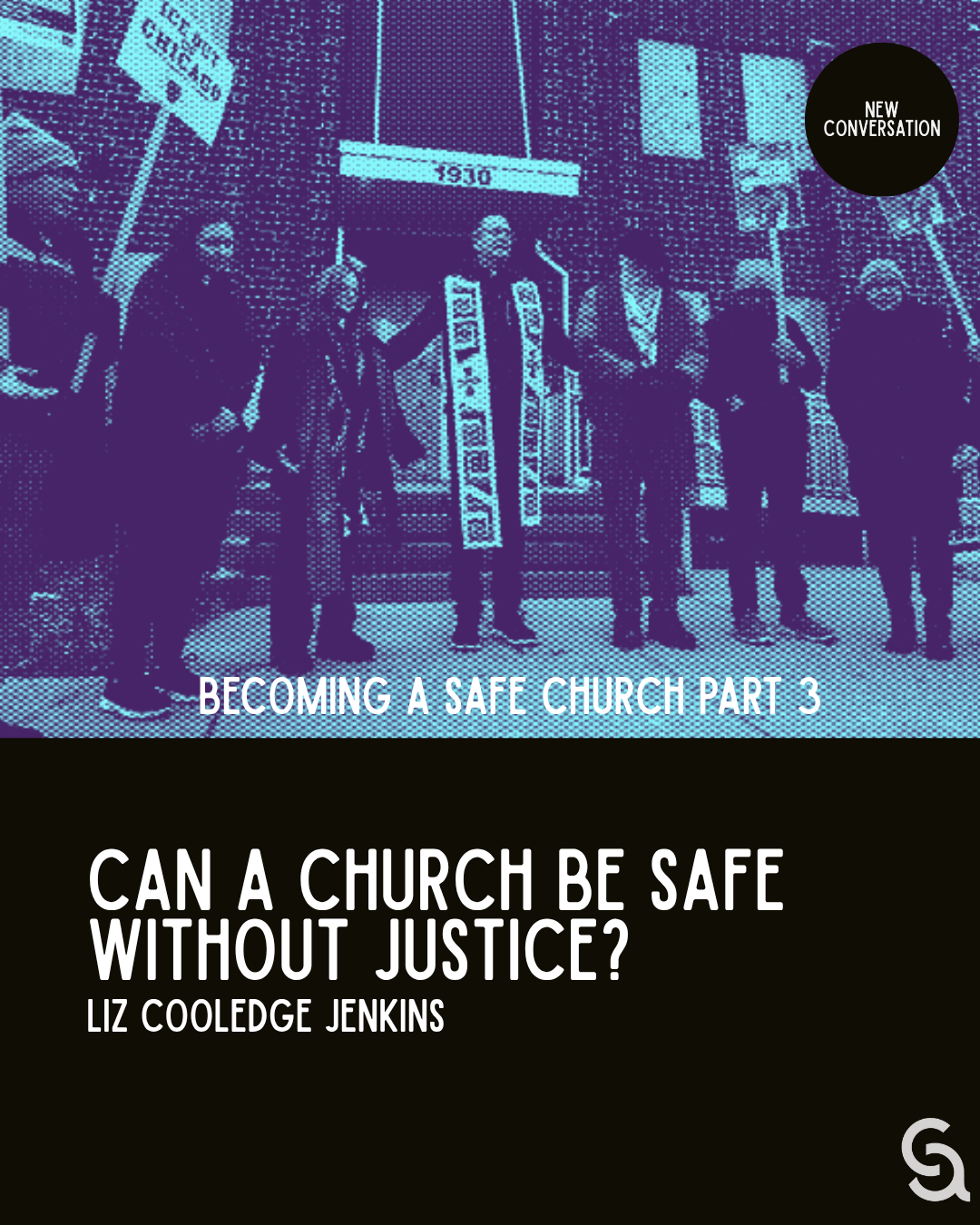
 (Editor’s Note: Churches are often evaluated not only by how they treat the people sitting in their pews, but by how they respond to those who are most vulnerable. Throughout Scripture, God’s concern for the oppressed, the marginalized, and the stranger is woven into the story of redemption, reminding us that justice is not separate from the church’s witness but central to it. In Part 3 of “Becoming a Safe Church: Cultivating Communities of Healing, Justice, and Belonging,” Liz Cooledge Jenkins explores why a church’s commitment to justice profoundly shapes whether people experience it as a place of refuge, trust, and belonging. Read Part 1 and Part 2 to follow the conversation from the beginning.)
“I have learned that many of us have not given up on faith, just the way our faith has been used to oppress others. We have not given up on the Bible, just the way it has been used to marginalize others. We have not given up on Jesus, we just know he ain’t a blue-eyed white Republican. We’re not becoming less spiritual or religious. It’s just that we have learned to put up with less, much less.”[1] -Danté Stewart
When people have given up on church — or on a particular church, or a particular kind of church — we might learn to ask: What exactly have they given up on? What drove them away? Did something — perhaps, as Danté Stewart suggests, a way Christianity was used to marginalize, or an interpretation of the Bible that justified oppression, or an image of Jesus as a “blue-eyed white Republican” — feel deeply unsafe?
Many younger adults have indeed decided to put up with much less — for ourselves, and also on behalf of communities more vulnerable than our own, or differently vulnerable from our own.
Grace,[2] the Filipina-American woman we met in Part 1 of this series, reflected on her current church:
“I would feel very comfortable bringing my queer friend here, or my gay friend” — or the youth she used to work with, who are ‘majority Black.’”
At a previous church, these youth were often subject to racial microaggressions. But at Grace’s church now, she said,
“I feel like I can invite anyone, and they won’t feel ashamed or traumatized. They would not experience that.”
She implicitly connects her own sense of safety in church to that of Black young people, and of LGBTQ+ friends, even though she does not share these identities herself. If people she cares about aren’t safe, nobody is truly safe.
I heard a similar thought process from other millennials I spoke with.
One white woman reflected on how disillusioning it was to attend a Christian conference where “the vibrant faith of queer Christians” was on full display — and then to go back to a church community where queer Christians were not “fully embraced and celebrated.”
For her, it wasn’t “even just churches not being affirming” that began to bother her deeply; it was “nonaffirming churches not taking any steps or thought of how to include queer people who have chosen to be celibate in their community.” She saw how much faith communities are missing if they do not create space for queer people to show up as their authentic selves and belong fully.
Aaron, the white man we met in Part 1, was drawn to a previous faith community because of their ministry to those who are unhoused. Although not homeless himself, he was moved by seeing that “there were homeless people who showed up at church and were treated like normal human beings instead of being offered a service.” The church was “happy to feed you, give you a place to get out of the cold, and give you a place to interact with other people in a way that’s not degrading.”
We know we are safe in a church community not only if we don’t feel personally degraded, but if we also see that no one is degraded. That everyone belongs. That the humanity and dignity of all people is supported fully. Whether we’re looking at racial justice, queer affirmation, or full inclusion of unhoused people, churches that are actively pursuing a sense of equality and kinship among all people are churches that feel safe.
When we look for a sense of safety in church, we sense on some level, whether or not we would explicitly articulate it, that our safety is tied to the safety of others around us. Our well-being really is wrapped up together. As activist Lilla Watson put it famously, “Your liberation is bound up with mine.”
In I Won’t Shut Up, Ally Henny writes,
“Freedom that is gained at another person’s expense isn’t freedom; it is just diverted oppression…We don’t get free by lording our power over others.”[3]
As a white woman, I experience our world differently from the way Ally Henny does as a Black woman or Danté Stewart does as a Black man. But I share their interest in faith communities marked by a concern for justice, committed to a Jesus who is not color-blind or callous to the harm being done to marginalized communities.
If a church spiritually invests in me and my leadership or other giftings as a woman but is simultaneously excluding queer people or colluding with systems of white supremacy, I know I am not safe there, even if it might look that way. Nobody is safe there. I don’t want to be grafted into the power-hoarding class in a community where some lord their power over others. I want to be part of communities where power is not hoarded or lorded over others at all.
I want to join Henny in “imagin[ing] a different world than the one we presently inhabit”—in “imagin[ing] freedom for all people.”[4]
What does this look like in our current political reality?
Today’s churches find themselves responding to a rapidly unfolding, ever-changing, interlocking set of crises in our country and our world. To consider one of these crises, one that impacts many of our cities and broader communities deeply, we might ask: How are churches responding to violence against immigrants, including the widespread kidnapping and unjust imprisonment of immigrants by US Immigration and Customs Enforcement (ICE) officers?
Appropriate responses differ depending on our contexts and communities. There is no one-size-fits-all right answer. But churches that serve as places of safety — following in the footsteps of Jesus and the Early Church’s commitment to radical hospitality and welcome (see Part 2 of this series) — side with immigrants over immigration enforcement. They find ways to resist the cruelty of kidnappings off the street and new detention centers being built, in ways that make sense for their own specific communities. They speak out on behalf of the truth that immigrants make our communities stronger.
They also make room for all of the feelings many of us experience as we see ICE raids and violent arrests play out on the news, on social media, and sometimes in front of our own eyes.
Kaitlin B. Curtice writes that in her time in white-dominated evangelical churches, “people would pass by one another, their smiles plastered on for a few hours each Sunday morning, asking, How are you? We would answer one another, Oh, good! How are you? as we made our way to the worship service.”[5]
Curtice wondered whether it was safe to share how she was really feeling:
“I wondered if I could say how angry I was that ICE was in our city, or that our political leaders had no sense of urgency to care for the land that we live on. Could I tell them that I was grieving the death of a friend or that God felt far away and stained by the colonialism I felt throughout Christian spaces?”[6]
Curtice felt that her strong emotions about injustice would not be met with empathy, understanding, or spaciousness — that is, with safety. Her anger would not have been affirmed as valid, let alone shared.
So many of us are angry, and for good reasons. Are our churches places where that anger can be held, expressed, metabolized? Where we can let it clue us in to the ways our bodies are responding to injustice? Where we can work through it together and find the good it might inspire us to do in our world?
Church leaders may sometimes feel that it is safer to remain silent on issues that feel politically charged. But this is counterproductive. In a world full of injustice, Christians are called to side wholeheartedly with those who are impacted by injustice, not those who perpetrate it.
We gain nothing spiritually by attempting to remain in the middle so as not to offend those who might disagree. Rather, we bear witness to the truth and power of the Christian tradition when we take up its better instincts to struggle toward justice.
One mixed-race millennial woman I spoke with reflected,
“A lot of the churches I’d gone to didn’t take an active stance in politics or social issues. When I was younger I was more okay with that, but as I became post-college I thought more about, What does it look like for the church to engage in issues? What should the role of the church be? Neutral, or involved?”
At one previous church, she recalled, a staff member
“wanted to take a more public and active stance on racial issues in America, but he ended up leaving the church over it because there wasn’t alignment with the rest of the staff. Things like that made me question, Why aren’t we doing more? Why are we choosing to not be more involved in these types of issues when they seem so prominent and important in our society right now?”
Churches’ attempts at neutrality no longer felt good enough.
Danté Stewart reflects on the church he was a part of in 2016 when Alton Sterling was shot and killed by police:
“The week after Alton was murdered, our sermon series began to explore marriage. Week after week, we heard about what God wanted us to do in our singleness, and what God wanted us to do in our marriages, and the grace of God for our sins, and the forgiveness of God for our failures. Not once during any of those Sundays—or any Sundays thereafter—was there any mention of Alton’s name.”[7]
The church’s silence felt like betrayal. It was a refusal to seriously explore what a Jesus-following tradition of justice might have to say about our country and our world today. “We were being taught, week in, and week out, how to be Christian,” Stewart reflects. “But we were not taught how to live in America.”[8]
When people walk into church coming from these kinds of backgrounds and carrying these kinds of experiences, we’re assessing the safety of a new church environment — at least in part — by asking whether a church is clear about God’s care for the vulnerable. Can we talk about police killings, about systemic racism, about misogyny and reproductive justice and queer rights, about the terrors immigrant communities are facing and how we might respond? Or is a church silent on these matters? If the latter, we see it as a reason not to trust, an indication that a church is perpetuating harm.
We are looking for places of holistic healing — for ourselves and people like us, and for people unlike us as well. And as Prentis Hemphill writes,
“It’s hard to heal when you’re still being hurt.”[9]
I would add that it’s also hard to heal — or at least hard to heal well — in an environment where others are still being hurt.
When we look for safe spaces where we can heal, we are looking for places where the biblical prophets’ calls toward justice are taken seriously. Where the mission of the community lines up with the mission of Jesus: to bring holistic good news to the poor, the kind that actually meets the needs of people experiencing poverty; to proclaim release to the captives, working with oppressed people toward liberation because we know we’re all bound up together (see Luke 4:18-19).
We have lost patience with communities that approach issues of justice with silence, ambiguity, doubling down and refusing to change, or refusing to engage at all. True safety requires a community to orient itself toward justice, openly and wholeheartedly. We no longer want to put up with anything less.
Endnotes
[1] Danté Stewart, Shoutin’ in the Fire: An American Epistle (Convergent Books, 2021), 123.
[2] Name changed for privacy
[3] Ally Henny, I Won’t Shut Up: Finding Your Voice When the World Tries to Silence You (Baker Books, 2023), 207.
[4] Ibid., 207-8.
[5] Kaitlin B. Curtice, Living Resistance: An Indigenous Vision for Seeking Wholeness Every Day (Brazos Press, 2023), 108.
[6] Ibid.
[7] Stewart, Shoutin’ in the Fire, 66.
[8] Ibid.
[9] Prentis Hemphill, What It Takes to Heal: How Transforming Ourselves Can Change the World (Random House, 2024), xvi.
 Liz Cooledge Jenkins is a Seattle-based writer, preacher, former college campus minister, and the author of Nice Churchy Patriarchy: Reclaiming Women’s Humanity from Evangelicalism. She writes regularly at growingintokinship.