 (Editor’s note: This is Part 4 of a four-part series exploring Christian faith, theology, and peacemaking in the Holy Land. In this concluding installment, Rev. Dr. Mae Elise Cannon offers a call to faithful Christian response through prayer, solidarity, advocacy, and relationship-building. This reflection invites Christians to consider what it means to embody the vocation of peacemaking while pursuing justice, dignity, and peace for all people of the land. You can find Part 1 here, Part 2 here, and Part 3 here.)
“Blessed are the peacemakers, for they shall be called the children of God.” (Matt. 5:9)
What is the call on the Christian church in light of the decades of violence and injustice perpetuated on the Palestinian people in the Holy Land? And how should Christians respond to the centuries of antisemitism experienced by Jewish people globally? And, in light of the issues addressed in previous essays in this series, how can Christians honor the Scriptures and Christian ethics and theology in their engagement with Jews, Christians, and Muslims in the Holy Land?
The church has been called to be a light to the world (Matt. 5:14-16), to do good (Gal. 6:10), to seek justice (Isa. 1:17), and to respond to the needs of those who are suffering (Ps. 82:3-4). What does that look like specifically in response to today’s current realities in Israel and the occupied Palestinian territories?
1. Pray for Wisdom and Discernment
“Rejoice always, pray continually, give thanks in all circumstances; for this is God’s will for you in Christ Jesus.” (1 Thess. 5:16–18)
Prayer is not a passive response, but rather an active one. Many Christian Zionists “pray for Israel,” meaning they pray for the success, domination, and physical prowess of the state. How might God shape and change our hearts and minds if we pray for the people of the land rather than the political powers that rule it?
- Pray for the people of Israel: Jewish and Palestinian, Muslim, Christian, and Druze.
- Pray that God would reveal wisdom and discernment to all who pray, and to those on whose behalf we pray.
- Pray that truth would prevail and that the reality of current circumstances — including the experience and suffering of millions of Palestinians living under military occupation and control — would no longer be ignored by the people of Israel or by the world.
- Pray against settler extremism and violence on all sides.
- Pray that justice might prevail without physical resistance and military domination.
- Pray for the safety and security of all people in the land, that mothers would not have to fear for the lives of their children.
- Pray that Palestinians and Israelis might once again live as neighbors without hatred toward the other after decades of violence and discord.
- Pray that Palestinians might experience self-determination and freedom, which they have sought for nearly a hundred years.
2. Mourn with Those Who Suffer
“Rejoice with those who rejoice; mourn with those who mourn. Live in harmony with one another.” (Rom. 12:15–16)
To grieve alongside those who mourn demands that one must know their suffering.
- Listen and learn about the stories of Palestinians. Over the course of devastating violence in Gaza these past two-plus years, Palestinian lives and stories continue to be dehumanized. Rarely do we hear the story of men, women, and children and learn about their hopes, dreams, and aspirations.
- Learn the stories of people in Gaza and what life is like under occupation in East Jerusalem and the West Bank.
- Learn the stories of Jewish Israelis and their fears and realities.
- Ask that God would give empathy and love for all of the people of the land. When I worked at World Vision, the Christian international development agency, we often prayed the prayer of its founder, Bob Pierce: “Break my heart for the things that break the heart of God.”
- Ask God to bring empathy and to allow our hearts to be broken for all who suffer.
- Respond with a spirit of love and kindness, mourning for the stories of grief, suffering, and loss. Having empathy for mothers who have lost their children and for young people who have become orphans does not mean one has to compromise on advocating for justice, human rights, and equality. In fact, one’s argument that justice prevails is only strengthened when people exercise empathy toward those who have suffered, regardless of what side of the line they might live on.
3. Solidarity with the Christian Church
“Be devoted to one another in love.” (Rom. 12:10)
Do not ignore the cry of the church in Palestine. Rev. Dr. Munther Isaac has asked global Christians,
“Where were you when Gaza was going through a genocide?”
The killing and maiming of tens of thousands of Palestinians has happened while the world could watch the almost daily bombing and devastation of the Gaza Strip. For over 2 years, 735 days, the more than 2 million people living in Gaza experienced not only daily warfare perpetuated upon them, but also the deliberate restriction of humanitarian assistance, food, and basic health needs being allowed into the territory.
The Palestinian church suffered alongside their family members in the Gaza Strip and begged the global community to respond. The less than 1,000 Christians living in Gaza before the war suffered attacks on the two major remaining churches in Gaza, the St. Porphyrius Orthodox Church (October 19, 2023) and the Holy Family Latin Catholic Church (July 17, 2025). The Anglican Al Ahli Hospital was bombed on October 17, 2023; struck by airstrikes on April 13, 2025; and invaded by Israeli forces on June 5, 2025.
Hundreds of Christian institutions, facilities, and programs were decimated and destroyed, including those belonging to Greek Orthodox, Catholic, and Protestant churches, and ministries like Dar al Kalima University run by Rev. Dr. Mitri Raheb from Bethlehem.
Palestinian Christians issued “A Call for Repentance: An Open Letter from Palestinian Christians to Western Church Leaders and Theologians” after the attack on St. Porphyrius Orthodox Church in October 2023, saying,
“We watch with horror the way many Western Christians are offering unwavering support to Israel’s war against the people of Palestine.”
And while recognizing the voices who have advocated for justice for Palestinians and stood alongside them, the church leaders continued,
“We write to challenge Western theologians and church leaders who have voiced uncritical support for Israel and to call on them to repent and change.”
For the sake of Christian witness, these Christian organizations criticized the “severely distorted moral judgment” in regards to the situation in the Holy Land.
What does solidarity with the church in Palestine look like? In November 2025, Palestinian Christians issued a very specific call for the global community via the Second Kairos Palestine document. Read the document and consider its assertions, including that truth must be named. The document demands the naming of reality, specifically that “the war that has left behind hundreds of thousands of martyrs and wounded, and nearly 2 million displaced people,” that experts have unequivocally called the state’s actions a genocide, and that the ongoing treatment of Palestinians in all of the occupied Palestinian territories is undergoing colonization and ethnic cleansing.
The final call of the church in the Kairos document includes a commitment to work for the good of the land of all humanity:
“until the day we live free in our land together with all of the inhabitants of the land in true peace and reconciliation founded on justice and equality for all of God’s creation, where mercy and truth meet, and righteousness and justice kiss each other.” (Psalm 85:10)
4. Advocate for Justice and Support Liberation
“Learn to do right; seek justice. Defend the oppressed.” (Isa. 1:17)
Solidarity is not only a spiritual posture; it also demands physical action. What does advocacy look like?
Advocacy can include spiritual, social, economic, legal, and political actions on behalf of a cause or a people group. Organizations like ours, Churches for Middle East Peace (CMEP), provide educational and awareness opportunities to engage and learn, in addition to direct opportunities to engage with elected officials in Washington, D.C., to call for U.S. government policies that will no longer be complicit and participatory in the ongoing occupation and ethnic cleansing of the Palestinian people.
American Christian denominations and organizations, including CMEP, will be hosting a joint advocacy summit on May 5-7, 2026, on Capitol Hill that will include the opportunity for people to meet with their Senators and elected members of Congress. Join hundreds of other Christians in taking actions to respond to the injustices in Palestine and Israel.
Partner with Repairers of the Breach
“Let us consider how we may spur one another on toward love and good deeds.” (Heb. 10:24)
The possibilities to learn and engage with others who are already actively involved with this work are abundant. Identify organizations that are bridging the gap and working for human rights, equality, and justice.
Numerous Christian ministries — like Tent of Nations, Bethlehem Bible College, Musalaha, and many others —do incredible work and regularly have opportunities to engage, like the May 26-30, 2026 Christ at the Checkpoint Conference in Bethlehem. Groups like Standing Together, the Parents Circle/Families Forum, and Combatants for Peace bring together Israelis and Palestinians to acknowledge the joint humanity and suffering while working to end the occupation.
In addition, Israeli human rights organizations work on their respective areas of focus, including groups like Breaking the Silence, where former Israeli soldiers share accounts of injustices perpetuated during their time in the Israeli military; HaMoked, the oldest Israeli human rights organization offering legal assistance to Palestinians; B’Tselem, which documents and reports on human rights violations; Gisha, working on human rights specifically related to Gaza; and Yesh Din, focusing on settlements, to name just a few. Palestinian human rights organizations, often under attack for their very existence, are numerous and include Jahalin Solidarity, Mossawa Center for Advocacy for Palestinians in Israel, Defense for Children International (DCI), and other groups doing incredible work for human rights in Palestine.
Pursue Peace and Seek to Love All
“Do not repay evil for evil. Be careful to do what is right in the eyes of everyone. If it is possible, as far as it depends on you, live at peace with everyone.” (Rom. 12:17-18)
Archbishop Oscar Romero was a stalwart advocate of the poor and oppressed in El Salvador. Romero preached the all-powerful love of Christ, saying,
“Amid hatred…Let us not tire of preaching love; it is the force that will overcome the world.”(1)
Romans 12:9 says,
“Love must be sincere. Hate what is evil. Cling to what is good.”
Christian engagement in advocating for peace must be compelled by love. As 1 John 4:19 says,
“We love because God first loved us.”
Might the love that we profess that comes from Christ Jesus be the most powerful force as we seek peace in the Middle East and around the world.
Endnote
(1) Romero, Oscar. The Violence of Love. Orbis Books, 2021.
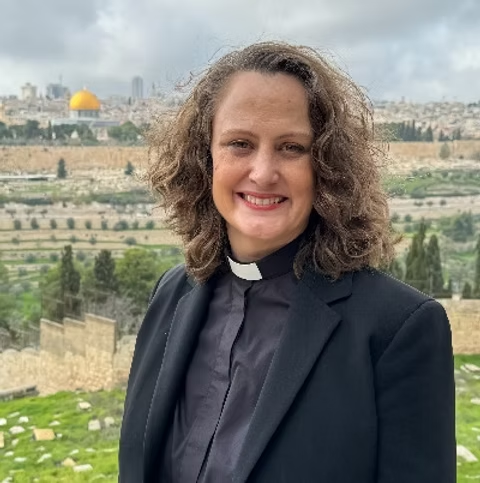 Rev. Dr. Mae Elise Cannon is Executive Director of Churches for Middle East Peace (CMEP) and is ordained with the Reformed Church in America (RCA). Cannon formerly served as the Senior Director of Advocacy and Outreach for World Vision U.S. on Capitol Hill in Washington, DC; as a consultant to the Middle East for child advocacy issues for Compassion International in Jerusalem; as the Executive Pastor of Hillside Covenant Church located in Walnut Creek, California; and as Director of Development and Transformation for Extension Ministries at Willow Creek Community Church in Barrington, Illinois.
Cannon holds an MDiv from North Park Theological Seminary, an MBA from North Park University’s School of Business and Nonprofit Management, and an MA in bioethics from Trinity International University. She received her first doctorate in American History with a minor in Middle Eastern studies at the University of California (Davis), focusing on the history of the American Protestant church in Israel and Palestine, and her second doctorate in Ministry in Spiritual Formation from Northern Theological Seminary. She is the author of several books, including the award-winning Social Justice Handbook: Small Steps for a Better World, and editor of A Land Full of God: Christian Perspectives on the Holy Land.