
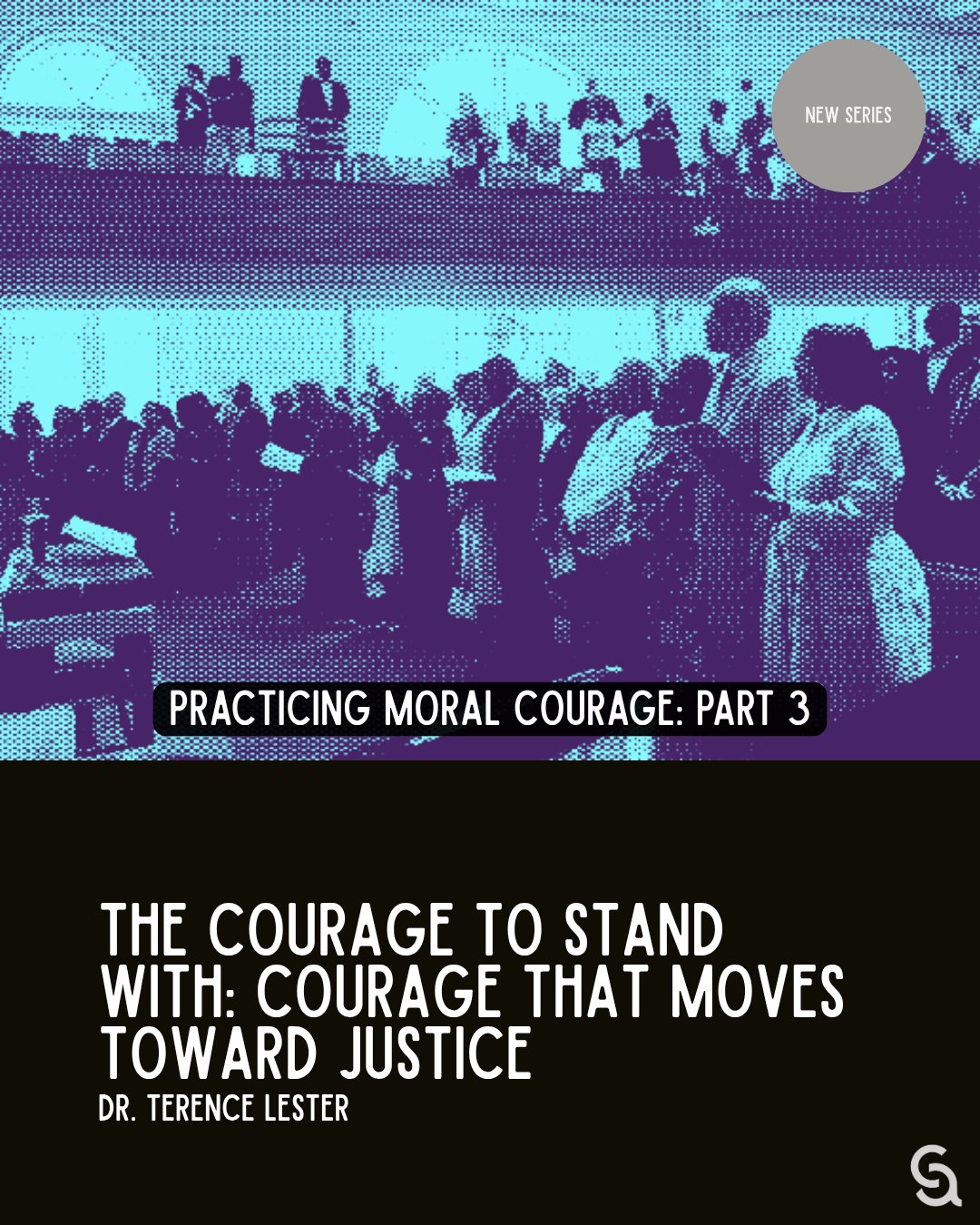
 (Editor’s Note: In Part 1 of our four-part “Practicing Moral Courage” series, Dr. Terence Lester asked what kind of people we are being formed to become in a culture shaped by fear and othering. In Part 2, Dr. Emiola Oriola Jr. explored the courage to stay human — to allow compassion, hospitality, and truth to interrupt the categories we place around one another. Now, in Part 3, Terence turns toward what happens when that formation moves us to act. What does it mean not simply to feel compassion for our neighbors, but to stand with them? Moving from charity to justice, from speaking for people to listening to them, Lester invites us to consider the kind of courage that pays attention to systems, uses whatever access we have, and stands alongside those most affected by injustice.)
In 2011, a team of researchers at the University of Michigan led by psychologist Sara Konrath published a widely cited study on empathy in America. They examined data from nearly 14,000 college students across three decades and found that empathic concern, the capacity to feel for people who are suffering, dropped by 48 percent between 1979 and 2009. Perspective taking, the ability to imagine how the world looks from someone else’s position, dropped by 34 percent.[1]
The steepest decline came after 2000.
Other research complicates that picture in a way that helps explain our political moment. Political scientists Elizabeth Simas, Scott Clifford, and Justin Kirkland found that people who score high in empathy are not necessarily more generous toward their opponents. Their empathy tends to stay inside their own group, and the more of it they have, the more hostile they can feel toward the other side.[2]
In plain terms, many of us have not lost compassion altogether. We have learned to ration it. We give it to people who vote like us, worship like us, and live like us, and we withhold it from everyone else.
That rationing has a religious face. Historian Anthea Butler, in White Evangelical Racism, traces how race has shaped White evangelical political activism from slavery to the present.[3]
Today some of the loudest voices claiming the name of Christ have aligned themselves with White Christian nationalism, the belief that this country belongs to a certain kind of Christian and that government power should be used to keep it that way. But most Americans are not following them.
In September, PRRI reported that 64 percent of Americans either reject or are skeptical of Christian nationalism, including most Hispanic Catholics, most White mainline Protestants, and a majority of Black Protestants. Large majorities of those who resist it say they want a country made up of people from a wide variety of religions.[4]
Others are walking away from church altogether. Sociologists Michael Hout and Claude Fischer found that much of the rise in Americans claiming no religion during the 1990s was “a symbolic statement against the Religious Right.”[5]
When faith gets tied to one political agenda, the people harmed by that agenda stop expecting anything good from the church. I understand why. If you are an immigrant or refugee, unhoused, food insecure, impoverished, or LGBTQIA+, and the loudest Christian voices you hear are cheering while your family is targeted, it makes sense to stop trusting the church altogether. Those voices do not speak for every Christian, but too often they are the only ones people hear.
Historian Dr. Jemar Tisby points to another way: “If we want to know how to fight racism and white Christian nationalism today, we need look no further than the expansive Black Christian tradition.”[6]
That tradition has always followed a Jesus who stood with the oppressed rather than with the powerful.
The Jesus I read about in the Gospels knew what it was like to live under someone else’s power. As a child, his family fled to Egypt as refugees (Matt. 2:13-15). As an adult, he told a would-be follower that he had nowhere to lay his head (Luke 9:58). The empire that ruled his homeland eventually executed him. Yet when he saw the crowds, Matthew writes, “…he had compassion for them, because they were harassed and helpless, like sheep without a shepherd. (Matt. 9:36, NRSV).
Jesus chose compassion for the very people the powerful had learned to ignore.
So the question in front of us goes deeper than whether we feel compassion. It is whose suffering we are willing to feel, and whether we will stand beside those neighbors when it costs us something.
From Charity to Justice
At Love Beyond Walls, the nonprofit organization I cofounded with my wife, Cecilia, we advocate for neighbors who are unhoused and impoverished. Our work has always included both immediate relief and community development. Through Love Feeds, we share meals with neighbors who do not know where their next one will come from. Our shower units exist because a shower is not a luxury when you have no home. Without one, it is harder to sit for a job interview, keep an appointment, or move through a public space without being judged.
Zion’s Closet serves students in Title I schools, which receive federal support because so many of their children come from low-income families. Some of those children are unhoused. In the 2022-2023 school year, public schools identified 1,374,537 students experiencing homelessness, a 25 percent increase in just two years.[7]
Those children are sleeping in shelters, motels, cars, or on a relative’s couch, and still showing up to class. Zion’s Closet provides clothing so a child can walk into school without being singled out for what they lack. We help families who have been separated find each other again. And through the Dignity Museum and our films, we tell the truth about why so many neighbors go unseen.
In my book All God’s Children, I described the difference this way: Charity is making sure people in a food desert have a meal for the night, but justice is understanding why the neighborhood is a food desert in the first place.[8]
What happened economically that caused one side of town to receive investment while the other side did not? Who made those decisions, and who was left out when they were made?
Dr. Martin Luther King Jr. pressed the same point at Riverside Church in 1967. He said that “true compassion is more than flinging a coin to a beggar” and that it “comes to see that an edifice which produces beggars needs restructuring.”[9] King was saying that when the same needs keep showing up year after year, something in the structure is producing them, and love has to deal with that structure, too.
Most people agree with King in principle. In practice, I have watched how quickly that agreement fades. A food drive gets praise. But when someone asks why the shelves keep emptying, why a full-time wage does not cover rent, or why so many families are losing food assistance, the response changes. Some people go quiet. Some tell you to stay out of politics. That is usually the point where courage is required.
Isaiah 58:6-7 holds both together. The same passage that calls God’s people to “share your bread with the hungry” also calls them to “loose the bonds of injustice.” That is what advocacy is: Loving our neighbors enough to pay attention to the policies that shape their lives.
Speaking When Silence Is Easier
Some years ago, Love Beyond Walls produced a documentary called Voiceless: A Documentary on Systemic Poverty that shares the stories of people living in poverty across the country. But the more time I spend with our neighbors, the more I realize that title was not quite right. The people in that film were not voiceless. They knew exactly what was happening to them and could explain it clearly. What they lacked was an audience willing to believe them.
The philosopher Miranda Fricker has a name for this. In Epistemic Injustice, she describes testimonial injustice, which happens when prejudice causes a listener to give someone’s word less credibility than it deserves.[10] In plain terms, a person can tell the truth about their own life and still be doubted because of who they are. This is one reason neighbors experiencing homelessness are so often disbelieved when they report being mistreated. Their word gets weighed against their housing status before it gets weighed against the facts.
Ida B. Wells knew this problem well. In 1892, after her close friend Thomas Moss and two other Black men were lynched in Memphis, she began documenting lynching across the South. That spring, while she was in New York, her newspaper, Free Speech, was destroyed, and she was warned that she would be harmed if she came home.
She never returned to Memphis.[11] She kept writing anyway, guided by her belief that “the way to right wrongs is to turn the light of truth upon them.”[12] Wells used the access she had, a printing press and a readership, to make the country look at what it wanted to ignore. Most of us have some form of access too: a pulpit, a classroom, a vote, a dinner table, a following online, a relationship with someone who makes decisions. The question is what we will do with ours.
Standing With, Not Standing Over
There is a kind of justice work that keeps the helper at the center. It speaks for people without listening to them and treats neighbors as projects. Solidarity is a commitment to stand with people against injustice, and it is what God did in Jesus. Eugene Peterson’s The Message paraphrase of John 1:14 puts it this way: “The Word became flesh and blood, and moved into the neighborhood.”
In All God’s Children, I offered a solidarity framework drawn from the way Jesus showed up for the people he was proximate to: lament with others, listen to others, learn from others, immerse yourself in their world, show compassion and empathy, stand alongside others in the fight for justice, and use your voice alongside theirs.[13]
Using your voice comes last for a reason. If we speak before we have listened, we will usually get the story wrong. Fannie Lou Hamer shows what it looks like when the people closest to the harm lead. On August 31, 1962, she went to the courthouse in Indianola, Mississippi, to register to vote. When she got home, the owner of the plantation where she and her husband had lived and worked for years demanded that she withdraw her application. She refused, and he ordered her off his land. The next June, she was beaten in a jail in Winona.[14] She kept organizing. She did not need anyone to speak for her. She needed people willing to stand next to her while she spoke.
Humility and the Courage to Stand With
People who care about justice face a particular danger. We can start treating whole groups of people as beyond hope, especially the ones who frustrate us most. That may feel like conviction, but it is another way of deciding who counts.
Humility reminds me that I also need grace. It lets me name injustice without calling anyone disposable. Rev. Dr. William J. Barber II has said that the issues in front of us “really are about right versus wrong,” not simply one party against another.[15] Barber keeps his attention on what is happening to people, and that leaves room for anyone to change sides. This work wears people out when they try to do it alone, which is why it has to stay rooted in prayer and community.
So ask yourself:
- Will I stand with my neighbors?
- Will I speak when silence is easier?
- Will I pay attention to the systems harming the people I say I love?
When Isaiah heard God ask, “Whom shall I send, and who will go for us?” he answered, “Here am I; send me!” (Isa. 6:8). May we answer the same way.
Endnotes
[1] Sara H. Konrath, Edward H. O’Brien, and Courtney Hsing, “Changes in Dispositional Empathy in American College Students over Time: A Meta-Analysis,” Personality and Social Psychology Review 15, no. 2 (2011): 180-98, https://doi.org/10.1177/1088868310377395.
[2] Elizabeth N. Simas, Scott Clifford, and Justin H. Kirkland, “How Empathic Concern Fuels Political Polarization,” American Political Science Review 114, no. 1 (2020): 258-69, https://doi.org/10.1017/S0003055419000534.
[3] Anthea Butler, White Evangelical Racism: The Politics of Morality in America (Chapel Hill: University of North Carolina Press, 2021), https://muse.jhu.edu/book/82226.
[4] PRRI, “Resistance to Christian Nationalism in All 50 States: A PRRI-Meanings of Democracy Lab Report,” September 24, 2026, https://prri.org/research/resistance-to-christian-nationalism-in-all-50-states-2/.
[6] Jemar Tisby, quoted in Greg Garrett, “Politics, Faith and Mission: A Conversation with Jemar Tisby,” Baptist News Global, January 22, 2024, https://baptistnews.com/article/politics-faith-and-mission-a-conversation-with-jemar-tisby/.
[7] National Center for Homeless Education, Student Homelessness in America: School Years 2020-21 to 2022-23 (Greensboro, NC: National Center for Homeless Education, 2024), https://nche.ed.gov/student-homelessness-in-america-school-years-2020-21-to-2022-23/.
[8] Terence Lester, All God’s Children: How Confronting Buried History Can Build Racial Solidarity (Downers Grove, IL: InterVarsity Press, 2023), 75-76, https://ivpress.com/all-god-s-children-ebook.
[9] Martin Luther King Jr., “Beyond Vietnam: A Time to Break Silence” (speech, Riverside Church, New York, April 4, 1967), Martin Luther King, Jr. Research and Education Institute, Stanford University, https://kinginstitute.stanford.edu/encyclopedia/beyond-vietnam.
[10] Miranda Fricker, Epistemic Injustice: Power and the Ethics of Knowing (Oxford: Oxford University Press, 2007), 1, 28, https://doi.org/10.1093/acprof:oso/9780198237907.001.0001.
[11] Ida B. Wells, Southern Horrors: Lynch Law in All Its Phases (New York: New York Age Print, 1892), preface and chap. 1, https://www.gutenberg.org/ebooks/14975.
[12] “Ida B. Wells,” Learning for Justice, no. 4 (Spring 2023), Southern Poverty Law Center, https://www.splcenter.org/resources/stories/ida-b-wells/.
[13] Lester, All God’s Children, 74-75.
[14] “Fannie Lou Hamer,” American Experience: Freedom Summer, PBS, accessed October 2, 2026, https://www.pbs.org/wgbh/americanexperience/features/freedomsummer-hamer/.
[15] Jessica Washington, “Reverend William Barber Says: Leaders Need to Offer More Than Partisanship,” The Root, December 21, 2022, https://www.theroot.com/reverend-william-barber-says-enough-of-the-partisan-po-1849919229.
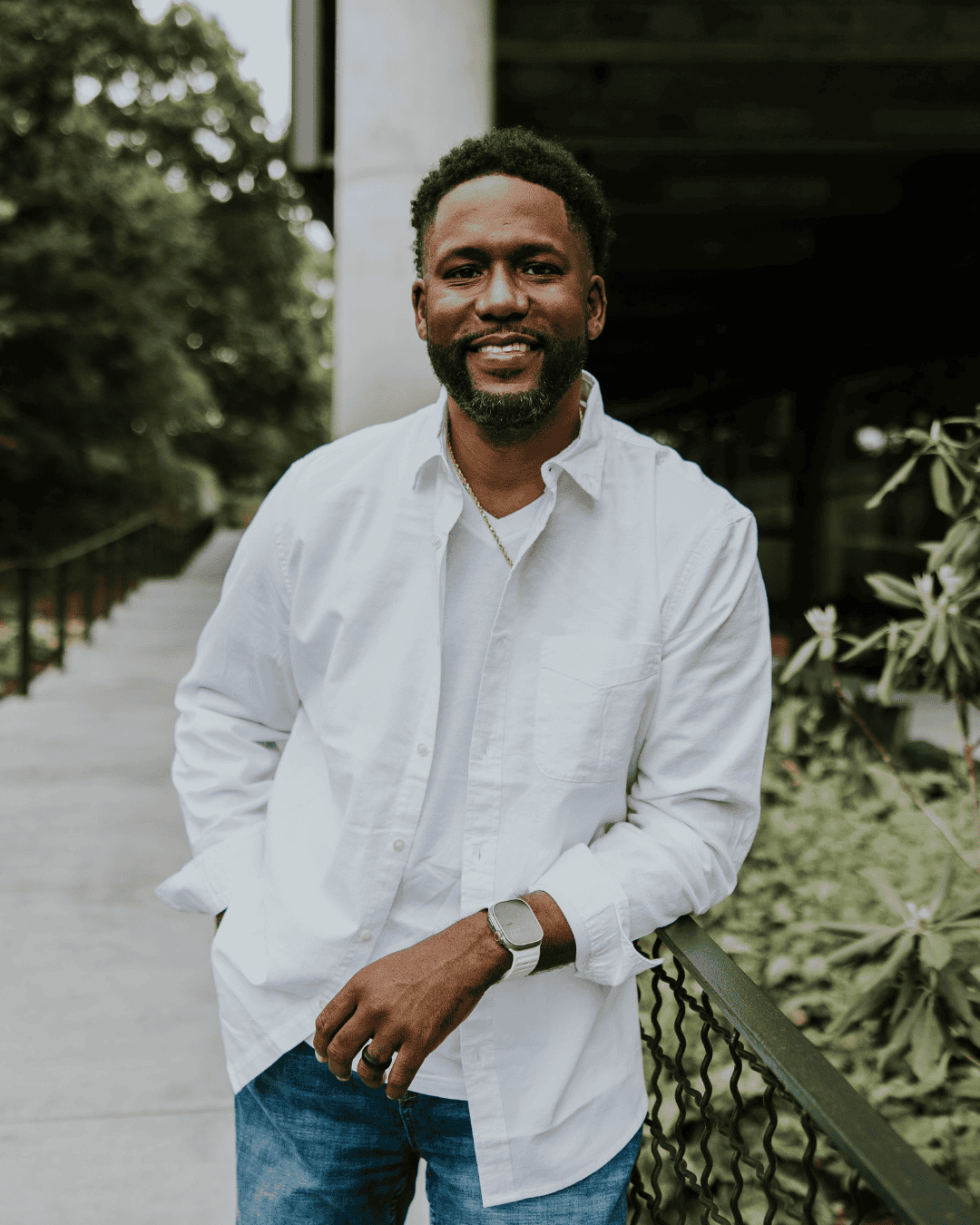 Dr. Terence Lester is a storyteller, public scholar, community activist, and author. He founded Love Beyond Walls, a nonprofit committed to raising awareness about poverty and homelessness, and teaches public policy and social change at Simmons College of Kentucky. His latest book, From Dropout to Doctorate: Breaking the Chains of Educational Injustice (IVP, 2025), traces his journey from high school dropout to PhD and issues a bold call for equity. Through his life and writing, he uses narrative, policy insight, and faith to challenge systems that leave people invisible and to inspire practical change. He is author of the four-part CSA series on Economic Injustice.